


How Reliance is building an integrated food ecosystem across sourcing, manufacturing, brands, retail, digital commerce and foodservice
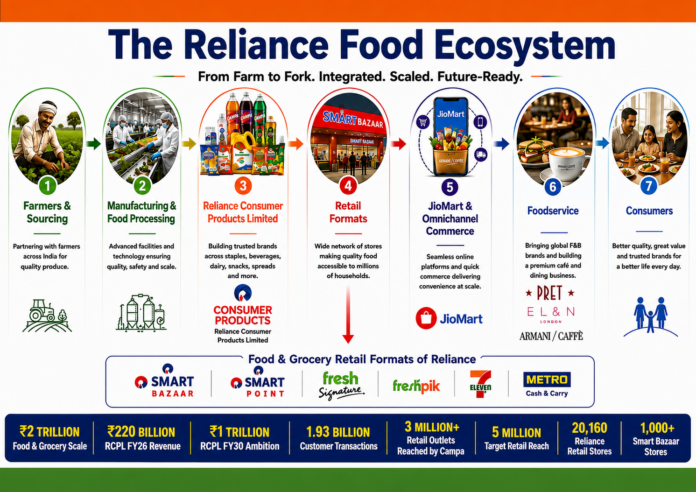
For most companies, food is a category. For Reliance, it is increasingly becoming an ecosystem. The distinction is important because the company’s food strategy is no longer defined by the number of grocery stores it operates or the brands it sells. It is being built across the entire journey of food—from farmers and sourcing to manufacturing and processing, from consumer brands to physical retail, from JioMart and omnichannel commerce to premium cafés and dining, with the consumer at the centre of the system. Business of Food estimates Reliance’s Food & Grocery business at approximately Rs. 2 trillion, while Reliance Consumer Products Limited (RCPL) has already reached Rs. 220 billion in FY26 revenue and is targeting a Rs. 1 trillion FMCG business by FY30. The scale of these numbers, combined with Reliance’s physical and digital reach, makes the company’s food strategy one of the most consequential developments in India’s consumer economy.
The Food Ecosystem is the Real Story
The easiest way to understand Reliance’s food ambition is not to look at its businesses individually, but to follow the journey of a product through the ecosystem. It can begin with a farmer and Reliance’s sourcing network, move through food processing and manufacturing, become part of an RCPL brand portfolio, reach consumers through Smart Bazaar or another food and grocery format, travel through JioMart’s digital network, or move through Metro India’s wholesale infrastructure to kiranas, restaurants and institutional customers. At the other end of the spectrum, Reliance Brands’ Food & Beverage business brings global concepts such as Pret A Manger, EL&N London and Armani/Caffè into India’s growing premium foodservice market.
Each of these businesses has a different operating model and serves a different consumer occasion. The strategic significance lies in the connections between them. Retail creates distribution for consumer brands; manufacturing provides greater control over product quality, cost and supply; digital commerce creates consumer and demand intelligence; wholesale expands distribution beyond Reliance’s own stores; sourcing connects the company more closely to the supply side of food; and foodservice gives it exposure to premiumisation and changing urban consumption patterns. Reliance is therefore building not simply a portfolio of food businesses, but an increasingly integrated food operating system.
Scale that is Already Difficult to Ignore
The underlying retail platform provides the foundation for this strategy. Reliance Retail reported Rs. 370,026 crore in gross revenue in FY26, processed 1.93 billion customer transactions and ended the year with 20,160 stores. Business of Food estimates that Food & Grocery accounts for approximately Rs. 1.8–2.1 lakh crore, or close to Rs.2 trillion, of this business. In Q1 FY27, Reliance Retail reported revenue of Rs. 90,408 crore, up 7.4% year-on-year, while continuing to invest in digital commerce and quick commerce.
These numbers matter because the food ecosystem is being constructed on top of a platform that already has extraordinary consumer reach. Reliance does not have to create an audience from scratch every time it enters a new food category. It can use its stores, digital platforms, distribution relationships, supply-chain infrastructure and consumer data to support new businesses and brands. That creates a fundamentally different starting point from a standalone FMCG company launching a brand, a digital platform building fulfilment infrastructure or a foodservice company expanding one restaurant format at a time.
A Retail Netwrok Built Around Consumptions Occasions
Reliance’s Food & Grocery retail strategy has also moved beyond the traditional idea of one large-format supermarket serving every need. Its portfolio increasingly addresses different shopping missions and consumption occasions. Smart Bazaar, which has crossed the 1,000-store mark, serves the large-format family and monthly-shopping proposition, while Smart Point takes food and everyday essentials closer to neighbourhood consumers and can also support fulfilment. Fresh Signature and Freshpik operate towards the premium end of grocery, while 7-Eleven addresses convenience and immediate consumption. Metro India adds a B2B layer, serving kiranas, hotels, restaurants, caterers and institutional customers.
This portfolio approach gives Reliance access to a much wider range of food consumption than a conventional supermarket network. A household buying its monthly groceries, a consumer making a neighbourhood top-up, a customer looking for premium or imported food, a restaurant procuring in bulk and a commuter seeking an immediate meal represent completely different occasions. Reliance can participate in each through a different format while potentially sharing sourcing, technology, logistics and inventory capabilities across the network.
The physical stores therefore become more than retail outlets. They can also function as inventory nodes, fulfilment points and consumer engagement platforms. This becomes particularly important as online grocery and quick commerce continue to change expectations around availability and delivery speed.
JIOMART Connects the Physical and Digital Network
JioMart increasingly provides the digital layer that connects consumers to this physical infrastructure. The opportunity is not simply to build another online grocery marketplace, but to use Reliance’s extensive store and supply-chain network as an integrated fulfilment system. A consumer may place an order digitally while the underlying inventory is positioned in a nearby store or distribution node, allowing the same physical infrastructure to serve both walk-in customers and digital demand.
This model becomes particularly relevant in quick commerce, where economics depend heavily on inventory density, fulfilment efficiency and proximity to consumers. Reliance’s existing retail footprint gives JioMart an asset that pure-play digital businesses have had to build separately. The challenge, of course, is to make that infrastructure work efficiently enough to deliver speed without allowing fulfilment costs to erode margins. The continued investments in digital commerce and quick commerce indicate that Reliance is willing to build for the long term as the boundaries between physical retail and digital grocery continue to disappear.
From Shelf Space to Brand Ownership
If the retail network gives Reliance reach, Reliance Consumer Products Limited gives it ownership of brands. This is perhaps the most significant shift in the food strategy because Reliance is moving beyond being primarily a distributor of products manufactured by others and increasingly participating across the FMCG value chain itself.
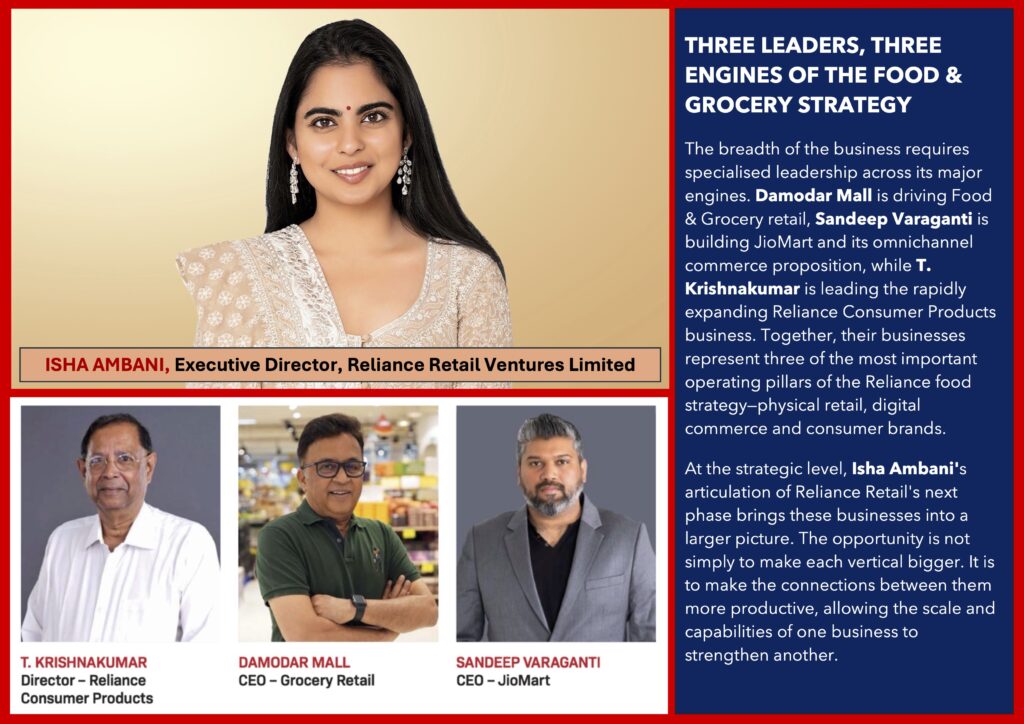
RCPL doubled its revenue to Rs. 220 billion in FY26 and has articulated an ambition to reach Rs. 1 trillion by FY30. The strategy is deliberately broad, spanning beverages, staples, packaged foods, dairy, snacks, spreads and other everyday-consumption categories. Rather than building a small number of premium brands, RCPL is targeting India’s enormous middle-class consumer base with what T. Krishnakumar has described as global-quality products at affordable price points. The proposition is not simply low pricing; it is the ability to make quality accessible by using scale across manufacturing, distribution and retail.
The company is also combining the revival of heritage Indian brands with the creation of new consumer propositions. Campa has become the most visible example, while SiL, Velvette and Independence form part of a wider portfolio intended to establish Reliance as a serious FMCG player across multiple categories.
Campa Shows the Power of the Model
Campa illustrates what happens when brand ownership is combined with manufacturing, distribution and retail scale. The revived Indian beverage brand has crossed Rs. 4,700 crore in gross sales and expanded its reach to more than 3 million retail outlets through a network of 5,000+ distributors. The significance of Campa is therefore larger than its own sales performance. It demonstrates how Reliance can take an established brand, combine it with capital and distribution muscle, and rapidly create national scale.
RCPL’s reach is also not confined to Reliance’s own retail stores. The company’s products are being distributed through general trade and other external channels, giving the portfolio access to millions of additional consumer touchpoints. This creates a two-way advantage: Reliance’s retail network provides a powerful internal route to market, while RCPL’s external distribution network allows its brands to reach consumers far beyond the company’s own stores.
Strategic acquisitions have added further capabilities. Manna Foods and Udhaiyam Agro Foods strengthen the staples, health-food and processing portfolio, while Lotus Chocolate adds confectionery manufacturing capabilities. These acquisitions are important not merely because they add individual brands or facilities, but because they increase Reliance’s ability to manufacture, process and scale products within a much larger consumer ecosystem.
Manufacturing Becomes a Strategic Advantage
As RCPL grows towards Rs.1 trillion, manufacturing becomes much more than a back-end supply function. It can determine product quality, cost competitiveness, supply resilience and the speed at which new categories can be developed. Reliance has therefore been investing in integrated manufacturing capabilities and food-processing infrastructure, with the proposed AI-powered integrated Food Parks representing a particularly ambitious component of the strategy.
The objective is to build a manufacturing backbone capable of supporting a rapidly expanding portfolio while using automation and artificial intelligence to improve efficiency. Reliance’s manufacturing investments also create the possibility of taking Indian consumer brands beyond the domestic market. RCPL is already expanding its international presence, and greater manufacturing scale can provide the supply consistency and cost structure required to support exports.
Fresh produce represents another important part of the equation. Better farmer relationships, sourcing infrastructure, cold chains and technology-enabled planning can potentially improve quality and availability while reducing wastage. In a food economy where the gap between farm production and consumer consumption remains significant, greater control and visibility across the supply chain can become a meaningful competitive advantage.
AI as the Connective Layer
Artificial intelligence could eventually become the invisible layer connecting much of this ecosystem. Demand forecasting can influence procurement; procurement can inform production; production can determine inventory positioning; inventory can support store and digital fulfilment; and consumer purchasing behaviour can feed back into product development, pricing and merchandising.
The value of AI in this context is therefore not simply automation. It is the ability to connect information across businesses that traditionally operate separately. A retailer sees what consumers are buying. A manufacturer knows what can be produced. A sourcing organisation knows what is available. A digital platform knows what consumers are searching for and ordering. Connecting these signals can potentially make the entire food value chain more responsive.
For a business operating at Reliance’s scale, even incremental improvements in forecasting, inventory turns, wastage or logistics efficiency can translate into substantial economic value.
Food Does Not End at the Grocery Shelf
Reliance’s food ambitions also extend beyond what consumers buy for their kitchens. Through Reliance Brands Limited’s Food & Beverage portfolio, the Group is building a premium out-of-home proposition around global concepts including Pret A Manger, EL&N London and Armani/Caffè. The portfolio currently includes 12 Pret A Manger outlets, two EL&N London cafés, with another planned for Delhi, and India’s first Armani/Caffè at Jio World Plaza in Mumbai.
This business operates on a different economic model from grocery retail. Here, the focus is on premiumisation, experience, international food trends and evolving urban consumption. Yet strategically it fits into the broader food ecosystem because it gives Reliance another set of consumer touchpoints and another window into changing food preferences.
The result is an unusually broad food footprint. A consumer can buy groceries at Smart Bazaar, place an order through JioMart, purchase an RCPL product through general trade, procure through Metro India, and experience a global café or dining concept through Reliance Brands. The occasions are different, but the consumer is the same.
The Bigger Food Play
India’s food economy is entering a period in which the traditional boundaries between retail, FMCG, manufacturing, logistics, digital commerce and foodservice are becoming increasingly blurred. Reliance is positioning itself for that convergence by participating across almost every major layer of the food value chain.
The ultimate test will be execution. Integration at this scale brings enormous opportunities, but it also creates complexity. The company will have to maintain speed and entrepreneurial agility while coordinating businesses with very different economics and operating models. It will have to convert scale into efficiency, brands into enduring consumer franchises and infrastructure into profitable growth.
Yet the architecture is already visible. Farmers and sourcing feed manufacturing; manufacturing feeds RCPL; RCPL brands feed retail and external distribution; retail feeds JioMart; JioMart and the physical network generate consumer intelligence; Metro extends the ecosystem into B2B and HoReCa; and Food & Beverage adds premium out-of-home consumption.
That is what makes the Reliance food story different from a conventional retail expansion story. It is an attempt to connect the journey from farm to fork—and increasingly to use every stage of that journey to strengthen the next one.
The full Business of Food cover story examines this architecture in greater depth, including Reliance’s food and grocery formats, JioMart’s omnichannel strategy, RCPL’s Rs.1 trillion ambition, Campa’s rapid scale-up, strategic acquisitions, manufacturing investments, AI-powered Food Parks, fresh-produce sourcing and the emerging premium Food & Beverage portfolio.
The question is no longer whether Reliance is building a large food business. The question is how far an integrated food ecosystem of this scale can reshape the competitive landscape of India’s food economy.
Read the complete cover story in the August issue of Business of Food.