

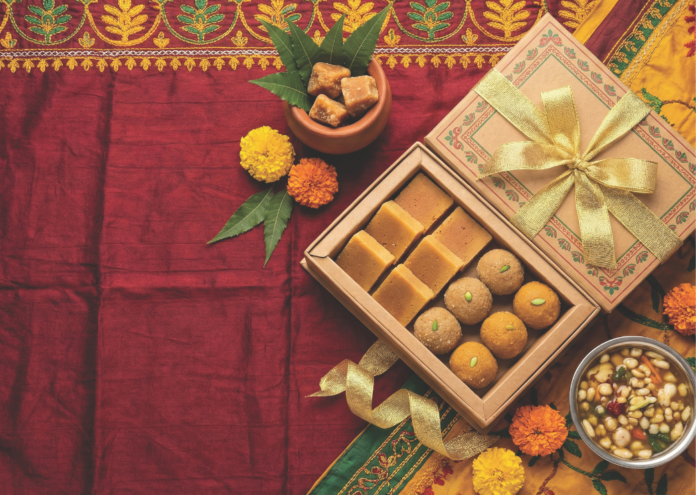

Consumers may be exploring new gifting formats, but familiarity still holds the strongest currency as brands find fresh ways to premiumise festive traditions.
India’s festive food-gifting market is no longer a simple contest between the neighbourhood mithai shop and the chocolate box. Over the past few years, the category has expanded into a much broader universe spanning traditional sweets, dry fruits, chocolates, savouries, baked products, gourmet foods and curated hampers. Established names such as Haldiram’s, Bikanervala, Bikaji, Amul and Cadbury continue to bring scale, familiarity and distribution, while premium mithai makers, craft chocolatiers, dry-fruit brands and D2C players are creating newer interpretations of the festive gift.
What has changed is the definition of what constitutes a ‘good’ food gift. Traditional sweets, chocolates and dry fruits remain firmly embedded in the occasion, but consumers are increasingly being offered products built around premium ingredients, health credentials, regional provenance, craftsmanship and presentation.
A 2024 LocalCircles survey of more than 31,000 urban households found that 53% of respondents who planned to gift during Diwali chose traditional sweets, chocolates or bakery products, while dry fruits also featured strongly in festive gifting. The survey also found that 57% of gift buyers preferred local stores, while 36% were buying online, pointing to a category that remains rooted in physical retail even as digital channels gain ground.
Festive Gifting: From Custom to Category
The premium end of the market, meanwhile, is becoming increasingly inventive. Business Standard reported in 2024 that some artisanal mithai brands were selling highly elaborate creations for as much as Rs 56,000 for a 100-piece box, a striking indication of how far the category can stretch when the sweet becomes a luxury product rather than simply a food item.
At the more accessible premium end, brands such as ProV are positioning dry fruits as a healthier alternative to conventional festive gifts, with its 2025 festive range priced between Rs 949 and Rs 1,699.
The competitive landscape is also widening as established snack companies and new-age brands increasingly position themselves for the festive gifting occasion. According to The Economic Times, India’s savoury snacks market was valued at Rs 46,571 crore in 2024 and is projected to more than double to Rs 1,01,811 crore by 2033. Haldiram’s remains the largest player, accounting for around 13% of the savoury snacks market, while Balaji Wafers reported revenue of Rs 5,453.7 crore in FY24, up 11% year-on-year. Bikaji Foods, meanwhile, reported mid-teens revenue growth in Q1 FY26.
The festive opportunity is drawing newer players into the same space. The Economic Times notes that D2C brands such as Farmley, TagZ, Bonvie and Too Yumm! are targeting consumers with premium, clean-label and healthier snack options, with Farmley introducing festive gift boxes and roasted makhana assortments. The report also highlights a shift in consumer preferences, citing Farmley’s Healthy Snacking Report 2025, which found that 55% of Indians prefer preservative-free snacks and 52% prioritise eco-conscious packaging.
Chocolate companies compete with mithai makers, dry-fruit brands compete with confectionery, and D2C brands compete with all of them by offering curation and personalisation. India’s packaged sweets market alone was estimated at Rs 7,268 crore in 2024, with IMARC projecting it to reach Rs 27,647.5 crore by 2033, highlighting the longer-term formalisation of a category historically dominated by fragmented, unorganised businesses.
Beyond the Mithai Box
While the occasion continues to be rooted in tradition, brands are responding with greater variety, premium presentation and options designed for different gifting occasions and budgets.
The scale of established players highlights the commercial opportunity in this shift. Haldiram Snacks Food, which brings together the FMCG businesses of the Delhi and Nagpur Haldiram groups, recorded revenue of Rs 12,977 crore in FY25, according to CRISIL Ratings. The company’s portfolio spans snacks, sweets, ready-to-eat meals, baked products and beverages, giving it a broad base from which to tap into the growing festive gifting opportunity.
“Festive gifting practices have undergone a significant transformation over the years as consumers want products other than traditional sweets and mithai. Today, various gifting options, including dry fruits, savouries, chocolates and thoughtfully crafted hampers, have entered the market,” shares a spokesperson from Haldiram’s.
The shift, however, does not mean that traditional sweets have lost their relevance. Instead, they continue to anchor the category, while newer formats and premium assortments are expanding the choices available to consumers.
“Consumers can now choose from an array of gifts across different price brackets, making it easier to select products according to the occasion. Premium boxes and hampers have also added greater choice to the category,” the spokesperson added.
For GRB Dairy Foods, an Indian FMCG brand, the evolution is similarly being driven by a combination of variety and value, even as traditional sweets remain central to festive celebrations.
Dhanraj Balasubramaniam, Executive Director, GRB Dairy Foods, explains that consumers are no longer looking at gifting only as an exchange of sweets; they are increasingly looking for products that offer a combination of taste, quality, variety and presentation. At the same time, the fundamentals of festive gifting remain firmly rooted in familiarity. GRB continues to see strong relevance for traditional offerings such as Mysore Pak, Soan Papdi, Gulab Jamun and Rasogolla, alongside growing interest in dry-fruit-led and differentiated sweet options.
The broader growth of GRB’s business also reflects the opportunity around these expanding categories. According to CRISIL Ratings, GRB Dairy Foods’ revenue grew at a 19% CAGR over the three years to FY25, reaching Rs 1,081 crore in FY25, compared with Rs 1,010 crore in FY24. The growth was supported by consistent expansion in its ghee segment and the ramp-up of its non-ghee business, which includes products such as sweets and instant mixes.
“Sweets continue to be an important part of how Indians celebrate and share goodwill. At the same time, we see consumers looking for dry-fruit-led and differentiated sweet options, along with products that offer greater convenience and longer shelf life,” Balasubramaniam adds. The opportunity, therefore, is not limited to premium gifting. While larger assortments and premium selections cater to consumers willing to spend more, accessible gifting remains important for larger groups and wider festive exchanges.
Why Tradition Still Wins
With the festive gifting landscape becoming more experimental, the emotional language of gifting remains remarkably familiar. Premium chocolates, wellness products and curated hampers may add novelty, yet traditional sweets carry something newer formats cannot easily replicate: Memory.
Their relevance is built over years of family rituals, shared celebrations and established gifting habits. This becomes particularly powerful when gifting decisions are made quickly, where a trusted sweet offers little risk and plenty of emotional resonance.
Historically, sweet foods have held a prominent place in festival celebrations, as they are closely associated with family traditions passed down through generations and the happiness of sharing experiences and festive moments. This enduring emotional connection continues to shape gifting preferences.
Traditional sweets from Haldiram’s have been around for many years, and time has formed gifting habits around these products. Their familiarity gives these sweets a strong advantage, particularly during festivals when consumers often seek gifts that are universally appreciated and closely associated with celebration.
At the same time, the continued relevance of traditional sweets does not mean the category remains static. Consumers today have a much wider choice, with brands experimenting with flavours, formats, assortments and presentation while retaining the essence of familiar Indian sweets.
Despite the fact that people love traditional sweets, Haldiram’s believes this area continues to develop with the times. Nowadays, consumers have a wide choice of sweets; however, the taste remains the same.
The shift, therefore, is less about replacing traditional sweets and more about reinterpreting how they are presented and consumed. As contemporary formats enter the festive basket, traditional sweets continue to benefit from the strongest currency in gifting — familiarity, nostalgia and the comfort of giving something people already know and love.
Premium, But Still Familiar
Premiumisation is not necessarily rewriting the festive gifting playbook; in many cases, it is simply giving familiar choices a more elevated expression. As consumers become more discerning, the value of a gift increasingly extends beyond what is inside the box to how thoughtfully it is put together.
Better ingredients, curated assortments, attractive packaging and presentation can transform a traditional sweet into a more premium proposition without taking it out of the festive comfort zone. The result is a category where novelty and familiarity coexist. Consumers may be willing to spend more, but they still want the gift to feel recognisable, relevant and rooted in the occasion.
Subramaniam believes it is a combination of both, but the larger change is in how consumers evaluate the gift rather than completely changing what they gift. As expectations rise, a premium gift is being evaluated not only by the product itself but also by the quality, assortment, presentation and sense of occasion it creates.
“At higher price points, consumers expect better product quality, carefully selected assortments, attractive presentation and a sense of occasion,” he adds.
This means premiumisation is not necessarily about replacing traditional sweets with entirely new products. Instead, brands are finding ways to elevate familiar offerings through better ingredients, thoughtfully curated assortments, contemporary formats and more sophisticated packaging.
For GRB, this distinction is central to how it approaches the changing festive landscape. The brand sees modernisation not as a departure from its traditional strengths, but as an opportunity to make authentic Indian products relevant to evolving gifting expectations.
The New Language of Gifting
What premiumisation appears to be doing is stretching the boundaries of tradition, taking products people already know and love and giving them new formats, combinations and visual identities. The sweet remains familiar, but the way it is experienced, presented and shared is evolving.
This growing appetite for experimentation is creating space for premium gifting and curated hampers, which allow brands to bring together products that may traditionally have occupied separate categories. A festive box can now combine sweets with dry fruits, snacks, chocolates and other festive treats, turning an assortment of familiar products into a more contemporary gifting proposition.
Ultimately, the evolution of festive gifting may not be a story of old versus new, but of how creatively the two can coexist. The sweet box is being opened up, rearranged and dressed differently for a consumer who wants both the comfort of tradition and the excitement of discovery. And perhaps that is where the real opportunity lies for food brands: showing consumers how many new ways there are to gift something they already love.