


After opening with wide-ranging conversations on food and grocery retail, consumer behaviour, quick commerce, brand–retailer partnerships and evolving routes to market on Day One, India Food Forum 2026 turned its focus on Day Two to one of the fastest-evolving parts of India’s food economy — Foodservice and HoReCa.
The second day of the 19th edition of India Food Forum brought together leading voices from restaurants, hospitality, food brands, chefs, nutrition, supply chains and the wider food ecosystem to examine what will define India’s next phase of eating out and food consumption. Discussions moved from the economics of running and scaling foodservice businesses to the future of Indian cuisine, the role of high-quality protein, changing consumer expectations and the emergence of new food destinations.
The conversations reflected a foodservice industry being reshaped not by a single trend, but by multiple forces operating simultaneously — consumers seeking greater value and healthier choices, businesses looking for sustainable economics, brands pursuing new occasions and formats, and food operators expanding into locations and consumption environments that were previously outside the conventional restaurant map.
From Ideas to Businesses: Sanjeev Kapoor Sets the HoReCa Agenda
Opening the HoReCa-focused proceedings, Padma Shri Chef Sanjeev Kapoor, Chairman (HoReCa), India Food Forum, called on the industry to move beyond incremental improvements and identify ideas that can be converted into scalable, sustainable businesses. He emphasised that India’s foodservice opportunity can also be found in the country’s own proven systems, traditions and operating models, provided they are reimagined for contemporary consumers.
“India Food Forum should be more than a place where we discuss the future; it should be a platform where the industry discovers ideas that can be built, scaled and sustained. We need to look at what India already has and reimagine it through innovation, technology and better operations. Health, sustainability and scale cannot remain aspirations; they have to become the foundation of businesses that create real value. The opportunity lies in ideas that challenge conventional thinking, take inspiration from India’s inherent strengths and turn difficult opportunities into viable businesses. From the efficiency of the Mumbai dabbawalas to the values of home-style cooking, there are models we can learn from and build for a larger market. If we combine these strengths with innovation and operational discipline, we can create food businesses that are healthier, more sustainable, scalable and commercially valuable. That is the kind of discovery, inspiration and opportunity a platform like India Food Forum should create for the industry.”
India’s Tea Economy Mapped
Adding to the forum’s focus on emerging opportunities across the food ecosystem, IMAGES Group launched “The Tea Economy: A Comprehensive Industry Report on India’s Most Consumed Manufactured Beverage 2026–2030.” The report examines the evolution and outlook of India’s tea economy, providing an industry view of a category deeply embedded in everyday consumption while also undergoing shifts in formats, preferences, channels and consumption occasions.
REIMAGINING HoReCa: Where Purpose Meets Profit
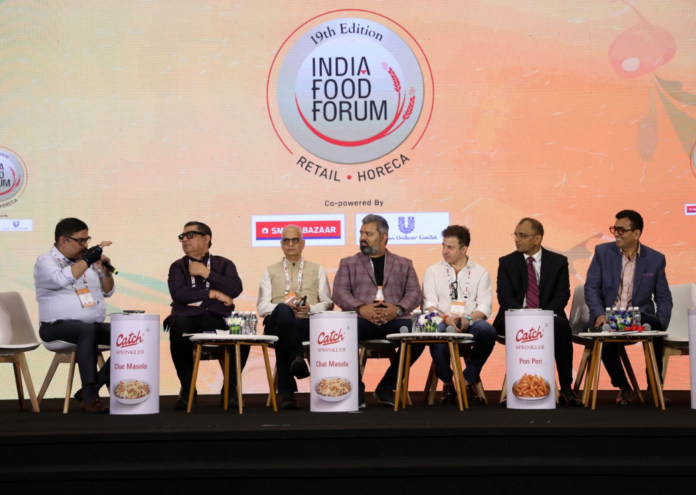
The inaugural HoReCa session, “Reimagining HoReCa: Where Purpose Meets Profit,” moved the conversation from aspiration to the operating realities of India’s foodservice industry. The discussion examined how restaurants, hospitality businesses and foodservice operators are navigating changing consumer expectations while managing affordability, efficiency, supply chains, staffing and profitability.
Manish Dawar, President & Group CEO, Devyani International, highlighted the changing relationship between health and eating out, pointing to an opportunity for foodservice businesses to balance indulgence with more meaningful and healthier choices. He also identified affordability, hygiene, convenience, rising incomes and changing workforce dynamics as important drivers of the sector.
The conversation widened beyond conventional restaurants. Manish Gupta, CEO, TajSATS, highlighted the fundamental role of food in aviation and the growing relevance of fresh meal consumption through pre-booking, corporate travel and family travel.
For Prashant Issar, MD, Bellona Hospitality & Founder, Ishaara, the opportunity ultimately comes down to understanding the consumer and getting the restaurant economics right. “If we understand what customers are willing to pay, deliver a product we are proud of and create genuine value for money, we can build healthy, profitable businesses.”
Anjan Chatterjee, Founder & CMD, Speciality Restaurants Ltd., brought the discussion to the changing economics of restaurant formats, noting how delivery and changing consumer behaviour have altered the traditional dine-in model.
“Restaurants are no longer built only around dine-in; delivery, longer operating hours and leaner staffing models have become important to the business equation.”
He added that customer expectations now extend beyond the plate to ambience, service, convenience and engagement, making the overall experience an increasingly important component of restaurant strategy.
Rooted or Reinvented? The Next Chapter of Indian Cuisine
If the economics of foodservice are changing, so too is the way Indian food is being interpreted. The session “Rooted or Reinvented? Where is Indian Cuisine Headed” brought chefs together to examine how culinary heritage can remain relevant while responding to changing consumer preferences.
Chef Altmash Patel argued that reinvention does not have to come at the expense of consistency. “Indian cuisine can be reinvented without losing its roots. The consistency comes from chefs teaching the next generation the right techniques and recipes; you don’t have to keep changing everything to create something new.”
Chef Dev Kasalkar emphasised the importance of documenting and preserving authentic recipes while allowing cuisine to evolve with the market. “Authentic recipes should be documented and preserved, but cuisine must continue to evolve with changing consumer preferences and market needs. Reinvention keeps the tradition relevant without losing its original foundation.”
For Chef Nitin Tandon, creativity lies in balancing heritage with the customer. “Creativity in food is a complex balance between being rooted in our habits, styles and beliefs and responding to the customer. Consumption remains largely rooted, but innovation gives chefs the space to reinterpret tradition and create something distinctive.”
Adding the dimension of familiarity and nostalgia, Chef Sherry Mehta observed: “Rooted traditions will always have a place in Indian cuisine, especially when food is connected to nostalgia and memories of home. At the same time, customers seek reinvented dishes, while signature classics continue to bring them back.”
Together, the perspectives pointed to an Indian cuisine that does not have to choose between preservation and innovation. Its next evolution could lie in retaining the techniques, flavours and memories that consumers recognise while finding new formats, presentations and occasions through which those traditions can travel.
Feeding the Future: The Role of High-quality Protein in Changing World
The conversation then moved from what consumers want to eat to what they increasingly want food to deliver. “Feeding the Future: The Role of High-quality Protein in a Changing World” examined how rising awareness around nutrition is influencing consumers, food businesses and restaurants.
The discussion moved beyond protein quantity to questions of nutritional quality, usability, sourcing, preservation, consistency and the processes required to deliver safe and reliable food at scale.
Dr. Varuna Rao, Nutrition Expert, stressed that consumers need to look beyond the protein number on a label. “High-quality protein is not simply about the number of grams on a label. We need to ask what it contains, whether the body can use it effectively, and what else comes with it. A complete protein should provide the essential amino acids we need, while processing should add value rather than compromise nutrition, and the overall product should avoid unnecessary fats, sugar and salt.”
From the supply side, Santosh Kumar, VP & Chief Business Officer Strategic Growth Retail, FreshToHome, underlined that quality has to become part of organisational culture rather than remain a periodic compliance exercise.
“Quality and consistency come from more than routine checks; they depend on a culture where rigorous testing, preservation and adherence to standards become non-negotiable parts of delivering good food every day.”
For restaurants, Dr. Sudhir Tamne, Founding Member, Sr. VP-Quality, Technical and Innovation, Burger King India (Restaurant Brands Asia Ltd.), highlighted the complexity of maintaining protein quality across the entire supply chain.
“Protein quality is not just about the nutritional profile; for restaurants, it also means taste and consistency, supported by the right suppliers, temperature control, packaging, logistics and rigorous quality checks.”
The New Food Map
The changing food economy is also redrawing the geography of consumption. “The New Food Map: Expanding Where Consumers are” explored how restaurant and food brands are moving beyond traditional high streets and malls to follow consumers into workplaces, travel hubs, neighbourhoods, campuses, hospitals and leisure destinations.
The discussion highlighted that expansion is increasingly about more than adding outlets. It requires understanding where consumers spend time, what occasions drive consumption and how formats and operating models need to adapt to individual locations.
Sudeep Goenka, Director, Goldiee Group, emphasised that relevance depends on continuous innovation across the consumer proposition. “Food brands need to continuously innovate to remain relevant as consumer expectations evolve across generations. Innovation is not limited to launching new products; it can come through new formats, packaging, convenience, technology, experiences and better ways of meeting everyday needs.”
Vikrant Batra, Co-Founder, Cafe Delhi Heights, brought the discussion back to the fundamental economics of expansion. “Every location has a story, and our approach to expansion has evolved through experience. With 50 outlets, we have learnt that high streets and malls require very different strategies.”
The message was clear: India’s next foodservice growth map will not be defined solely by the traditional hierarchy of premium high streets and shopping centres. As consumption becomes more distributed across work, travel, neighbourhood and leisure environments, the ability to adapt formats and economics to each location will become increasingly important.
From Food Growth to Food Systems: The Next Industry Imperative
Across two days, India Food Forum 2026 brought the food industry’s biggest questions into one conversation — from the changing grocery basket and emerging consumption patterns to foodservice economics, culinary identity, nutrition, technology and the geography of consumption.
Day Two, in particular, underscored that the future of HoReCa and foodservice will not be built on growth alone. The next phase will demand businesses that understand what consumers value, where they consume, how they want to experience food and what makes the underlying economics sustainable.
The conversations also pointed to a broader shift in the definition of innovation. It is no longer limited to a new dish, product or format. It can mean redesigning a supply chain, improving consistency, creating healthier choices, finding value at a new price point, taking Indian culinary traditions into contemporary formats or locating food businesses closer to emerging consumption occasions.
That makes Health | Sustainability | Scale less a three-part theme and more a framework for the industry’s next operating cycle. The opportunity ahead lies in connecting these priorities rather than treating them as separate agendas — building food businesses that can serve changing consumers, preserve what matters, adapt what needs to evolve and scale without losing the quality, experience and value that create demand in the first place.
As India’s food economy expands across retail, foodservice and technology, the next competitive advantage may belong to businesses that can turn this complexity into a coherent model for growth. India Food Forum 2026 closes with that larger industry challenge: not simply to feed a bigger India, but to build a food ecosystem capable of doing so with greater value, responsibility, resilience and scale.