


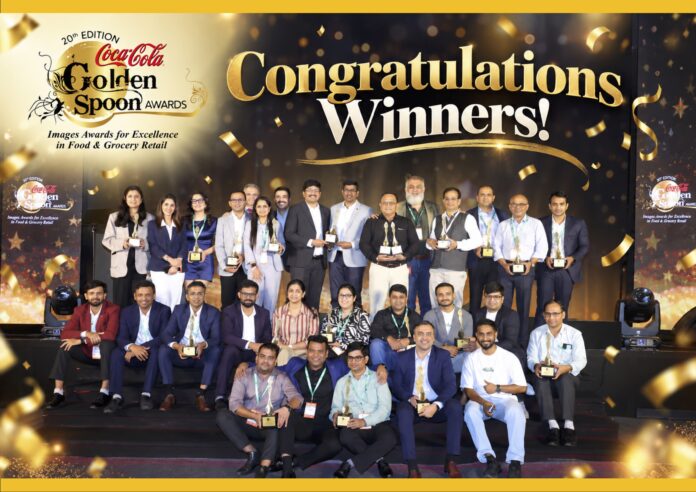
From small-town supermarkets and regional clusters to 1.6 million daily quick-commerce orders, experiential gourmet stores, a 50,000-sq-ft global retailer’s India return and a new generation of brand–retailer partnerships, the 20th Coca-Cola Golden Spoon Awards captured how rapidly the business is changing.
The 20th Coca-Cola Golden Spoon Awards 2026, held on 22 September at Jio World Convention Centre, Mumbai, brought together a remarkably diverse set of businesses and ideas shaping India’s food and grocery retail landscape. The awards are a part of India Food Forum, which brings together the food and grocery retail ecosystem around business, innovation, consumer trends and the changing architecture of food distribution.
What stood out this year was the breadth of the winners. The awards moved comfortably from regional supermarket expansion to quick commerce, from experiential gourmet retail to convenience, from store launches and turnarounds to shopper marketing, and from retailer-led initiatives to sophisticated brand–retailer partnerships.
The result was less a conventional awards roll-call and more a snapshot of where Indian food retail is today.
The New Retail Scorecard is About More Than Store Count
The eight Coca-Cola Golden Spoon Excellence Awards offered a useful window into this changing scorecard, without necessarily being about the largest businesses in the room.
Aadhaar Supermarket demonstrated the importance of productivity within an existing regional network. Its FY26 revenue reached ₹400 c, up 6% YoY, but the more revealing number was that 89 of 98 same stores were growing at 11% YoY. With reported sales productivity of ₹1,600 per sq ft, 5.50% COCO ROI and approximately 12-month new-store payback, the case was about the economics behind regional expansion rather than expansion alone.
SuperK, meanwhile, represents a very different proposition: organised grocery designed around the economics of India’s smaller towns. Its FOFO model has taken the network from 20+ stores in 2021 to 180+ stores across approximately 120 towns, serving around 2 lakh active households. A ₹300 six-month Gold Membership contributes to a model in which 75%+ of sales come from Gold Members, supported by proprietary Retail OS, 5,000+ products and household-level transaction data.
Ghodawat Retail, through Star Localmart and Star DusMinute, showed another route to regional scale: combine organic expansion with acquisition and hyperlocal digital fulfilment. Its 100+ stores across 20+ towns, ₹75+ c FY26 topline, 10% LFL growth in Q1 FY27 and acquisition of 40 DusMinute outlets illustrate how a regional player can combine physical density with digital convenience.
Then comes JioMart, where the meaning of the physical store itself is being rewritten. JioMart Quick is reported at approximately 1.6 million daily orders, growing 360% YoY and 53% QoQ, across 1,200+ cities and 5,100+ PIN codes. More than 3,100 Reliance Retail stores serve as dual-use retail and fulfilment hubs, while 5.8 million new transacting users were added.
It is an important shift: the store is no longer only where the customer shops. It can also be where the digital order originates, is picked and is dispatched.
Foodstories takes the opposite route — making the physical store itself part of the consumer proposition. Its five flagship experiential stores across four metropolitan markets combine gourmet retail with cafés, discovery, food craft and community. Products such as Viral Tissue Bread, Croissant Loaf and Salt Bread sit alongside collaborations with makers, chefs, fromageries, bakeries and farms. Customers can blend spices, roast nuts, grind speciality flours and participate in Kitchen Studio masterclasses.
LuLu Group India represents the continuing evolution of the large-format model. Its 19 retail outlets across 11 cities and five states generated FY26 revenue of ₹5,654 c, up 17%, with four new stores added during the year. But its architecture is increasingly multi-format — LuLu Hypermarket, LuLu Daily and LuLu Express Fresh — allowing the business to address different shopping missions and catchments.
At Freshpik Powai, the story became even more granular. A single 12,000-sq-ft store increased monthly sales from ₹3.6 c to ₹5 c, delivering 40% YoY growth and crossing ₹5 c in August 2026. The store recorded 50,000 NOB at an average basket of ₹1,000 in August. Ramen Bar, Matcha Bar, Grain Basket, Korean Beauty Zone, self-checkout, electronic shelf labels and robotic shopping form part of the proposition.
And Ratnadeep Retail brought the story back to regional depth. Its 195 stores across 20 cities added five stores in Q1 FY27, while revenue reached ₹600.9 c, up 11% YoY and 5% QoQ, with 6.2% same-store sales growth. Its Supermarket and National Mart formats are supported by RD Click, while FY26 also saw PAT move from a ₹26.69 c loss to a ₹36.70 c profit.
Eight businesses. Eight different routes to growth.
And that is perhaps the most interesting part.
Wow! Momo: Scale Becomes a Consumer Experience Story
The evening opened the Excellence narrative with Wow! Momo, recognised for Consumer Experience Innovation.
The timing is significant. Wow! Momo added approximately 200 stores in FY26, taking its network beyond 850 outlets across 90+ cities. Its portfolio has also expanded beyond the original momo proposition into Wow! China, Wow! Chicken and Wow! Kulfi, across dine-in, cloud-kitchen and modern-retail formats.
The award therefore sits at the intersection of scale and experience: how does a homegrown food brand preserve consistency, speed and consumer relevance while moving rapidly into new cities and formats?
From Retailers to Retail Formats
The next group of awards broadened the canvas considerably.
Carrefour, Noida was recognised as IMAGES Most Admired Retail Launch of the Year, following the global retailer’s return to India with its Greater Noida West flagship. The approximately 50,000-sq-ft store at Boulevard Walk marked Carrefour’s return to the Indian market after its earlier exit, with more than 15,000 products and a strategy built around future multi-format and omnichannel expansion.
The significance goes beyond one store opening. A global retailer returning to India in 2026 reflects the continuing attraction of India’s food and grocery opportunity — but with the market now demanding localisation, format flexibility and an omnichannel proposition.
New Shop, recognised as IMAGES Most Admired Retailer of the Year: Market Expansion, represents another distinctly Indian answer to modern convenience.
The company has built a 24/7 convenience proposition around neighbourhood locations as well as transit hubs, airports, gas stations and other high-density catchments. Its proposition combines FMCG and grocery with fresh food, café-style offerings and services such as ATMs, courier, printing and other neighbourhood conveniences. 350+ stores across 55 cities, and the business continues to expand through a franchise-led model.
The market-expansion award therefore speaks to a category that was once almost invisible in India’s organised retail landscape: modern convenience.
When Shopper Marketing Moves Closer to the Store
The IMAGES Most Admired Retailer of the Year: Shopper Marketing, Customer Experience & New Initiatives category produced three distinct stories.
SPAR India – SPAR on Wheel was recognised for Shopper Marketing, reflecting the growing importance of taking the retail proposition closer to consumers rather than waiting for consumers to enter a conventional store.
QMart was recognised for Customer Experience, putting the focus firmly on the experience delivered to the shopper rather than simply the merchandise available.
And Freshpik Ramen Bar was recognised for New Initiative — an example of how food retail itself is becoming more experiential. The ramen proposition effectively creates a foodservice occasion inside a gourmet retail environment, adding another reason for customers to spend time in the store.
Together, the three awards make an important point: shopper marketing, customer experience and innovation are increasingly converging inside the physical store.
Dusminute: The Turnaround Story With a Regional Retail Twist
The IMAGES Most Admired Retailer of the Year: Business Transformation / Turnaround Success Story went to DusMinute.
The recognition is particularly interesting in the context of Ghodawat Retail’s broader expansion. DusMinute’s presence has been strengthened through the addition of 40 outlets to the Ghodawat Retail network, creating a larger hyperlocal footprint in residential and gated-community catchments.
This is where the Golden Spoon Awards move beyond conventional expansion metrics.
Transformation can come through ownership, integration, format evolution, operating discipline or a new route to market. In DusMinute’s case, the award sits alongside a broader regional retail story in which the format is becoming part of a larger physical-plus-digital grocery proposition.
The Brand-Retailer Partnership is Becoming a Growth Engine
Perhaps the most revealing part of the evening was the sheer breadth of the IMAGES Most Admired Brand Retailer Partnership of the Year awards.
The message is straightforward: in modern food retail, the brand and the retailer increasingly create growth together.
For Brand Building, there was a tie between YiPPee & LuLu Hypermarket and Kissan & Reliance Smart Bazaar.
For Product Launch, the award went to Alpino & Reliance SMART.
For Market Expansion, it was Weikfield & Reliance SMART Bazaar.
For Merchandise Differentiation, Hajmola & Smart Bazaar took the honour.
And for Sales Growth, the award went to Ferrero & Reliance SMART.
The categories themselves are telling.
A brand–retailer relationship is no longer simply about securing shelf space and negotiating trade terms. It can be about building the brand inside the retail environment, launching new products, expanding into new markets, creating differentiated merchandise and ultimately driving measurable sales growth.
That is a substantial change in the role of modern trade.
The retailer brings consumer access, data, visibility, physical and digital infrastructure and increasingly sophisticated shopper understanding. The brand brings product, equity, innovation and marketing power. The strongest partnerships increasingly sit at the intersection.
What the 2026 Winners Tell Us About Food Retail
Look across the winners and five themes emerge.
First, regional retail is becoming more sophisticated. Aadhaar, SuperK, Ghodawat and Ratnadeep are all demonstrating different ways of building density outside the conventional metro-first narrative. The models range from FOFO to cluster expansion to acquisition-led growth.
Second, the physical store is being reinvented. Freshpik’s Ramen Bar, Foodstories’ Kitchen Studio, experiential gourmet retail and New Shop’s convenience-and-services proposition all expand the purpose of the store beyond a traditional grocery transaction.
Third, quick-commerce is no longer necessarily the enemy of physical retail. JioMart’s model demonstrates how an existing store network can become fulfilment infrastructure, while regional retailers such as Ghodawat are integrating hyperlocal delivery into their physical network.
Fourth, productivity is becoming as important as expansion. Aadhaar’s 89 out of 98 same stores growing at 11%, Freshpik Powai’s 40% YoY growth and Ratnadeep’s 6.2% SSSG demonstrate the value being placed on what existing stores can deliver.
And fifth, the brand–retailer relationship is becoming more strategic. The eight partnership recognitions across brand building, product launch, market expansion, merchandise differentiation and sales growth underline how much of food retail growth is now created jointly.
From More Stores to More Productive Ecosystems
The Coca-Cola Golden Spoon Awards have historically tracked the evolution of organised food and grocery retail in India. The 2026 edition perhaps offered one of the clearest pictures yet of how many different models can coexist.
There is the regional supermarket. There is the small-format franchise store. There is the hyperlocal neighbourhood retailer. There is the large-format hypermarket. There is the experiential gourmet destination. There is the 24/7 convenience store. There is the quick-commerce fulfilment network. There is the food-and-retail hybrid.
And increasingly, there is no clean boundary between them.
A supermarket can be a fulfilment centre. A gourmet store can be a café and classroom. A convenience store can be a service hub. A QSR can become a multi-brand food platform. A hypermarket can operate neighbourhood formats. A brand can work with a retailer not merely to sell more product, but to build the category itself.
That is what made the 20th Coca-Cola Golden Spoon Awards 2026 particularly relevant to the food and grocery industry.
The awards did not present one definition of retail success.
They presented a market in which scale, productivity, experience, regional depth, technology, convenience and collaboration are all becoming part of the same retail equation.
And that is arguably the bigger story behind the trophies handed out in Mumbai on September 22, 2026.
This is the new food and grocery retail India is building — one format, one market, one consumer and increasingly, one brand–retailer partnership at a time.