

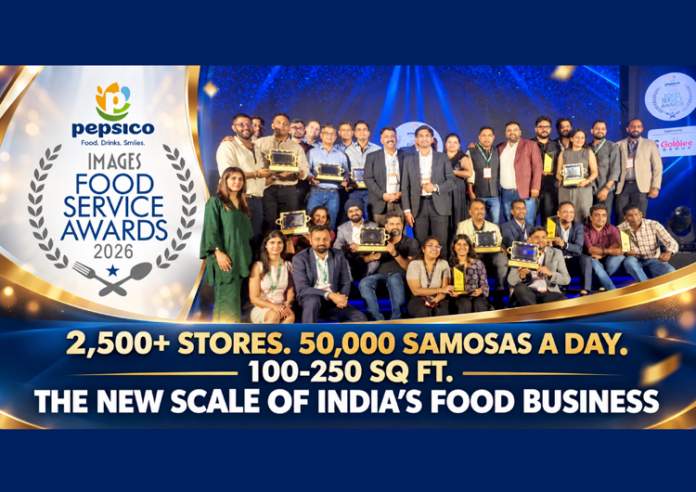

The PepsiCo–IMAGES Food Service Awards 2026 reveal a market where the next growth story may come as much from a 225-sq-ft tiffin room, a 100-sq-ft café, a food truck or a micro-retail outlet as from a 2,500-store foodservice platform
For years, the shorthand for foodservice growth was simple: open more outlets, enter more cities and serve more consumers.
The PepsiCo–IMAGES Food Service Awards 2026 suggest that the equation has become considerably more interesting.
Look closely at this year’s awardees and there is no single template. A bakery is scaling through production discipline. An ice-cream brand is expanding while protecting its original product philosophy. A tiffin concept is building a brand from 225 sq ft. A café that began with ₹10–12 lakh of founder capital has evolved into a much larger foodservice business. A samosa has been industrialised without losing its street-food identity. A coffee company is building beyond cafés. And a food truck is turning highway retail into a destination.
At the other end are McDonald’s, Tata Starbucks and Devyani International—businesses operating at substantial scale but still finding new ways to expand the consumer proposition.
The awards therefore offer less a list of winners and more a snapshot of where Indian foodservice is going next.
THE FIRST SIGNAL: THE FORMAT ITSELF IS BECOMING THE PRODUCT
The nomination-based awards provide the first clue.
Ishaara, Bengaluru was recognised for Food Service Launch of the Year. Bobakat and Yeti – The Himalayan Kitchen were recognised for Unique Format / Specialty Retail. Wow! Momo received recognition for Customer Experience, Loyalty & Engagement and Market Expansion, while Café Delhi Heights was recognised for Menu Design, Display & Presentation. Mad Over Donuts received the Marketing & Promotions recognition, and Weikfield – Kulfi Falooda Micro Franchise was recognised for Brand Food Service Partnership.
| What the awards recognised | Awardee |
| Food Service Launch | Ishaara, Bengaluru |
| Unique Format / Specialty Retail | Bobakat; Yeti – The Himalayan Kitchen |
| Customer Experience, Loyalty & Engagement | Wow! Momo |
| Menu Design, Display & Presentation | Café Delhi Heights |
| Market Expansion | Wow! Momo; Ishaara |
| Marketing & Promotions | Mad Over Donuts |
| Brand Food Service Partnership | Weikfield – Kulfi Falooda Micro Franchise |
The underlying message is subtle but important: foodservice differentiation is moving beyond the food on the plate.
The format, the occasion, the experience, the way the product is presented and the way the consumer discovers it are becoming part of the business model.
THEN COME THE BUSINESSES THAT HAVE MADE SCALE A DISCIPLINE
Consider Theobroma.
The business has grown from a boutique pastry proposition into a national café-bakery brand with 330+ outlets across 50+ cities. It reported ₹575 c FY25 revenue, with 27% growth, while retaining a predominantly company-owned model and centralised production. Its signature brownies alone are produced at 25,000+ a day.
That is not simply an outlet-expansion story.
It is a story of what happens when production, product consistency and customer experience are treated as infrastructure for growth.
Naturals Ice Cream illustrates a different challenge: how to grow an artisanal Indian proposition without diluting what made it distinctive.
The brand now has 200+ stores, has recently entered Chennai and Punjab, and has expanded its proposition through Vegan, No Added Sugar, Sorbet and Jalebi Ice Cream. Quick commerce contributes 25%, alongside strong recent year-on-year growth.
In other words, scale is not necessarily about changing the DNA. It can also be about protecting the DNA while widening the addressable market.
THE NEW UNIT OF SCALE MAY BE THE CONSUMER, NOT THE STORE
Subway India’s numbers provide another perspective.
The business has crossed 1,000 stores, with 1,030+ stores across 165+ cities and a ₹480 c+ annual revenue run-rate. Its model combines 100% localised sourcing, a dedicated vegetarian proposition and the Fresh Forward format, while repeat customer order frequency has increased by 35%.
The significance is that physical expansion is only one part of the equation.
Localisation and frequency are equally important measures of whether a national QSR can remain relevant across a diverse market.
That distinction becomes even clearer when one moves from national chains to India’s emerging small-format brands.
225 SQ FT. 100 SQ FT. AND A LOT OF AMBITION.
Benne is perhaps one of the neatest illustrations of the small-format opportunity.
Founded by Shriya and Akhil in 2024, it started with a 225-sq-ft outlet in Bandra, Mumbai and has grown to five outlets across three states, including three in Mumbai and two in Delhi-NCR. Its focused menu centres on Ghee Podi Idlis and Masala Dosas, while a recent fundraise valued the brand at ₹350 c.
Boojee Café started with an even smaller footprint—a 100-sq-ft café—and just ₹10–12 lakh of founder capital. It has since evolved into larger formats, an espresso bar, bakery and own roastery, with ₹103 c in latest management-reported annual revenue.
These stories challenge an old assumption in foodservice: that meaningful scale requires a large box.
It may instead require a format with the right economics.
THREE SMALL-FORMAT STORIES, THREE DIFFERENT ECONOMIES
| Business | Distinctive model | Evidence of scale |
| Benne | Compact tiffin-led format | 5 outlets across 3 states |
| Boojee Café | Capital-efficient café evolving into multiple formats | ₹103 c latest management-reported annual revenue |
| Samosa Party | Street-food product built into a speciality QSR | ₹150 c+ annual run-rate; 50,000+ samosas daily; 60+ locations |
Samosa Party takes the proposition one step further. It has built a modern speciality QSR around one of India’s most familiar street-food products, with a ₹150 c+ annual revenue run-rate, 50,000+ samosas produced daily and 60+ locations across Bengaluru, Hyderabad and Delhi-NCR. Automated frying and three-layer vacuum flasks are part of the operating system behind the model.
The bigger lesson is not about samosas.
It is about taking something inherently local and designing the processes required to make it repeatable at scale.
THE CAFÉ IS NO LONGER JUST A CAFÉ
Blue Tokai’s evolution illustrates how a foodservice brand can widen its economic footprint.
Founded in 2013, it has grown to 130+ specialty cafés, with direct relationships across 50+ Indian coffee estates. But the business extends beyond cafés into roasted coffee, subscriptions, B2B and artisanal bakery. Its $35 million Series C has strengthened its expansion platform.
This is a significant change in the café business model.
The café can be the consumer-facing front end of a much broader ecosystem—retail product, subscription, B2B and experience—rather than the sole source of revenue.
Baskin Robbins India demonstrates a similar transition from another category. The award citation identifies 1,150+ exclusive franchise parlours and 8,000+ retail touchpoints, supported by Blinkit, Swiggy Instamart and Zepto. Its under-15-minute cold-chain proposition and reported double-digit off-season digital sales growth show how an ice-cream brand is extending consumption beyond the parlour.
The store remains important. But the consumption occasion is becoming bigger than the store.
MATURE BRANDS ARE NOT SITTING STILL
There is another important thread running through the awards: innovation does not belong only to emerging brands.
McDonald’s West & South India operates 480+ restaurants, but its award citation focuses on what is happening inside that mature estate—100% localised supply, McSaver, McDelivery, self-ordering kiosks, drive-thrus and McCafé formats.
Tata Starbucks has similarly combined scale with experience. The citation highlights its 500-store milestone, the 7,697-ft Starbucks on the Manali–Leh Highway, described as the country’s highest-altitude Starbucks, its 500th Reserve store in Gurugram, and Reserve formats in Delhi and Hyderabad.
The implication for the industry is straightforward:
A large store network is not the end state. It is an asset that can be continually redesigned around new occasions, formats and experiences.
FROM RESTAURANT COMPANY TO FOOD SERVICE PLATFORM
Devyani International represents perhaps the most platform-like model among the awardees.
It was recognised as PepsiCo IMAGES Most Admired Food Service Group of the Year for a portfolio spanning 2,500+ stores across 350+ cities and 15,000+ foodservice professionals.
The citation also records 250+ net new stores in a single fiscal cycle across India, Nepal, Nigeria and Thailand, with the portfolio combining global franchises and homegrown brands added through acquisitions.
Here, scale has moved beyond the individual restaurant brand.
It is about the capability to operate brands, formats, markets and people at the same time.
THE HIGHWAY IS BECOMING A FOOD DESTINATION
One of the more unconventional stories comes from the single broad category of Excellence in Food Truck Innovation & Street-Retail Scalability.
The three awardees could hardly be more different.
Hariom Sweets was recognised for Micro-Retail Standardization & High-Density Street Footprint. Its model combines rapid-turnover micro-outlets, tighter supply-chain control and freshness discipline to bring consistency and scalability to a traditionally fragmented street-retail category.
Kannadigas Café was recognised for High-Velocity QSR Scaling & Viral Community Activation, with high-profile launches at Outlet Mall of India, Bhiwandi and Khadakpada, complemented by initiatives such as the Lifetime Free Dosa Gold Card.
And then there is Smoke Woods Pizzeria, recognised for Mobile Gourmet Formats & Highway-Retail Infrastructure. Its destination truck on the Mumbai–Nashik Highway at Bhiwandi, alongside urban locations in Surat, demonstrates how a mobile kitchen can turn live-baked food and highway retail into a destination experience.
| Business | What makes the format distinctive |
| Hariom Sweets | High-density micro-retail |
| Kannadigas Café | QSR + community-led activation |
| Smoke Woods Pizzeria | Mobile gourmet + highway destination |
This is perhaps where the conventional definition of foodservice gets stretched furthest.
The restaurant does not always need four walls.
THE OTHER SIDE OF THE EQUATION: PARTNERSHIPS
The PepsiCo Away from Home Awards add another layer to the industry’s growth story.
KFC received the QSR Excellence Award 2026, Pizza Hut was recognised for Best Culinary Innovation, PVR for Best in Class Consumer Experience, Café Delhi Heights for Best Dining Excellence, and German Doner Kebab as Rising Star – QSR.
Sapphire Foods received the Dynamic Food Service Partner recognition, Biryani By Kilo was recognised as Food Services Growth Catalyst, and Lenexius FoodWorks received the Best in Multi-Brand QSR Growth award.
Lenexius’ citation describes a portfolio comprising Chinese Wok, Big Bowl and The Momo Co., with Chinese Wok alone present in 270+ locations across 52 cities. The company is positioned around quality, hygiene, affordability and culturally relevant food propositions.
The partnership awards therefore point to another reality: foodservice growth is increasingly an ecosystem activity, involving operators, brands, franchise partners and other consumer-facing businesses.
THE AWARDS ALSO TELL A STORY ABOUT WHAT IS NOT BEING STANDARDISED
There is an irony in bringing all these businesses into one awards programme.
The industry is scaling, but it is not becoming uniform.
The same awards recognise:
- a national bakery business built around centralised production;
- an indigenous ice-cream brand protecting its product philosophy;
- a localised international QSR;
- a 225-sq-ft tiffin concept;
- a capital-efficient café;
- a street-food QSR;
- a specialty coffee ecosystem;
- a mature global restaurant estate;
- an experiential coffee network;
- a multi-brand foodservice platform;
- a mithai micro-retail model;
- a dosa-led community proposition;
- and a gourmet pizza truck on a highway.
That diversity may be the most useful takeaway for the industry.