
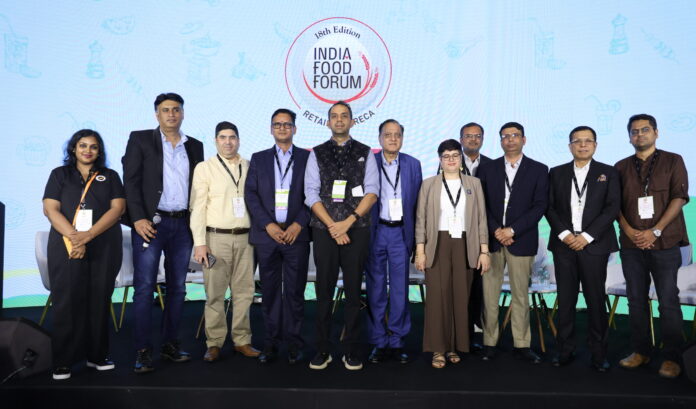

By mid-afternoon on November 11, the ballroom at the Jio World Convention Centre was humming with a peculiar tension—part curiosity, part impatience, part opportunity waiting to be seized. Retailers from Jalgaon, Nashik, Malegaon, Pune, and dozens of fast-growing trade pockets had travelled to Mumbai, not merely to listen but to be heard. On the other side sat the architects of some of India’s most ambitious FMCG brands: Parle Agro, Madhusudan, Empire Spices, Sweet Karam Coffee, The Organic World, Wonderland Foods, and others.
The theme—Unlocking Growth in Semi-Urban India—was simple enough. The intent was not. Moderators Chetan Damji Sangoi and Vinayak Joshi had choreographed the discussion as a live confrontation between demand and supply—between those who know the customer and those who shape the product. What followed was one of the most candid, high-voltage conversations the India Food Forum stage has witnessed in recent years.
Where the Growth Is—And Why the Playbook Must Change
The first spark came from Ruman Pathan of Parle Agro, who set the tone with an admission that sounded less like a corporate line and more like an industry confession: “Semi-urban is not a subset of metros. It is the fastest-growing geography. It needs its own channel—and its own approach.”
This was a turning point. For years, brands quietly treated semi-urban markets as a downstream extension of urban India. Now, the acknowledgement was public: the centre of gravity has shifted.
This shift is visible in categories once assumed too premium or niche for deeper markets. Health snacking brand Yellow Spoon is seeing its biggest traction from beyond metros. Founder Swathi Varun credited India’s digital awakening: “Instagram and e-commerce have opened these markets for us long before distribution reached. Semi-urban consumers have become intensely aware and health-conscious.”
The story was similar for organic brands. Gaurav Manchanda, Founder and Director, The Organic World, described the consumer’s new hierarchy beautifully: “What they want is authenticity, accessibility, and affordability—in that order. If brands and retailers align on these three, collaboration becomes effortless.” And then came the clincher: premium organic products flying off shelves in towns that many brands still consider ‘emerging.’
“In Tirunelveli, a single store gives us Rs.12,000 per SKU per month,” revealed Varun Gupta of Pro Nature Organics. “People in small towns want the same brands, the same purity—they just want reliable access.” If there was any doubt that semi-urban India mirrors the aspirations of metro India, it dissolved here.
Stepping in from the snacking aisle, Vikram Agarwal, MD, GreenDot Health Foods, the company behind Cornitos, underlined how even an originally “international” format has been indigenised for Bharat and pushed deep into the map. “When we brought nachos to India 16 years ago, our goal was clear—I wanted to take a global product and rebuild it with Indian taste for our Bharat consumer,” said Agarwal. “Today we cover markets from Leh–Ladakh to Kanyakumari and Manipur, but the real headroom for growth is in semi-urban India.”
The Semi-Urban Consumer: Aspirational, Aware—and Underserved
Dry fruits major Wonderland Foods, for instance, discovered something profound. Founder Rakesh Gupta dismantled the long-held assumption that deeper markets demand cheaper goods: “Tier-3 consumers want the same brands their metro counterparts buy. The shift you need is not quality—it’s denomination. Give them Rs.10–Rs.99 options, and they convert.”
He added a cultural nuance that resonated deeply with both retailers and designers in the room: “To win these markets, you must speak their language. Local flavours. Local pack design. Local cues. You cannot impose a metro identity.”
Packaging specialist Dhun Patel (Therefore Design) expanded on that thought: “Their aspirations match metros, but their influencers don’t. You must contextualise your storytelling—otherwise the consumer feels unseen.”
For Cornitos, that combination of aspiration and localisation plays out in very specific ways. “For semi-urban markets, I always say taste comes first, affordability second,” Agarwal explained. “If we get those two right, distribution becomes a growth lever, not a barrier—and we’re seeing the same story with our nuts and seeds, like pumpkin and sunflower, where demand from these towns is rising every quarter.”
The Real Friction Point: Supply, Not Demand
If the first half of the discussion was about potential, the second half was about pain. The moment the mic moved to retailers, the atmosphere shifted—the conversation turned visceral, immediate, and unmistakably grounded in day-to-day reality.
“What our grocers really require is continuous support and continuous supply,” stressed moderator and Director, Ealtitude Retails, Vinayak Joshi, framing the core issue before handing the mic to the retailers.
Akash Kankariya of Navjeevan Plus spoke first, and his words captured the sentiment of every retailer in the room: “Give us the SKUs that work in our markets, not the entire metro assortment. And give us a consistent supply. We are ready to build your brand—if you are ready to back us.”
In supermarket after supermarket, across districts and talukas, the pattern is the same: Demand is strong. Supply is weak. Ankiit Didwania (Didwania Super Bazar), representing a 150-year-old retail legacy, brought blunt clarity: “We run large supermarkets in taluka towns, but brands expect us to self-manage supply. Why does modern trade support stop at city limits?”
The tension peaked when a retailer highlighted a price disparity: the 1.8L Frooti pack that arrived at his store at Rs.81 was being sold in the same town by larger players at Rs.72.
Pathan of Parle Agro responded with rare candour: “Price parity is essential. E-commerce distortions have created chaos. Brands across categories are now enforcing parity to protect the market.”
To the retailers in the room, this honesty mattered. They weren’t asking for favours—only for fairness.
Brands Step Up: New Formats, New Packs, New Routes to Market

Some brands came armed not just with explanations but with solutions. Madhusudan’s Amit Aggarwal outlined a model that blends accessibility, entrepreneurship, and cold-chain innovation: “Entry-level packs let hesitant consumers try what metros consume. And exclusive micro-entrepreneur-run stores—with freezers we provide—help solve cold-chain gaps and expand reach.”
Desai Brothers’ Kuldeep Sharma revealed how data-led SKU customisation for Tier-3 markets has unlocked meaningful growth: “If PET bottles sell better than glass in smaller towns, we shift. If a SKU works in the Northeast but not the West, we redesign. Geography must determine packaging and pricing.”
This was reinforced by Empire Spices, which declared uniform schemes across modern and standalone trade: “We don’t differentiate between MT and independent supermarkets. Both matter equally,” said GM Marketing Bhanudas Gundakar. The message: Semi-urban India is not an afterthought. It is a deliberate market. And brands that treat it as such are already winning.
A New Compact Between Brands and Retailers
By the final stretch, something unusual happened on stage: The conversation shifted from frustration to co-creation. Moderator Chetan Sangoi, CEO, Sarvodaya Supermarket, synthesising the day’s energy, articulated the emerging pact: “The consumer is ready. Retailers are ready. The missing piece is coordinated brand support. Solve distribution, solve pricing, solve localisation—and this market will outgrow metros.”
There was nodding across the panel—brands and retailers both recognising that India’s next wave of FMCG growth will come not from saturated metros but from the surging appetite of semi-urban Bharat. In that moment, the session ceased to be a debate. It became a roadmap.