


While global alco-bev markets have slowed, India has moved in the opposite direction. Indian consumers are becoming more informed, more intentional, and more open to exploration. Premium wines are gradually entering everyday dining, celebrations, and lifestyle expression. As consumption spreads beyond metros and as regulatory barriers reduce over time, India’s wine market is set for a structural leap.
Advancing with this, Morgan Beverages serving and promoting Paladin Wines has emerged as one of the clearest indicators of this shift. Wine consumption in the country has grown at a remarkable 25 percent CAGR over the last decade, and the industry was valued at $195.3 million in 2023. Forecasts project a further 17 percent CAGR from 2024 to 2032. This growth reflects not just increased consumption, but a cultural evolution linked to lifestyle, food habits, and rising aspiration. Within this context, Paladin has become a key driver, contributing an impressive 20 to 25 percent of Morgan Beverages’ total retail distribution sales in the current year.
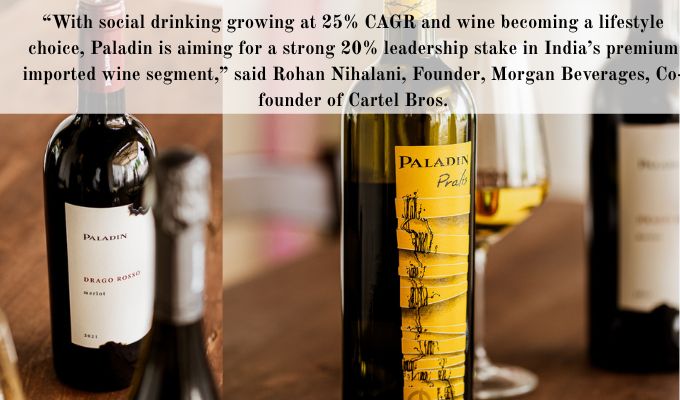
“When Paladin entered India in 2017, the consumer base was curious but inexperienced. Today, the shift is dramatic,” said Rohan Nihalani, Founder, Morgan Beverages, Co-founder, Cartel Bros.
A Palate That Has Transformed Since 2017
Paladin has expanded to importing nearly 45,000 to 60,000 bottles annually, largely concentrated in Mumbai and Pune.
Rohan mentioned, “The impact of conscious consumption is visible in the brand’s certified vegan portfolio, which has attracted a rising segment of ethical and ingredient-aware buyers.”
At the same time, taste remains the strongest driver. Draggo Rosso Merlot has become one of the fastest-selling reds in its price segment, with quarterly sales touching 1,500 to 1,700 bottles. Prosecco Rose, Syrah, Pinot Grigio, Dry Prosecco, and Amarone continue to record consistent growth, reflecting India’s growing comfort with Italian varieties.
Food, Culture, and the Next Category Unlock
“India’s next major alco-bev unlock is expected to come from the intersection of dining culture and wine. As exposure to global cuisines increases, consumers are pairing wine more frequently with food, both at home and at premium restaurants,” Rohan elaborated.
Social drinking has grown at a 25 percent CAGR over the last decade, and wine is increasingly chosen for celebrations, gatherings, and lifestyle occasions. The rising participation of women in the category is also shaping demand for lower-ABV, smooth, and versatile formats.
Old-world wine origins, particularly Italy, France, Spain, Chile, Australia, and Argentina, continue to dominate consumer preference, and Paladin’s Italian identity aligns naturally with this trend.
Expansion into Southern India
“Our expansion strategy for Paladin’s in between 2024 to 2026 is anchored in selective and insight-driven distribution,” Rohan explained. The brand has recently entered Goa and Karnataka with a starting price point of Rs 2,499 plus taxes.
Instead of volume-led expansion, Paladin is partnering with retailers and on-trade venues that specialise in discovery categories.
“Guided tastings, wine-and-food pairing menus, and staff education are being deployed to build familiarity,” Rohan added. The brand began this phase by launching a limited set of SKUs that are already proven performers in Mumbai and Pune. Once consumption behaviour across these states is fully analysed, it plans to expand further into other metros in the coming year.
Regulatory Constraint Slowing True Scale
Inconsistencies that delay new product launches and create price gaps on retail shelves. The biggest obstacle to premium wine adoption in India is not demand. It is the fragmented regulatory system. Each state operates with its own excise framework, pricing norms, and registration procedures.
Rohan commented, “For a category that relies on trust, discovery, and consistent availability, regulatory delays limit momentum.”
Paladin navigates these pressures through bulk procurement, supply chain efficiencies, optimised logistics, and a careful SKU mix that balances cost shocks without compromising quality..
Imported and Homegrown Wines Without Dilution
Morgan Beverages manages its imported and domestic wine portfolios through clear segmentation. Imported wines carry global aspirational value, while homegrown wines highlight Indian terroir and offer accessible entry points.
“Distinct pricing, branding, and communication ensure each segment retains its own identity and equity,” Rohan noted.
This clarity has prevented cannibalisation and has allowed both portfolios to grow simultaneously.
Young India and Its New Drinking Rituals
Rohan asserted, “India’s young population is reshaping alco-bev consumption with new rituals. Home consumption has risen significantly, especially in small social gatherings.” There is growing interest in mixology, global flavours, and wine pairing, influenced by digital content, travel, and the restaurant ecosystem. Wine has become less intimidating and more thematic, with curiosity now driving exploration.
Can India Become Wine-Confident?
India is on the cusp of becoming a serious wine-drinking market, but requires progress on multiple fronts. Retail education must become sharper, with better guidance around varietals, serving temperatures, and pairings. Rohan mentioned, “Accessibility must improve beyond metros, and pricing must communicate value rather than exclusivity.”
Retail and on-trade environments need knowledgeable staff and a consistent ambience. When these elements align, India can transition from wine-curious to wine-confident.
Ambition for Category Leadership
Paladin is targeting 20 percent category leadership in premium imported wines. Leadership is defined not only by sales but by depth of portfolio, range of varietals, retail visibility, and geographic reach.
Rohan responded, “We aim to build dominance across reds, whites, sparkling, vermouths, and vegan-labelled wines.” Expansion beyond metros into Tier I and II cities will be central to the brand’s leadership journey.
Volume Growth and 2026 Outlook
“For 2026, we are targeting a substantial uplift in ARR (revenues) driven by both volume growth and a richer mix of premium, higher-margin SKUs, “ Rohan concluded.
The strongest volume contributions will come from approachable Italian reds such as Merlot, expanding white wine demand, and growing adoption of sparkling and rosé wines for celebrations. Vegan-certified SKUs are also projected to capture increasing share as younger drinkers enter the market.
5 Year Plan for Pan-India Presence
Morgan Beverages’ five-year roadmap focuses on three pillars. The first is comprehensive portfolio expansion across reds, whites, rosés, sparkling wines, vermouths, and vegan options. The second is nationwide retail and distribution growth through strategic partnerships, including boutique liquor stores and premium restaurants. The third is brand development through education, tastings, and digital storytelling that strengthens wine awareness in new markets.