

Friday, February 20, 2026

Understanding Three Decades of Scale, Systems and Structure with Ajay Mariwala

Must Read

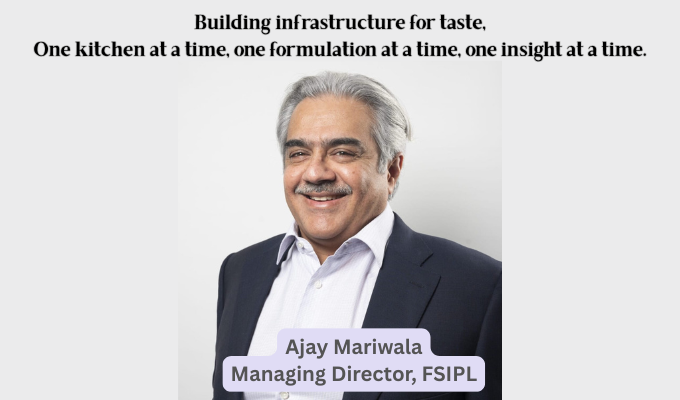
When Ajay Mariwala entered the food industry in the late 1980s, he did not approach it as a culinary pursuit. With a chemical engineering degree from Purdue and a systems-focused education from MIT Sloan, he viewed food through the lens of process, control, and scalability.

What intrigued him was not just flavour, but how flavour could be standardised, reproduced, and institutionalised at scale. Over the next three decades, that perspective would shape a career defined by building, scaling, and exiting businesses across seasonings, processed foods, food service supply, and specialty ingredients. His work has consistently centred on one idea: turning taste into infrastructure.

The Engineer Who Refused to Romanticise Food

Mariwala did not enter the food business driven by nostalgia or culinary storytelling. He entered it through the process. As a chemical engineer, he was fascinated by transformation — how raw materials behave under controlled conditions, how variables alter outcomes, how scale amplifies small inefficiencies. Food, to him, was simply chemistry experienced daily by millions.

This framing changed the way he looked at taste. It was not art alone. It was repeatability. It was control. It was systems.

That orientation would define every enterprise he built over the next three decades.

From Flavour Manufacturing to Category Building

His early years were about mastering formulation and scale. With VKL Seasonings, Mariwala built one of India’s leading seasonings businesses, institutionalising scientific precision in a market often driven by instinct.

The 2019 exit of True North from VKL Seasonings was not merely a financial milestone. It marked a validation of institutional scale, proving that disciplined systems in food manufacturing could attract long-term capital.

In 2023, the sale of VSPL to DSM-Firmenich further reinforced that trajectory. Each exit was less about stepping away and more about demonstrating that Indian food businesses could be built to global benchmarks of governance and performance.

Across ventures, Mariwala’s consistent focus has been structure before speed, be it in seasonings, processed foods, food service supply, or specialty ingredients

Thinking in Infrastructure, Not Products

Over time, his thinking evolved beyond individual products. He began to look at the structural gaps within India’s food ecosystem.

Food Service India emerged from one such gap: the absence of a dependable, full-service solutions partner for the HoReCa sector. Instead of supplying isolated products, the model is centred on integration, where gravies, sauces, seasonings, beverages, and functional ingredients are delivered through coordinated systems.

Today, the business manages 550–700 SKUs, works with over 30 factories, distributes through 650 distributors across 550 cities, and services tens of thousands of kitchens. Growth from Rs 240 crore in FY24 to a projected Rs 320–330 crore in FY25 — with a long-term target of Rs 1,000 crore by 2027–28 — reflects not opportunism, but compounding systems.

Pre-COVID CAGR stood at 45–50 per cent. Over the past three years, it has stabilised at 30–31%. For Mariwala, the numbers are not the story. The architecture behind them is.

Engineering Taste in a Diverse Nation

India’s culinary diversity presents an inherent challenge: variability.

“Engineering taste,” in Mariwala’s vocabulary, means ensuring that flavour performs identically across geography, kitchen formats, and skill levels. It requires tight raw material specifications, sensory benchmarking against gold standards, and continuous feedback loops from metros to Tier 3 towns.

Whether the flavour profile is Middle Eastern, Oriental, Korean, Japanese, or regional Indian, the test remains the same — reproducibility without dilution.

This discipline has become increasingly critical as Indian consumers globalise. With India now the world’s largest outbound travel market, exposure to international cuisines has reshaped expectations. Demand for authenticity, clean labels, and premiumisation is rising. The broader food services market, projected to reach Rs 7.7 lakh crore by 2028, will only intensify this shift.

Mariwala reads these trends not as fashion cycles, but as structural evolution.

Separating Signal from Noise

Across decades, his investment filter has remained consistent.

Is there a structural gap? Can the opportunity scale without eroding its core? Does it solve a tangible operational problem?

Nutriti Ingredients, for instance, responds to the rising need for specialty ingredients across food and pharma — a supply-side gap rather than a consumer fad.

This disciplined lens explains why growth has been steady rather than volatile. For Mariwala, infrastructure outlasts excitement.

Bridging Kitchens and Laboratories

One of the defining aspects of his leadership has been aligning chefs and scientists within the same innovation framework.

Chefs prioritise flavour, texture, and experience. Scientists focus on stability, heat tolerance, and shelf life. Mariwala’s role has been to institutionalise collaboration.

In one instance, a QSR client faced a practical issue: burger patties drying under heat lamps during peak hours. The solution combined culinary insight with moisture-retention systems, controlled flavour release, and heat-stable browning techniques. The result was operational consistency at scale.

Such examples illustrate his core thesis: flavour must survive real-world stress, not just kitchen testing.

The Gaps That Still Matter

Despite the sector’s momentum, Mariwala remains clear-eyed about systemic weaknesses.

Cold chain infrastructure outside metros remains fragile. Skilled kitchen manpower is limited. Sustainability and waste management practices require deeper integration. Kitchen automation adoption is slower than global benchmarks. Funding for B2B and ingredient innovation trails consumer-facing brands.

With MSMEs employing over 110 million people across manufacturing, trade, and services, the structural backbone of India’s food economy is significant but uneven.

For the next generation of entrepreneurs, he sees opportunity in these inefficiencies. Curiosity, resilience, and systems thinking will determine who builds enduring businesses.

Education as a Leadership Framework

Mariwala’s time at Purdue and MIT instilled analytical discipline. That mindset now shapes his organisational culture, encouraging questioning, cross-functional learning, and independent decision-making.

His advisory role at Chinmaya Vishwa Vidyalay reflects a parallel commitment to education. The principle is simple: teach people how to think. In business, that translates into building leaders who understand systems rather than silos.

Reading Policy Through a Systems Lens

His interpretation of the 2026 Union Budget is similarly structural. The emphasis on high-value agriculture, allied sectors, and technology-led farming strengthens the upstream layer of the food value chain. Improved agricultural productivity and supply stability influence processing quality and long-term competitiveness.

For MSMEs, the proposed Rs 10,000 crore SME Growth Fund and the continuation of the Rs 2,000 crore Self-Reliant India Fund signal intent to deepen capital access. Linking the Government e-Marketplace to TReDS to ease payment cycles addresses liquidity, which is now a persistent friction point.

Policy, in his view, matters when it improves system efficiency. The food economy responds to stability, not slogans.

One Enduring Thesis

Across manufacturing, food service, specialty ingredients, and institutional exits, a single idea runs through Mariwala’s professional journey: Build infrastructure for taste — one kitchen, one formulation, one insight at a time.

Latest News

General Mills invests Rs. 100 Crore in New Nashik plant to expand Pillsbury production

General Mills India has inaugurated a new manufacturing facility in Nashik, Maharashtra, investing approximately Rs. 100 crore to bolster...