


Convenience on the plate: Ready to Eat meals redefining Indian eating habits/kitchens
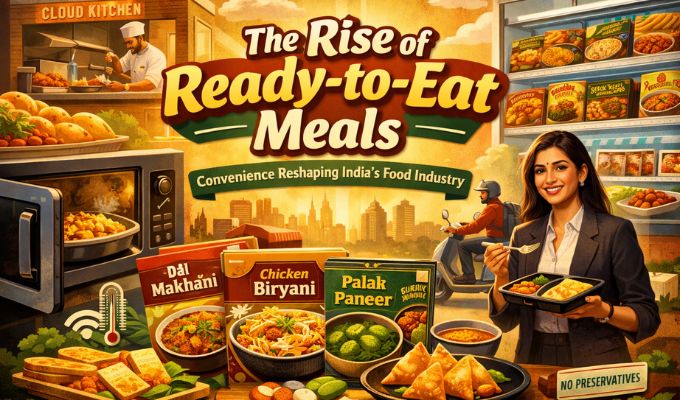
Walking through any modern grocery store today reveals a shift that no number of market research reports can capture. The freezer aisle has quietly and steadily expanded, replacing the area once dedicated to condiments and biscuits. Frozen parathas are now placed alongside marinated chicken, while biryani kits share shelf space with ready-made gravies. Items like dal makhani, palak paneer, and chicken tikka are all sealed, frozen, and prepared for quick cooking within minutes.
India’s ready-to-eat and ready-to-cook segments have undergone a subtle transition — from the margins to the heart of the market. Look at what people are eating on an ordinary weekday. The answer required very little time to prepare. A frozen snack. A pre-cooked curry. Something that moves from freezer to plate in minutes.
Market Research Future estimates that India’s ready-to-eat meals market was approximately $ 6.34 billion in 2024 and is expected to grow to $ 19.95 billion by 2035, with an average annual growth rate of about 11 percent from 2025 to 2035. Additionally, a study by Markets and Data predicts that the packaged RTE food market will expand from $ 1.10 billion in FY2024 to $ 3.41 billion in FY2032, with a CAGR of 16.4 percent.
Projections may vary. But the direction is steady. In less than a decade, a meal for each of the 5 consumers of packaged food would include a large portion of RTE products.
Time and generation are rewriting the menu
Research on Indian convenience food consumption conducted by Dr D.Y. Patil Institute of Hotel Management & Catering Technology shows that working women and dual‑income households increasingly reach for “packed, clean and reasonably priced meals” rather than elaborate traditional cooking after a full workday.
Other trending factors of nuclear families, rising incomes and a desire to save effort on weekday cooking without giving up the idea of a “proper meal” fuel the shift. A frozen paratha or heat-and-eat dal isn’t a compromise when it frees up 20-30 minutes after a 12-hour day.
However, the major factor remains the rapid urbanisation. The Union government’s Economic Survey report 2023-24 expected that by 2030, more than 40 per cent of India’s population will live in urban areas.
These statistics reflect kitchens with less time, smaller families with fewer hands, and a generation that does not view frozen food through the same suspicious lens as earlier generations did.
The ready-to-eat adoption is generational. The consumption patterns of the younger generation are shaped by global content. They have grown up watching food content through reels, shorts or YouTube videos from kitchens across the world. The concept of food freshness is outdated for them, unlike for earlier generations.
This cohort is more comfortable equating quality with standardisation, packaging, and safety. For them, the idea that food can be prepared elsewhere, preserved efficiently, and consumed later without compromising on taste or hygiene feels far more acceptable.
The government’s Household Consumption Expenditure Survey for 2023-24 backs this up. In cities, people are spending over 11 per cent of their food budget on RTE products.
Local is the new flavour
What has further accelerated the adoption is localisation. For a long time, the frozen food conversation in India centred on imported formats featuring products associated with a certain kind of urban cosmopolitanism, such as nuggets, spring rolls, and patties. What changed the game was localisation.
Indian manufacturers began filling the gap that imported products could never fill. The craving for proper biryani, slow-cooked dal, smoky seekh kebab, and a paratha that tastes like it was made at home was more appealing to people. Once the frozen food started feeling Indian, the hesitation dissolved. The category stopped being a compromise and started being a preference.
Infra, tech pushing the scale
Improved infrastructure and cutting-edge technology proved to be game-changers in scaling the RTE market.
The country’s cold chain capacity has improved over the last decade, supported by government incentives and private investment. The country now has over 37 million tonnes of cold storage capacity.
The days of unreliable reefer trucks are over. Now, sensors monitor in real time the transit, temperature, humidity and equipment functions.
Warehouses are becoming smarter with AI, figuring out and optimising ways to stack and store goods, helping avoid wild temperature swings that could spoil food. Think of it like a super-efficient packer who knows exactly where everything goes to keep things cool and stable all the time.
But the distribution remains uneven, as metropolitan cities and large urban clusters are well served, while smaller towns still face gaps in refrigerated transport and storage reliability.
At the same time, quick commerce platforms have introduced a new layer of access. Frozen and ready-to-eat products can now be delivered in minutes.
For time‑conscious urban middle‑class consumers, the ability to have groceries and full meals delivered in minutes has turned convenience from an occasional fallback into a default setting. Every time a platform suggests a “heat‑and‑eat dal makhani” alongside regular staples, or a frozen biryani next to fresh produce, it nudges the trial of RTE. It’s compounding into habits — office workers build their lunch routines around microwavable meals. At the same time, students and young professionals stock RTE pouches the way earlier generations stored loose atta and dals in bulk.
Cloud kitchens push growth story
While the growth story of the RTE industry largely relies on the retail segment, a significant chunk of this sector’s expansion is driven by the rise of Quick Service Restaurants (QSRs) and cloud kitchens.
QSRs depend on frozen and semi-processed ingredients for consistency. A chicken preparation in a Bengaluru outlet must be identical to the one in Lucknow. In a centralised kitchen model, it is only possible with standardised, blast-frozen inputs.
As India adds more cloud kitchens and organised food chains at a considerable pace, this institutional dependence on frozen and processed food will only deepen. The growth of the sector is not just a retail story. It is also a story about a commercial kitchen.
Health can’t be in the backseat
No discussion on ready-to-eat food is complete without addressing health.
Consumers are more aware, and ingredients on the back of labels significantly drive their buying decisions
They are asking about additives, about sodium, about whether what they are eating has been stripped of everything that made it food in the first place.
The honest answer is that manufacturers must be aware that, when done correctly, freezing is one of the most benign preservation methods available. It locks in nutrients and eliminates the need for many chemical preservatives. The issue is not freezing; it is formulation—what goes in before freezing. Brands that address this clearly will build long-term trust.
RTE is the makeover of Indian Kitchens
The RTE meals are not replacing traditional cooking in India, but are integrating into spaces once reserved for traditional cooking. The Indian kitchen has always been adaptive. Pressure cookers, mixers, packaged atta — each innovation was once seen as a shortcut. Today, they are standard. Ready-to-eat and ready-to-cook foods are following a similar trajectory.
RTE meals are no longer a curiosity on the supermarket shelf; they sit at the centre of how urban India is learning to save time, outsource labour and still feel in control of what lands on the plate.