
Tuesday, January 13, 2026

Daryaganj Restaurant: Reviving a Legacy, Building a Rs.100-Crore Powerhouse
Must Read

Daryaganj’s story begins where many Indian food stories begin—in forced migration, reinvention, and the stubborn insistence to start again. The brand positions itself as a tribute to the culinary legacy of Kundan Lal Jaggi and the resilience of Punjabi refugees who arrived in Delhi after Partition, bringing with them both loss and flavour, and eventually building restaurants that would define the city’s palate.

But what makes Daryaganj interesting as a modern brand is that it refuses to freeze its legacy in time. Instead of treating it as something to be displayed, the brand treats its heritage as something to be lived—protected through consistency, reinforced through experience, and delivered with the same care whether the guest is dining in the restaurant or enjoying the food at home.

That duality—old-world taste memory with new-world operating discipline—runs through everything Amit Bagga says about the business. And it’s visible in the way Daryaganj has built an experience that’s deliberately “approachable,” never intimidating, and yet engineered down to details most restaurants don’t even notice.

“Customer experience isn’t a department. It’s the whole job,” says Bagga. His operating philosophy is simple in principle and demanding in execution: every function in the organisation ultimately ladders up to one outcome—how the guest feels. “It starts with the customer and ends with the customer,” he adds, noting that Daryaganj has a dedicated customer experience head and holds every role, across front-end and back-end operations, to the same service lens. It’s an insistence that sounds obvious until you run a restaurant at scale. Because scale introduces a thousand small “exceptions”: a rush-hour compromise here, a skipped step there, a new hire who hasn’t absorbed the culture yet, a kitchen that is efficient but emotionally detached.

Bagga’s answer is not more SOPs. It’s culture—tracked and reinforced through routine and measurement. He speaks about using comment cards, scanning feedback, and counting “mentions” to recognise staff performance, so people aren’t judged randomly or by gut feel but by evidence. Over time, that feedback loop does more than improve service—it builds pride and stability, strengthening morale and retention through a workplace that invests in its people, supports them with meaningful safeguards, and makes them feel seen. And the subtext is clear: consistency is a people problem before it is a recipe problem.

Reviving a legacy

For all the mythology surrounding Daryaganj, there is a hard, uncomfortable truth at the heart of its modern story: the original restaurant—the physical space that carried the Jaggi family legacy—was no longer theirs. When Bagga speaks about this phase, his tone remains measured and composed, even as the significance of the loss is evident in what followed. The original Daryaganj restaurant, run by Raghav Jaggi’s grandfather, Kundan Lal Jaggi, and later by his family, had been sold off years earlier. The name, the kitchen, the address— everything that anchored the legacy in brick and mortar—was gone.

What remained was something far more fragile: memory. “When we decided to launch Daryaganj, we were very clear that we were not opening a restaurant,” Bagga says. “We were rebuilding a legacy from scratch.” What endured was not a physical space, but something far more enduring: memory. When Raghav Jaggi and Amit Bagga came together to open Daryaganj, the intent was never to reclaim the past or position the restaurant as a continuation of what once existed. Instead, it was about paying homage to a culinary legacy that had shaped North Indian dining, and interpreting it thoughtfully for a new generation. Raghav Jaggi, the grandson of Kundan Lal Jaggi, brought with him stories, recipes, and lived context. Bagga brought a complementary perspective—how modern consumers evaluate authenticity, how brands earn trust today, and how heritage must be experienced rather than asserted. Together, they were clear on one thing: Daryaganj would open as a contemporary restaurant shaped by its legacy, but designed for the present.

That clarity shaped every early decision. The legacy was acknowledged quietly—through the recipes they chose to foreground, the old menus they referenced, and conversations Bagga recorded with Jaggi family elders—but never used as a shortcut. There was no attempt to lean on history for instant credibility. The food had to stand on its own.

So when the first Daryaganj restaurant opened in 2019, it did so without fanfare. The menu was deliberately tight, the ϐlavours reassuringly familiar, the execution disciplined. There were no experimental flourishes designed to chase trends or impress critics. The ambition was simpler, and far harder: serve food that made people pause and think, this feels right.

Only after guests began forming that connection—often without knowing the backstory—did the brand start speaking more openly about the lineage it drew from. In that sense, Daryaganj’s credibility was not inherited or reconstructed. It was earned. And it was that restraint, more than any claim to history, that became the foundation of the brand’s trust.

How Daryaganj decoded the vibe before it plated the food 

Most restaurants start with cuisine and mood boards. Bagga describes starting with a more fundamental question: what is “experience” actually made of? In 2019, as the first restaurant was being planned, he says he “decoded” customer experience into the five senses—everything a guest absorbs in a restaurant comes through sight, smell, touch, sound, and taste. From there, the brand began designing backward. Sight: interiors that mix retro and modern— brick walls, warm lighting, colours that feel nostalgic yet not formal. Smell: a signature fragrance, developed after “hundreds of iterations,” combining an Indian flower note with a contemporary note—something guests begin to associate with the brand itself. Touch: the feel of tableware and materials— traditional bowls for dal makhani, modern plates for other dishes—plus the “touch” of hospitality: how the staff speaks, how the guest is treated. Sound: a carefully curated playlist (Bagga calls it a Daryaganj Studio experience), built around feel-good tracks that bridge generations—old songs, new voices, unplugged textures. Taste: the anchor— great ingredients, old techniques, uncomplicated food that leans into simplicity because that’s what people return for.

This is not “theming” in the superficial sense. It’s a system: a repeatable blueprint that makes the experience portable across outlets—and, crucially, across formats. Because Daryaganj didn’t stop at designing the dining room. It tried to design the dining memory. What emerges is a rare thing in foodservice: delivery not as a compromise, but as a brand stage—engineered, branded, and measured.

Why the room has to “feel like Delhi” before the food even arrives

Bagga is candid about the role interiors play in a legacy cuisine brand. If you’re selling taste memory—especially dishes people believe they “already know”—the room has to align with the promise. He talks about deliberate choices: brick walls, black-and-white frames, old artefacts and family photos, paired with contemporary comfort in furniture, and influences drawn from the 1940s–50s— not just Indian references but elements of colonial British design that shaped Delhi’s visual culture. 

The website notes echo the same intent: a mood that blends contemporary chic with references to the 1950s, using brass and wood for earthy warmth, latticework for depth, and tiles and marble to create distinct zones, all designed to feel familiar yet refined. In other words, the room isn’t just visual dressing. It’s an extension of the experience—meant to put guests at ease, mirror the comfort of the food, and create a setting that feels instinctively right for the kind of dining Daryaganj stands for.  

The dishes that carry the brand 

At Daryaganj, the menu is not a showcase of range. It is a declaration of priorities. Amit Bagga is clear that the brand’s most powerful marketing asset is not its interiors, its delivery innovations, or even its story—it is the food that people come back for repeatedly. “There are some dishes that people order almost instinctively,” he says. “And those dishes are non-negotiable.” At the centre of that gravity sit butter chicken and dal makhani—recipes that are not treated as menu items but as anchors of the brand’s identity. At Daryaganj, the butter chicken is guided by balance rather than embellishment, with ϐlavours allowed to come through cleanly instead of being masked or amplified. The cooking is unhurried and methodical, reϐlecting an emphasis on authenticity and technique over theatrics. The dal makhani follows the same philosophy: long hours, patience, and an emphasis on texture over theatrics. “These are dishes everyone thinks they know,” Bagga explains. “So the margin for error is actually very small.”

That awareness drives obsessive consistency. The kitchen does not chase novelty for these core items. Ingredients are tightly controlled, cooking times are sacred, and even the vessels used to serve them are chosen to reinforce familiarity and comfort. Beyond the flagships, Daryaganj’s popularity is reinforced by a supporting cast of dishes that reϐlect old-school Punjabi hospitality rather than modern reinvention. Mutton seekh kebabs, chicken tikka, bharwan mushrooms, paneer classics, and robust breads form the spine of the menu—designed for sharing, repetition, and memory-building. Desserts, too, are rooted in tradition, with kulfi emerging as a signature—not just because of flavour, but because of how the brand rethought its consumption experience, from drip-proof trays to hygienic presentation.

What’s notable is what’s missing. There is no pressure to “modernise” North Indian cuisine for novelty’s sake—no deconstructed classics or fusion experiments in search of attention. For Bagga, innovation lies elsewhere. “Innovation for us is about making the experience better without changing the soul of the dish,” he says. That philosophy explains why operational and design refinements—such as packaging that preserves texture or serving formats that improve ease—are treated with the same seriousness as recipe integrity. It also explains why customers return with such consistency. At Daryaganj, the food offers comfort and familiarity, becoming a reliable, go-to choice for diners who know exactly what they want and trust it to be delivered well, every time. And in a market flooded with new launches and ϐleeting concepts, that reassurance has quietly become the brand’s biggest competitive advantage.

Becoming the dining hotspot 

Daryaganj didn’t manufacture its reputation through splashy launches. The brand’s visibility travelled the older Delhi way—through repeat visits, family recommendations, and that one question people keep asking after a good meal: ‘Where did you eat this? Bagga speaks about this aspect of the business without emphasis or ϐlourish. Well-known people and public ϐigures do dine at Daryaganj, he acknowledges, but not because the restaurant sets out to attract them. They come for the same reasons as everyone else: familiar food, a comfortable setting, and the assurance that the experience will unfold exactly as expected. 

What matters most to these guests, Bagga explains, is not attention but predictability. Privacy, ease, and the ability to enjoy a meal without interruption or ceremony often outweigh novelty or spectacle. Daryaganj works in those moments because it removes friction. There are no special menus, no preferential treatment, and no visible distinctions in service. The food, the service, and the experience remain the same for every table.

This consistency is not accidental. It is central to why Daryaganj functions as a default choice for many diners— public-facing, or otherwise. When people know what they are going to get and trust it to be delivered well, the restaurant becomes a place they return to without overthinking the decision. There is also a generational factor at play. Many of these guests—especially Delhi-based celebrities—grew up eating North Indian food in family settings. Daryaganj taps into that emotional register, offering a version of the cuisine that feels indulgent yet grounded, celebratory yet familiar.

Bagga believes this is why Daryaganj often becomes a “default” choice. “It’s the restaurant people come to when they don’t want to think too much. When they just want to enjoy themselves.” Over time, these visits began reinforcing the brand’s stature. Not because Daryaganj advertised them aggressively, but because word travelled the way it always has in Delhi—through conversations, recommendations, and quiet endorsements. The effect has been cumulative. Daryaganj is now widely perceived not just as a heritage restaurant, but as a safe cultural space— one that can host a family celebration, a business dinner, or a low-key celebrity meal without changing its character. And perhaps that is the real achievement. In becoming a destination for famous people, Daryaganj never stopped being a place for everyone else.

The business of nostalgia 

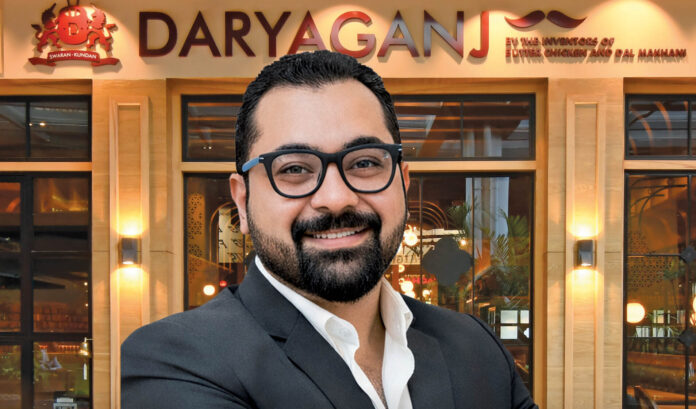
L to R: Raghav Jaggi (Founder & Promoter); Amit Bagga (Co-founder, CEO & CMO)

Bagga recalls the early days with a kind of amused honesty. The ambition, he suggests, wasn’t initially grand in spreadsheet terms. “When we started the first restaurant, honestly, we never thought we’ll ever reach here,” describing how the original intent was simply to open one outlet and see how it goes. The response was immediate and unmistakable—the kind every restaurateur hopes for, and quietly worries about. Within weeks of opening, the restaurant began drawing consistent queues, sometimes with 50 to 60 guests waiting at peak hours. As word spread, so did the suggestions. Friends, well-wishers, and industry peers all offered the same advice: this is working, now open more. 

Daryaganj expanded, then weathered Covid, and returned to growth with a belief that the demand for the product and experience still outstrips what the brand has supplied so far. But the part that matters is the strategic restraint: Daryaganj chose to dominate its home market before chasing the national map. “We want to spread out in one market first,” Bagga says in essence—win Delhi-NCR properly, become the best there, then take on other territories.

He cites a market reality the brand uses as a planning anchor: a large share of organised food consumption sits in the top eight cities, and nearly half is concentrated in the Delhi–Mumbai–Bengaluru triad. So the expansion logic becomes less romantic and more surgical:  Make Delhi-NCR unshakeable.  Build Mumbai and Bengaluru as the next engines.  Expand outward once the core is won. Bagga even quantifies the base: around Rs. 89–90 crore of the current business, he says, comes from Delhi NCR—and he believes Delhi alone can become a Rs. 200 crore market for Daryaganj. 

Profitable growth

Daryaganj has stayed EBITDA-positive except during Covid and treats “profitable growth” as non-negotiable, with internal accruals strong enough to fund expansion on its own. Bringing in Anicut Capital, Bagga says, was a choice of discipline, not necessity. As its first institutional investor, Anicut’s capital is aimed at consolidating Delhi-NCR, strengthening talent and processes, and driving operational excellence. With revenue above Rs. 100 crore and double-digit corporate EBITDA margins, the investment serves as both validation and preparation for the next phase of expansion. For Bagga, the real objective is governance — building transparency, controls, and discipline early to operate like a large, professional company. The deeper ambition: professionalise a heritage brand without losing its soul — keeping the romance, while building the rails.

Expansion without franchising 

Bagga outlines the company’s preferred expansion formats: COCO (company-owned, company-operated) in India, and JV internationally, with a clear preference for prime locations and no franchise-operated model. Bagga clarifies that the stance isn’t rigid — just highly selective. If a strong, established partner with a proven operating backbone and a shared long-term vision emerged, the conversation could evolve. Any partnership — whether a master franchise or joint venture — would depend on deep alignment around quality, brand integrity, and disciplined, corner-free growth. Proϐitability matters, he says, but never at the cost of the brand’s purpose. The real challenge is finding a partner who treats scale not as speed, but as stewardship.

Small moves, big mindset

Daryaganj’s innovations aren’t tech gimmicks — they’re rooted in hospitality psychology, removing frictions guests have long accepted as “normal.” Two examples stand out:

  • Kulfi Drip Tray — prototyped and tested to prevent dripping and stains, turning a messy end-of-meal moment into something cleaner, premium, and conversation-worthy.
  • Mouth Freshener Box — a hygienic, portable, portioned alternative to shared saunf and mishri, often paired with a small gesture of appreciation.

They’re small details — but they reveal the mindset: the experience isn’t just the food, it’s every moment around it — before, during, and after. And that philosophy reϐlects Bagga’s core belief: experience is multi-sensory and deliberately engineered, not accidental.

The footprint, the momentum 

Daryaganj’s brand story is backed by consistent performance. Since 2019, it has grown from one outlet to 15 across six Indian cities and two countries, delivering a 59% guest repeat rate, 57% CAGR over six years, and Rs. 4,300 revenue per square foot. Cultural relevance is reϐlected in celebrity visits, awards, media coverage, and a high-view “Shark Tank India” appearance, though its operating metrics remain the stronger proof point. The brand has a strong NCR presence—Civil Lines, Aerocity, CP, Tagore Garden, multiple Gurugram locations, and Noida—along with outlets in Ludhiana and Mohali. Internationally, it debuted in Bangkok in May 2025 with a premium vertical, Daryaganj GOLD, and plans expansion across the UK, GCC, and Southeast Asia.

The kitchen as culture

Bagga notes that SOPs crack under rush-hour pressure — culture doesn’t. What sustains quality is accountability and pride in every dish. That belief shapes how Daryaganj measures performance: guest feedback, data tracking, and rewards linked to real customer experience. Its management model balances two priorities — keeping teams emotionally rooted in hospitality while running measurable, scalable systems. Where many founders pick one, Daryaganj runs both with discipline. That foundation powers its larger ambition: to make North Indian cuisine the world’s most loved — a mission Bagga frames, including in the Anicut investment note, as long-term purpose, not marketing.

The credibility lies in the engine behind it — sensory branding, experience design, tight operational controls, and quality- ϐirst expansion. Even its delivery strategy reϐlects the same philosophy: exporting not just food, but the full sensory experience of the cuisine.

Legacy is what you can repeat

Daryaganj’s most consequential move isn’t rooted in nostalgia or scale alone, but in its decision to treat experience as a system—one that can be thoughtfully designed, consistently reviewed, and continually improved without losing warmth. Bagga pairs a guest-first mindset with hard operational discipline, speaking as easily about senses as he does about payback periods and ratings—a rare balance in Indian foodservice. The real test ahead isn’t opening more outlets, but delivering the same “taste memory” across hundreds of rooms, markets, and teams without reducing legacy to a formula. If Daryaganj succeeds, it won’t just be a scaled restaurant chain—it will show that Indian heritage cuisine can globalise as a modern brand: measurable, repeatable, and deeply human.


Latest News

Wild Date expands offline presence with onboarding at Barista café chain

Clean-label snacking brand Wild Date has announced its onboarding with Barista, marking a significant step in the brand’s offline retail expansion. Wild...