

Tuesday, June 9, 2026

The Nestlé Blueprint for India’s Next Food Boom

spot_img
R S Roy
R S Roy
R S Roy serves as Editorial Advisor at IMAGES Group

Beyond MAGGI: How Nestlé India is Building the Next Food Consumption Engine Coffee. Rural India. Foodservice. Petcare. Technology.

For decades, Nestlé India was synonymous with a handful of iconic products—MAGGI noodles, NESCAFÉ coffee, KITKAT chocolates and CERELAC infant nutrition.

Today, however, Nestlé is becoming something much larger.

The company’s FY2025-26 Annual Report reveals a business that is aggressively expanding beyond traditional FMCG boundaries into foodservice, omnichannel commerce, premium coffee experiences, rural distribution ecosystems and even pet nutrition. The result is a company that increasingly resembles a modern food platform rather than a packaged-food manufacturer.

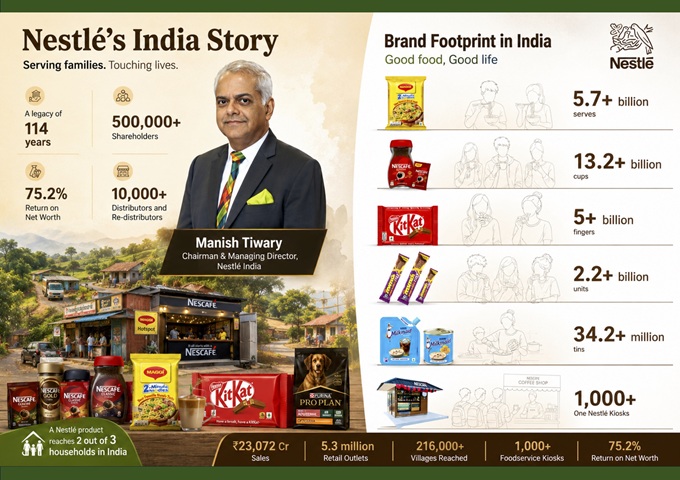
Nestlé India reported sales of Rs.23,071.5 crore during FY 2025-26 while delivering double-digit volume-led growth and market-share gains across categories. Chairman & Managing Director Manish Tiwary described the year as one focused on “fundamentals” and “disciplined execution.” Yet beneath those words lies a far more significant transformation.

The Real Growth Story Is No Longer Urban India

One of the clearest messages emerging from the report is that Nestlé’s future growth engine is increasingly rural.

The company now reaches approximately 216,000 villages and claims the highest reach among industry peers, supported by a rural strategy built around infrastructure, technology, visibility, communication and localised product portfolios.
A decade ago, Nestlé was heavily urban-focused. The company began its “RUrban” journey in 2019 and expanded further into rural markets in 2025. Manish Tiwary acknowledges the complexity of the opportunity:

“Rural India remains one of our most significant growth opportunities, given both the pace of demand expansion and the headroom we still have to deepen our presence.”

What makes this important for India’s food industry is that many FMCG companies still approach rural India as a distribution challenge.

Nestlé increasingly views it as a consumption-design challenge.

The company is adapting assortment, pack sizes, pricing architecture and route-to-market models region by region, recognising that consumption patterns in rural Bihar may differ substantially from those in rural Karnataka. This hyper-local approach is likely to become the next competitive battleground across food and beverage categories.

From FMCG to Foodservice: Nestlé’s Quiet QSR Expansion

Perhaps the least discussed but most consequential development is Nestlé Professional’s expansion.

Nestlé now operates more than 1,000 Retail ONE formats across India, including NESCAFÉ Corners, MAGGI Hotspots and KITKAT Break Zones. These are located across educational institutions, healthcare facilities, airports and other high-footfall environments.

This effectively places Nestlé among India’s largest organised foodservice networks.

Tiwary highlights the strategic rationale:

“As people spend more time outside the home, the need for convenient, high-quality food and beverage choices continues to grow.”

The move mirrors global trends where food manufacturers increasingly participate directly in consumption occasions rather than merely supplying products to retailers.

For India’s food industry, the implication is profound.

The future battle may not simply be fought on supermarket shelves. It may increasingly be fought in airports, colleges, hospitals, offices and transit hubs where brands can control the entire consumption experience.

Coffee Is Becoming India’s Most Important Beverage Story

While tea remains India’s dominant beverage, Nestlé’s report suggests coffee may be entering a new phase of mainstream growth.

The Powdered and Liquid Beverages business delivered another year of high double-digit growth, driven by penetration expansion and category development. NESCAFÉ achieved its highest-ever household penetration in India, while premium formats, ready-to-drink products and specialty coffee offerings gained momentum.

According to Sunayan Mitra, Head – Coffee and Beverages:

“NESCAFÉ is shaping the future of coffee in India by expanding access, elevating experiences and redefining how consumers connect with coffee.”

Three separate trends are converging:

Coffee TrendNestlé Response
Mass adoptionNESCAFÉ Classic, Sunrise, affordable packs
PremiumisationNESCAFÉ Gold, Roastery, Nespresso
Youth-led cold coffeeReady-to-drink portfolio, Vietnamese Latte, Iced Cappuccino

The launch of new ready-to-drink variants such as Vietnamese Latte and Iced Cappuccino indicates that Nestlé sees cold coffee as one of India’s most promising beverage opportunities.

In many ways, coffee today resembles where cafés were fifteen years ago—still relatively underpenetrated but growing rapidly among younger consumers

Omnichannel Is Replacing Traditional Channel Thinking

Another major shift visible in the report is Nestlé’s evolving omnichannel strategy.

Rather than viewing quick commerce as a threat to traditional retail, the company is orchestrating channels according to usage occasions.

The report explicitly notes that quick commerce is becoming increasingly relevant for top-up, impulse and convenience-led purchases, while general trade continues to anchor growth across semi-urban and rural India.

This is an important acknowledgement from one of India’s largest food companies.

The future retail landscape is unlikely to be a winner-takes-all contest between kiranas, modern trade, e-commerce and quick commerce. Instead, each channel will own specific consumption missions.

For food brands, success will increasingly depend on matching products to occasions rather than channels.

Petcare Could Become Nestlé’s Next Billion-Rupee Category

One of the strongest signals in the annual report concerns pet nutrition.

For years, pet food remained a niche category in India. Nestlé now appears convinced that the category is approaching a structural inflection point.

Through Purina PetCare, the company is investing in science-based nutrition, distribution expansion and category development.

Tiwary recounts a conversation with a young pet-owning couple in Bengaluru who questioned whether feeding pets household food was sufficient nutrition.

That anecdote reflects a broader shift taking place across urban India: pets are increasingly treated as family members, creating demand for premium nutrition solutions.

As incomes rise and pet ownership increases, petcare could emerge as one of the fastest-growing food-adjacent opportunities in India over the next decade.

Technology Is Becoming a Distribution Weapon

Technology occupies a surprisingly central position in Nestlé’s growth strategy.

The company has expanded NesMitra, its retailer self-ordering platform, and deployed India’s first RD DMS (Re-distributor Distributor Management Solution) to automate rural distribution networks.

According to Sushrut Nallulwar, Head – Sales:

“We have significantly accelerated reach expansion, especially in rural markets, by scaling up distribution touchpoints through technology-led interventions.”

The importance of this extends beyond Nestlé.

In India’s next consumption cycle, competitive advantage may increasingly come not from manufacturing scale alone but from digital visibility into millions of retail transactions occurring across villages, towns and neighbourhood stores.

The Final Take

Nestlé India remains India’s largest MAGGI company.

But that description is rapidly becoming inadequate.

The FY2025-26 annual report reveals a business building four future growth engines simultaneously—rural consumption, out-of-home foodservice, coffee culture and omnichannel commerce.

The company already reaches two out of every three Indian households, serves more than 5.7 billion MAGGI servings annually, sells 13.2 billion cups of coffee and operates more than 1,000 foodservice kiosks across the country.

Those numbers suggest Nestlé is no longer merely responding to India’s food transformation.

It is actively shaping it.

And if the company’s current strategy succeeds, the next decade of growth may come not from selling more products to the same consumers, but from creating entirely new consumption occasions wherever Indians choose to eat, drink, travel, work and socialise.

spot_img
📝 Discover India Food Forum