


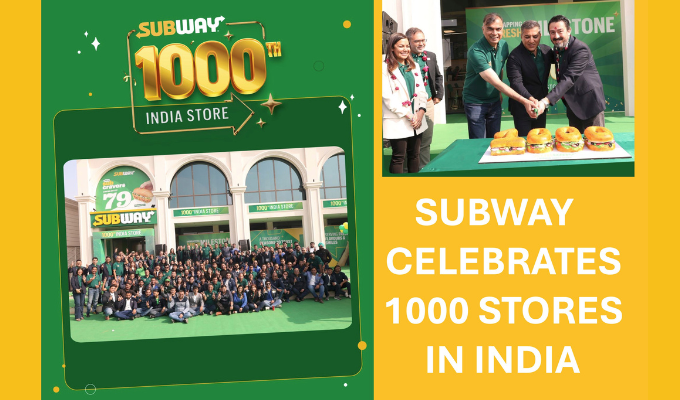

Subway, the global quick-service restaurant brand known for freshly made-to-order, customisable sandwiches, has reached a defining milestone in its India journey with the opening of its 1,000th store at Paras Florett in Gurugram. More than a symbolic number, the milestone signals the brand’s accelerating momentum in one of the world’s fastest-growing foodservice markets—and highlights India’s rising importance in Subway’s global growth narrative.
The road to 1,000 stores has been shaped by rapid, sustained expansion over the past few years. Operated in India by EverBrands, part of the Everstone Group, Subway has maintained an aggressive rollout pace—opening roughly two new restaurants every week over the last three years. This expansion has taken the brand into 165+ cities and built an ecosystem that today supports over 3,500 employees across its network.
A Partnership That Reset the Growth Curve
Subway’s current growth phase can be traced back to its strategic partnership with Everstone Group in 2021. At the time, the ambition was clear: to significantly scale the brand across India and neighbouring markets over the long term, building on a base of roughly 700 stores.
Since then, Subway India has not only delivered on that ambition but moved faster than originally anticipated. The brand’s rollout has extended well beyond top metros, with a clear push into tier-2 and tier-3 cities, supported by a robust pipeline that continues to prioritise new store openings across diverse urban formats.
Access Over Destination
What distinguishes Subway’s India expansion is not just speed, but where and how it is choosing to grow.
Instead of concentrating disproportionately on malls and destination-led formats, Subway has leaned into street-facing neighbourhood stores, local commercial clusters, and mixed-use developments—locations designed to make the brand part of everyday eating habits. These formats cater to repeat consumption occasions such as workday lunches, quick dinners, and convenience-driven snacking.
High streets and dense urban corridors serve as brand anchors, delivering visibility and walk-in traffic, while neighbourhood stores provide consistency, familiarity, and predictable footfall. This approach has helped Subway integrate into daily consumer routines rather than rely solely on episodic dining occasions.
Capturing Mobility and Captive Demand
Alongside neighbourhood expansion, Subway has maintained a selective presence in travel and transit-linked environments, including airports and high-footfall mobility zones. These outlets are optimised for speed and throughput, capturing on-the-go consumption without compromising operational discipline.
Institutional locations—such as office campuses, business parks, and educational hubs—form another important pillar of the network. These stores benefit from captive audiences and clearly defined demand windows, aligning well with Subway’s made-to-order yet quick-service positioning.
Localisation as a Growth Enabler
As the footprint widens, localisation has played a central role in sustaining momentum. Subway has adapted menu offerings, pricing structures, and store designs to suit regional preferences and consumption patterns, while retaining its core global identity built around freshness, transparency, and customisation.
This balance between global brand consistency and local relevance has helped Subway stay competitive across varied Indian markets—particularly as consumer expectations around choice, value, and convenience continue to evolve.
Why India Matters More Than Ever
India has emerged as a pivotal market in Subway’s global strategy. At a time when the brand’s footprint in some mature markets, including the U.S., has contracted, international expansion—led by India—has become a key driver of global growth.
The sustained pace of store openings, coupled with strong franchise interest, points to healthy top-line momentum and growing confidence among investors and operators. This is further reinforced by the broader outlook for India’s QSR sector, which continues to benefit from urbanisation, a young consumer base, rising disposable incomes, and increasing preference for convenient, perceived-better-for-you food options.
Looking Ahead
Subway’s leadership has signalled a long-term commitment to India, with plans to nearly double its footprint over the next five to six years. The focus will remain on expanding into emerging urban centres, strengthening neighbourhood accessibility, and deepening relevance across consumption occasions.
The opening of the 1,000th store at Paras Florett is therefore less a culmination and more a marker of transition—underscoring Subway’s strategic pivot toward high-growth emerging markets and an India playbook that blends global sandwich heritage with local tastes, formats, and habits.
In a market where scale often dominates the conversation, Subway’s India story stands out for pairing speed with strategy—building not just presence, but everyday relevance in one of the world’s most dynamic food economies