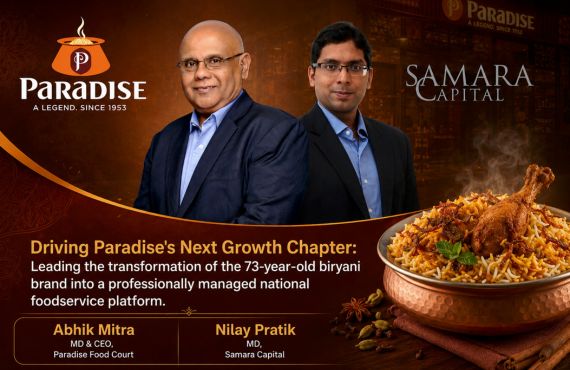

Backed by private equity, powered by technology and driven by disciplined expansion, the 73-year-old Hyderabad icon is aiming to build one of India’s largest organised regional restaurant chains.
Paradise Biryani’s announcement of 20 new outlets in Bengaluru is only the visible part of a much larger story. Behind it lies a decade-long transformation that has seen the 73-year-old Hyderabad brand evolve from a regional restaurant chain into a professionally managed, technology-enabled food service platform targeting national scale. Today, backed by Samara Capital, Paradise is no longer merely expanding its restaurant network. It is attempting something far more significant—transforming a heritage regional brand into a professionally managed, technology-enabled national food service platform.
The latest evidence of that ambition comes from Bengaluru, where Paradise has announced plans to invest Rs. 25 crore to open 20 new outlets. While the city expansion is significant in itself, it is also the first visible milestone of a much larger strategy to invest Rs. 100 crore, add 100 new outlets over the next three years and expand the network from 57 operational restaurants across six cities to around 150–160 outlets.
For India’s organised foodservice industry, the announcement signals something bigger than another restaurant rollout. It demonstrates how private equity is increasingly backing proven regional food brands that combine strong consumer equity with the ability to scale nationally through disciplined execution.
Reinventing a Seventy-Three-Year Legacy
Paradise’s transformation has unfolded over more than a decade.
Samara Capital first invested in the company in 2014, acquiring a 35% stake for Rs. 70 crore, when Paradise operated just six restaurants in Hyderabad. Rather than pursuing rapid expansion, the initial years focused on professionalising the business, strengthening leadership, modernising operations and creating systems capable of supporting long-term growth.
The journey entered a new phase in February 2022, when Samara acquired the remaining promoter stake, taking complete ownership of the business. Since then, the company has accelerated investments in technology, people, operating systems and expansion planning, positioning Paradise for its most aggressive growth phase yet.
“The successful store model, best-in-class technology systems and strengthened leadership team provide a strong foundation for national expansion,” says Nilay Pratik, Managing Director, Samara Capital. “Our focus extends beyond adding stores to building a business that delivers consistency, operational discipline and an authentic customer experience across geographies.”
That philosophy reflects a broader shift taking place across India’s restaurant industry, where investors are increasingly favouring scalable operating models over rapid, capital-intensive expansion.
Beyond Restaurants, Building a Scalable Platform
Paradise’s current strategy is built around three complementary formats – high street restaurants, shopping mall outlets and cloud kitchens.
Rather than viewing delivery as an extension of dine-in, the company is designing an omnichannel business where every format serves a distinct purpose. Compact restaurants improve capital efficiency, malls strengthen brand visibility and impulse consumption, while cloud kitchens extend delivery reach into dense urban neighbourhoods.
Bengaluru has emerged as the ideal testing ground for this model. The company reports 30% year-on-year revenue growth in the city, with its latest mall outlets outperforming internal benchmarks and encouraging a wider rollout across organised retail destinations.
For Managing Director & CEO Abhik Mitra, however, expansion is only one part of the equation.
“The challenge isn’t opening more restaurants; it’s ensuring that customers receive the same Paradise experience every single time,” he has said in earlier media interactions.
That objective explains why Paradise continues to retain a company-owned, company-operated model rather than pursuing large-scale franchising.
Technology as the Secret Ingredient
As Paradise expands nationally, technology is becoming as important as its famous biryani recipe.
Automated kitchen systems, centrally managed recipes, digital operating dashboards and real-time quality monitoring have become integral to maintaining consistency across the network. Every outlet follows identical standard operating procedures, supported by structured staff training and continuous quality audits.
This investment in operational discipline is designed to ensure that the biryani served in Bengaluru, Chennai or Gurugram delivers the same experience that made Paradise a Hyderabad institution.

The Road Ahead
Paradise’s financial ambitions are equally ambitious. Management has outlined a roadmap to grow annual revenues from the current Rs. 260–300 crore to Rs. 500–550 crore by FY29, supported by a network of 150–160 outlets.
To fund this next chapter, the company is planning to raise Rs.100 crore through a 10–12% equity dilution, with the proceeds earmarked primarily for new store development rather than operational funding.
The strategy reflects confidence not only in the Paradise brand but also in the broader evolution of India’s organised foodservice market. Consumers are increasingly gravitating towards trusted regional brands that offer consistent quality, strong delivery capabilities and modern retail experiences.
For Paradise, the expansion into Bengaluru is therefore, not the destination. It is the opening chapter of a larger journey—one that seeks to demonstrate that an iconic regional restaurant chain can successfully scale into a national food brand without losing the authenticity that made it famous.