

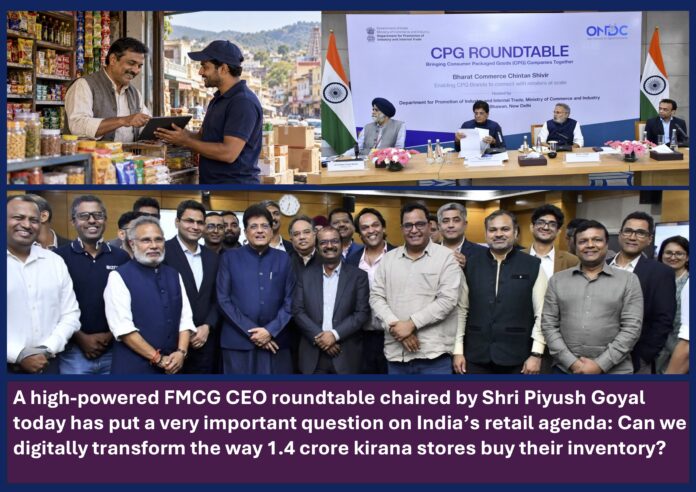

A high-powered FMCG CEO roundtable chaired by Shri Piyush Goyal puts the spotlight on digitising General Trade—with packaged food and grocery potentially among the biggest beneficiaries.
India’s next big digital-commerce opportunity may not be another consumer-facing marketplace. It could be sitting behind the shelves of the country’s 1.4-crore neighbourhood stores, in the way they order packaged food, grocery and everyday FMCG products. That is the significance of ONDC DigiDukaan, the B2B procurement initiative being positioned by the Department for Promotion of Industry and Internal Trade (DPIIT) and the Open Network for Digital Commerce (ONDC) as common digital infrastructure for India’s General Trade ecosystem.
The significance of the initiative received a fresh push today, when Shri Piyush Goyal chaired a high-powered FMCG CEO roundtable at Vanijya Bhawan, New Delhi, convened by DPIIT and ONDC under the Bharat Commerce Chintan Shivir. More than 40 leaders from leading FMCG companies participated in discussions around an industry-wide roadmap for strengthening and digitising General Trade through DigiDukaan. For the packaged-food industry, the conversation is particularly relevant because the neighbourhood kirana remains one of the most important routes to market for packaged foods, beverages, staples, snacks, confectionery, personal and home care and a vast universe of regional and emerging brands.
The Food Shelf Begins With the Purchase Order
The digital transformation of retail has largely been discussed from the consumer side—online discovery, digital payments, quick commerce, delivery and increasingly sophisticated marketplaces. But for packaged-food companies, an equally consequential digital opportunity sits on the other side of the transaction: how millions of small retailers purchase the products that eventually land on their shelves.
The traditional General Trade system is remarkably extensive but highly fragmented. A kirana may deal with multiple distributors, sales representatives and wholesalers, place orders through different mechanisms, maintain inventory manually and make purchase decisions based on a combination of memory, experience, distributor visits and immediate requirements. For a packaged-food brand, this creates a very different challenge from simply having demand in the market. The product has to be available at the right store, at the right time, in the right pack and quantity, with replenishment happening before the shelf goes empty.
DigiDukaan approaches the problem from the procurement side. Instead of attempting to replace the existing distribution network, it seeks to create a common digital interface through which retailers can discover and procure products from multiple brands and distributors. Pricing, trade schemes and product availability can become more visible, while the underlying distributor relationship can remain intact.
For packaged-food companies, that distinction matters. The objective is not necessarily to create another direct-to-consumer channel. It is to make the existing brand–distributor–retailer supply chain more visible, connected and potentially more efficient.
Why Packaged Food Could Be a Major Beneficiary
Packaged food is uniquely dependent on distribution depth. A consumer may want a particular biscuit, snack, beverage, spice, edible oil, packaged staple or ready-to-eat product, but the sale can happen only if the product is physically available in the neighbourhood store when the purchase decision is made. Availability, therefore, is as important as brand awareness.
This is where a digital procurement layer could have a disproportionate impact. A retailer able to view products across participating brands through a single interface has a potentially wider assortment available to order. A distributor receives a more structured digital order. A brand potentially gets better visibility into where and how its products are moving through the distribution network. And the retailer can potentially replenish more frequently rather than waiting for the next sales visit.
The implications become even more interesting for regional packaged-food brands and emerging FMCG companies. Large national brands have traditionally had the scale to build extensive distributor and sales networks. Smaller brands often face a different equation: they may have strong consumer acceptance in a particular geography but limited ability to build a dense physical sales force across thousands of stores.
An open digital procurement infrastructure could lower some of those barriers. If product catalogues, retailer discovery, ordering and distributor connectivity become more standardised, a brand does not necessarily need to build an entirely new commercial architecture every time it wants to enter another market. The digital network could potentially make distribution more discoverable and more scalable.
21,000 Retailers and 450 Brands: The Early Signal
The initiative is still at an early stage, but the initial numbers suggest that retailers are willing to experiment with digital procurement when the proposition solves a real business problem. As of September 2026, DigiDukaan had connected more than 21,000 retailers and 450 brands across Hyderabad, Jaipur and Mumbai, up from more than 12,000 retailers in the previous quarter.
Hyderabad is currently the strongest signal, with more than 16,000 retailers connected. Monthly repeat ordering has reportedly reached 73–78%, an important metric because onboarding alone does not create a digital ecosystem. Repeat procurement indicates whether the platform is becoming part of the retailer’s actual operating routine.
There is another early signal that should interest packaged-food companies. An initial ONDC retailer study found that 40% of surveyed retailers reported lower inventory holdings for products procured through DigiDukaan. While this is an early finding and not yet a measure of industry-wide impact, it points towards one of the most important potential benefits of digital procurement: better inventory discipline.
For food and grocery retailers, inventory is working capital. Holding too much stock ties up cash; holding too little risks lost sales. For packaged foods, where assortment can be wide, and demand can vary by locality, season and pack size, improving replenishment can have a direct commercial impact.
From Distribution Reach to Distribution Intelligence
The bigger opportunity for packaged-food companies may ultimately be the data generated around procurement.
General Trade has always generated enormous commercial intelligence, but much of it has historically remained distributed across sales teams, distributors, DMS platforms, invoices and individual relationships. A common digital layer could potentially bring more of this activity into a connected ecosystem.
That does not mean that every brand will immediately obtain granular consumer-level intelligence. The more immediate opportunity is procurement intelligence: what retailers are ordering, how frequently they reorder, which products are available, where demand is emerging and where replenishment is weak.
For a packaged-food business, that can influence everything from distributor planning and sales-force productivity to assortment decisions and inventory management.
A brand that sees an increase in demand for a particular product across a cluster of neighbourhood stores can potentially respond faster. A distributor can potentially plan inventory around actual digital orders rather than relying entirely on periodic sales estimates. A retailer can potentially compare available products and schemes more transparently.
In a category where the difference between a sale and a missed sale can simply be whether the product is on the shelf, that visibility can become commercially valuable.
The Distributor Is Still Central to the Food Ecosystem
One of the most important aspects of the DigiDukaan proposition is that it does not seek to eliminate the distributor.
That is particularly important in food and grocery. India’s packaged-food distribution system has evolved over decades, with distributors performing functions that go far beyond taking orders. They manage inventory, credit, local relationships, delivery routes, assortment and the physical movement of products into thousands of stores.
ONDC proposes to digitise the retailer as a buyer while strengthening the existing distribution network. The retailer gets a common digital interface; brands and distributors get a more structured ordering mechanism; and the broader ecosystem can potentially build shared services around logistics, warehousing and financial services.
ONDC MD & CEO Vibhor Jain has highlighted this distinction, noting that distributors are already substantially digitised in areas such as billing, printing and order placement, while many mom-and-pop retailers continue to depend on pen, paper and memory. DigiDukaan therefore starts at a critical missing link—the retailer as a digital buyer.
For food companies, this could mean that digital transformation does not require rebuilding the distribution architecture. It can instead be layered onto the infrastructure that already exists.
A Single Digital Shelf for Multiple Food Brands
One of the most interesting possibilities is the creation of a common digital catalogue across brands and distributors.
Imagine a neighbourhood retailer who needs to replenish several categories before the weekend: packaged snacks, biscuits, beverages, staples, confectionery, packaged dairy products and household essentials. Today, these requirements may involve different sales representatives, distributors and ordering processes. A common interface could potentially allow the retailer to view a wider range of products and place orders through a single digital environment.
For packaged-food manufacturers, the benefit could be greater reach without necessarily requiring every brand to create a separate retailer-facing ordering application.
This could become particularly significant as India’s food market becomes more fragmented at the brand level. Large FMCG companies continue to dominate many categories, but regional brands, specialist food companies, challenger brands and digitally native food businesses are increasingly looking for physical distribution.
The traditional challenge has been simple: how do you get thousands of retailers to know that your product exists, and how do you make it easy for them to reorder it?
An interoperable procurement network could potentially address both sides of that equation.
The Commercial Challenge: Will the Ecosystem Incentivise Adoption?
Technology, however, may not be the biggest challenge.
For DigiDukaan to become a meaningful part of General Trade, the economics have to work for everyone involved. A retailer needs a clear reason to change behaviour. A distributor needs to see commercial value rather than additional complexity. A brand’s sales team needs to support digital ordering rather than regard it as competition to established processes.
This is why the discussions around commercial incentives for sales teams, distributors and channel partners are important. Digital ordering, wider product discovery and greater market coverage have to become economically attractive to the people who currently make General Trade work.
The roundtable chaired by Piyush Goyal therefore goes beyond a technology conversation. The objective is to build institutional commitment among FMCG companies, distributors and ecosystem participants around common digital infrastructure, shared services and commercially sustainable models.
For packaged food, this could be the difference between a platform that merely exists and one that actually becomes embedded in the distribution system.
From Hyderabad to the Next 10,000 Food Markets
The next phase will be about geographical scale.
Hyderabad, Jaipur and Mumbai provide three very different market environments. The larger question is whether the model can work across the thousands of urban, semi-urban and smaller-town food markets that make up India’s consumption geography.
The opportunity is particularly compelling in Tier-2 and Tier-3 cities, where regional food preferences, local brands and fragmented distribution often coexist. Cities such as Indore, Lucknow, Coimbatore, Rajkot, Guwahati, Patna, Nagpur, Kanpur, Ranchi, Vijayawada and Kochi represent very different food cultures and distribution structures.
If an open network can accommodate that diversity without forcing every market into a single commercial model, its relevance to Food & Grocery could be substantial.
The ultimate ambition is therefore not simply to put more kirana stores online. It is to make General Trade itself more digitally connected.
Credit Could Be the Next Unlock
There is another potential consequence that could be particularly relevant for small food retailers: formal credit.
Once procurement becomes digitally visible, the transaction history of a retailer could potentially become useful to financial institutions. A consistent record of purchases, frequency, value and replenishment could eventually help create a more formal basis for working-capital products.
That possibility is still part of the longer-term roadmap rather than an immediate outcome. But for millions of small retailers, access to working capital can be as important as access to technology.
For packaged-food distributors and manufacturers, better-connected retailers with better access to working capital could also mean healthier and more predictable purchasing patterns.
The idea is simple: digitise procurement first, create a transaction trail next, and potentially build financial services around that trail.
The Bigger Food & Grocery Opportunity
DigiDukaan’s early numbers are small when placed against the scale of India’s General Trade market. 21,000 retailers and 450 brands are only a fraction of the 1.4-crore-plus kirana universe. But scale is not the only metric to watch.
The more important question is whether digital procurement can change behaviour.
If retailers begin ordering more frequently, if inventory holdings become more efficient, if distributors get better visibility, if brands improve availability and if smaller food companies gain a more accessible route to market, the impact could extend well beyond the ordering transaction.
It could influence the economics of distribution itself.
For the packaged-food industry, that is the real story. India’s food market is not going to be built only through modern trade, e-commerce and quick commerce. The neighbourhood store will remain a critical consumption touchpoint for years to come. The next phase of food retail transformation may therefore depend not on moving the kirana out of the traditional ecosystem, but on digitising the ecosystem around it.
And that makes today’s high-powered FMCG CEO roundtable more than another discussion about retail technology. It is potentially the beginning of a much larger conversation about how India’s packaged-food and grocery industry can make its last mile more connected, more visible and more commercially efficient.
DigiDukaan: The Food & Grocery Numbers to Watch
| Metric | Current position |
| India’s kirana / neighbourhood retail universe | 1.4 crore+ |
| DigiDukaan retailers | 21,000+ |
| Brands connected | 450+ |
| Current markets | Hyderabad, Jaipur, Mumbai |
| Hyderabad retailers | 16,000+ |
| Hyderabad monthly repeat ordering | 73–78% |
| Retailers reporting lower inventory holdings in initial study | 40% |
| ONDC cumulative transactions | 500 million+ |
| FMCG leaders at today’s roundtable | 40+ |
The Food Companies Already in the Ecosystem
The ecosystem already includes participation at different stages from major FMCG and food companies including Hindustan Unilever, Marico, Colgate-Palmolive, Emami, Amul, ITC, Tata Consumer Products and Britannia, alongside technology, network, payments, logistics and warehousing players.
The next challenge is scale: getting more brands and distributors to participate, giving retailers compelling commercial reasons to order digitally, and extending the model into more markets. For India’s packaged-food industry, the prize is potentially significant—not another consumer marketplace, but a common digital procurement layer underneath the country’s largest food and grocery distribution network.