


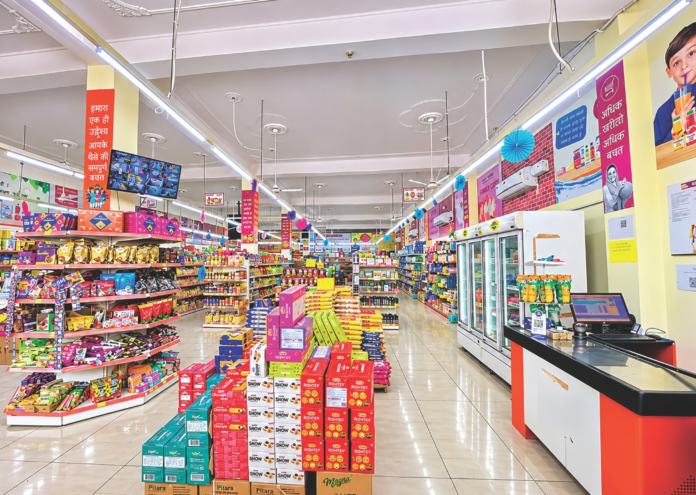

From a rural retail experiment to a focused food & grocery business, Aadhaar is building a value-led supermarket network across semi-rural and semi-urban catchments, particularly Tier 2, 3 and 4 cities — with 400 COCO stores planned by March 2030.
India’s organised food and grocery story is no longer only a metro story. While large national retailers, quick-commerce platforms and digital marketplaces continue to fight for urban consumers, another opportunity is steadily taking shape in smaller cities and towns. Consumers here are upgrading their shopping habits, looking for better assortment and value, and increasingly willing to move from fragmented shopping to organised retail when it is available close to home.
Aadhaar Supermarket has built its business around this opportunity. Its focus is on semi-rural and semi-urban catchments, particularly Tier 2, 3 and 4 cities, where it sees tremendous untapped potential for organised food and grocery retail.
Today, Aadhaar has 110 COCO (Company-Owned, Company-Operated) stores across six states. But the number that defines the company’s current ambition is 400. The network is planned to rise from 94 stores in March 2026 to 110 as of 31 October 2026, 129 by March 2027, 205 by March 2028, 283 by March 2029 and 400 by March 2030.
The Expensive Years Taught the Simple Lesson
Aadhaar’s current confidence has been built on a journey that began with a very different idea. Incorporated in 2005, the business was originally conceived as a rural retail route to establish agricultural products such as seeds, pesticides and agricultural equipment closer to rural consumers and farmers. The opportunity looked attractive, but the company soon discovered that knowing rural markets and agricultural products was not the same as knowing retail.
Retail demanded different capabilities — store operations, assortment, merchandising, customer understanding, supply chain management and disciplined execution. In 2008, Future Group entered through a joint venture and took on store operations, but the business continued to struggle and incurred losses.
The first major strategic reset came in 2011, when Aadhaar returned to the Rural Aadhaar Supermarket proposition, exited Agri, Apparels and CDs and concentrated on the supermarket business. By 2013, after removing the non-core categories, the company reached break-even.
But there was another detour. In 2014, Aadhaar experimented with a PDS-linked initiative in Rajasthan involving approximately 5,000 Annapoorna shops, along with a few Cash & Carry stores. These initiatives again moved the organisation away from the supermarket proposition it understood best and resulted in heavy losses.
The lesson was eventually clear: innovation was not the problem; dilution of the core business was.
In 2021, management made what it describes as the second and defining reset: ‘No More Experiments. Only Aadhaar Supermarket.’ Capital, management attention and operating energy were redirected towards one model. Since 2023, the company says it has remained profitable not only at EBITDA level but also after covering all costs, creating the platform it now believes is strong enough for disciplined, sustainable expansion.
The 400-store ambition therefore has a different meaning. Aadhaar is not trying to create a new retail format every few years. It is attempting to replicate one model it believes has finally been proven.
One Format. Many Local Tastes
Satish Sharma, CEO, Aadhaar Retailing Ltd., is clear about one important distinction: Aadhaar does not intend to create a radically different business in every state. The core supermarket model remains common, while assortment, pricing and execution adapt to local consumer preferences.
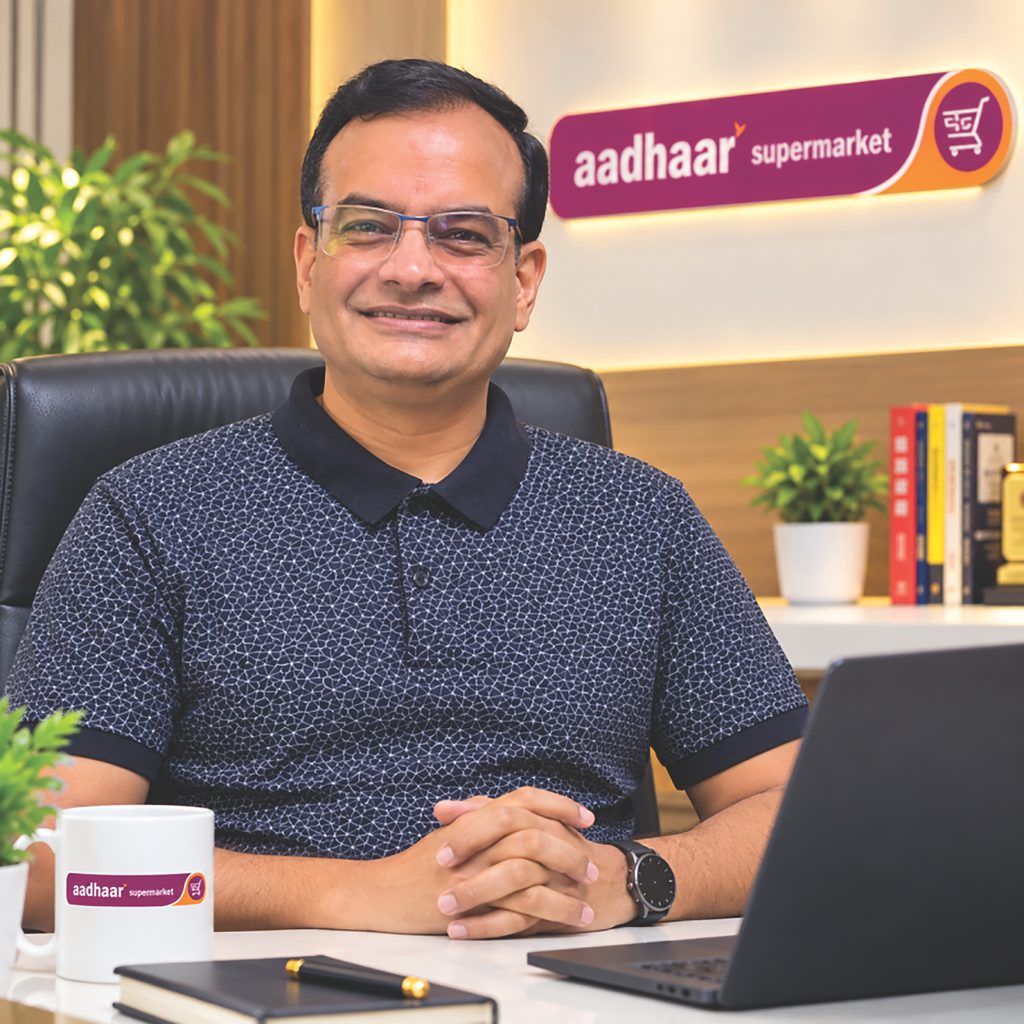
Punjab is currently Aadhaar’s number-one and most mature market, followed by Gujarat, Haryana and Rajasthan. Uttar Pradesh is emerging, while Karnataka is still at an early stage. In these newer territories, the immediate priority is to understand the opportunity, identify the right catchments and properties, and execute the proven model with discipline.
The store is designed around three simple ideas — Close to Home, Everyday Value and Local Landmark. Aadhaar wants to offer an organised supermarket within the customer’s own city or catchment, with a relevant everyday basket at competitive prices, while becoming a familiar and trusted part of local life.
For food and grocery, convenience in a smaller city does not necessarily mean a 10-minute delivery promise. It can mean having a reliable, well-stocked supermarket nearby where the customer can buy everyday essentials, compare products, discover new categories and still feel that the basket represents good value.
When the Small-Town Basket Becomes More Aspirational
Dry Fruits have grown by almost 300% at Aadhaar over the last three years, reflecting changing consumption aspirations in Tier 2, 3 and 4 markets. The growth points to a change in aspiration. The smaller-town consumer remains value conscious, but that does not mean the basket is restricted to necessities. As incomes, exposure and aspirations rise, consumers are also seeking products that were once considered discretionary or premium.
Dry Fruits therefore offer Aadhaar an interesting bridge between everyday grocery and consumption upgrade, while Staples remain its foundation.
National Trust, Regional Relevance
The brand architecture adds another layer to Aadhaar’s localisation strategy. Approximately 73% of the business comes from national brands and 27% from regional brands. The strategy is to combine the trust and familiarity of national brands with the affordability, relevance and local connect of regional brands.
Aadhaar has strong relationships with leading FMCG and food companies including HUL, ITC, Nestlé, Tata Consumer, Dabur, Britannia, PepsiCo, Coca-Cola, Mondelez, Marico and P&G. These brands are particularly strong across packaged food, beverages, personal care, home care and grocery categories.
At the same time, regional brands are not treated as fillers around the national-brand portfolio. They are an important part of the assortment, particularly in food, tea, snacks and staples, where familiarity with taste, quality and price can be a strong consumer advantage.
The assortment itself is customised according to regional consumption patterns. Punjab, Gujarat, Rajasthan, Haryana, Karnataka and Uttar Pradesh have different food habits and preferences. Aadhaar uses store-level sales data, SKU movement, category performance, customer feedback and local market understanding to determine what should be stocked in each catchment.
Regional snacks and namkeen, traditional food products, tea and locally preferred staples can vary significantly from one state to another. The philosophy is straightforward: stock what customers want to buy rather than force a uniform assortment across markets.
That philosophy also informs brand and vendor onboarding. Brands and vendors are evaluated on consumer demand, quality, competitive pricing, margins, brand acceptance, local relevance and supply capability.
When Suppliers Become Partners
Aadhaar’s relationship with vendors goes beyond a conventional supplier-retailer transaction. The company considers vendors business partners and works jointly with them on promotions, new product launches, category development, visibility and availability.
Aadhaar’s partnership with regional brands such as Sanjivani Tea shows how organised retail can create a bridge between regional producers and India’s growing supermarket shopper. The most visible example is Sanjivani Tea, which entered Modern Trade for the first time through Aadhaar and subsequently grew significantly to become a leading player in its segment.
The same partnership approach is visible in Aadhaar’s work with ProV. Over more than a year, the two have worked together not just on product placement but on building the Dry Fruits category — through a wider assortment, consumer education, sampling, new launches, merchandising and store-level manpower. The partnership has helped ProV report 80% YoY revenue growth through Aadhaar.
A third example is GivMi, where Aadhaar helped open the door for a new noodles brand to enter organised retail and let consumers experience the product first-hand. The challenge was to persuade shoppers to switch from familiar brands in a category where taste is the primary purchase driver. Aadhaar’s role went beyond putting the product on the shelf: taste trials with freshly prepared bowls helped remove the risk of trial and allowed the product to prove itself directly to consumers.
Together, these partnerships show three different ways Aadhaar can create value for its vendors — giving regional brands access to Modern Trade, building emerging categories and helping new products win consumer trial.
Aadhaar’s philosophy is simple: “When our partners grow, Aadhaar grows with them.”
The company is also looking beyond external brands. Own Brand Label is emerging as an important growth opportunity, particularly in Staples such as pulses, spices and Dry Fruits, along with other high-volume grocery categories. Existing initiatives include GH and Karmiq, with the objective of providing quality products at competitive prices while improving customer value and strengthening margins.
Desi Marketing, Done Seriously
Aadhaar’s localisation does not stop at merchandise. Its marketing is equally local. The company describes its approach as “Desi and locally connected.”
Digital media can provide reach, but in local retail, familiarity and physical visibility can be equally powerful. A roadshow in the local market, a local-language message or an activation that becomes part of the town’s daily activity can sometimes do more for a neighbourhood supermarket than a nationally designed campaign. That is central to Aadhaar’s ambition of becoming a local landmark rather than merely another grocery outlet.
The Store Has to Earn its Space
The economics of the model are at the heart of Aadhaar’s expansion strategy. The current indicative store model is built around approximately 2,000 sq ft, sales productivity of around Rs 1,450 per sq ft and average sales of approximately Rs 29 lakh per store, with an estimated gross margin of around 14%.
The indicative store cost structure is approximately 3.5% staff, 2% rent, 0.5% power and 2% other store costs, taking total store operating costs to around 8% of sales and leaving an indicative balance of around 6% before central and other costs.
When the Right Store Meets the Right Catchment
Kapurthala is the standout. At approximately Rs 100 lakh a month, it generates around Rs 5,000 per sq. ft., operates at approximately 15% margin and carries costs of around 6%. Ajnala and Doraha reinforce the potential, with monthly sales of approximately Rs 80 lakh and Rs 75 lakh respectively, and around 15% margins.
These stores also explain why property selection will become increasingly important. Aadhaar is not simply searching for more locations; it is searching for locations where catchment, property, assortment and execution come together.
Punjab Proved it. UP and Karnataka will Test it
The existing network provides encouraging evidence. Aadhaar has 98 stores, of which 89 are growing at around 11% YoY. The remaining nine stores are declining by approximately 3%. The growth story is therefore not dependent entirely on opening new outlets; the established network is contributing as well.
Punjab has provided the strongest evidence so far. It is the most mature market and houses Aadhaar’s strongest-performing stores. Gujarat, Haryana and Rajasthan are established markets with their own consumer preferences. The next test will come from Uttar Pradesh and Karnataka, where the company is still building its understanding of local demand and catchments.
Uttar Pradesh is expected to move from one store as of 31 October 2026 to five by March 2027, 30 in FY28, 60 in FY29 and 110 by March 2030. Karnataka is planned to move from five stores to seven by March 2027, 33 in FY28, 53 in FY29 and 75 by FY30.
The numbers show the strategic shift clearly. Punjab will remain the largest individual market, but the growth engine increasingly moves south and east. Uttar Pradesh alone is planned to reach 110 stores by March 2030, while Karnataka is targeted at 75. The immediate focus in UP and Karnataka is to understand the opportunity, identify the right retail properties and catchments, and execute the existing Aadhaar model with discipline. The company sees enormous potential in both states, but recognises that opportunity alone does not guarantee a successful supermarket. The location has to work.
Technology Behind the Shelves
The physical supermarket remains at the centre of the business, but technology is increasingly becoming the operating backbone. Aadhaar has implemented SAP HANA Retail across Aadhaar and Galaxy, with technology supporting POS through AURA, inventory management, procurement, sales reporting, financial control and store operations.
The focus is practical: improve stock availability, strengthen replenishment, increase inventory productivity, improve fill ratios and make decisions using data. This becomes particularly important as the network expands across states with different consumption patterns. Store-level sales, SKU movement and category performance provide inputs into assortment decisions, replenishment and vendor management.
Physical First, Digital Next
Aadhaar’s core business today remains physical retail. Home delivery and digital commerce are not yet at the centre of its model, but the company recognises the growing importance of digital engagement, WhatsApp ordering and home delivery and plans to explore these opportunities progressively, keeping local customer behaviour and commercial viability in mind.
Customer loyalty is similarly evolving. Aadhaar currently understands customer behaviour through store-level sales, SKU movement, category performance and customer feedback. As technology capabilities develop, it intends to strengthen engagement and build more structured loyalty initiatives.
The underlying philosophy is simple: loyalty is built through trust, everyday value, product availability and convenience.
Customer service follows the same four basics — the right product, the right price, availability and a clean shopping environment. Store teams are encouraged to understand customer requirements and resolve complaints and suggestions promptly.
Value Every Day, Occasions When They Matter Next
Aadhaar’s pricing strategy combines Everyday Low Pricing on essential products with competitive pricing and category-specific promotions. The objective is not to train customers to wait for a discount, but to make Aadhaar a destination for everyday value. At the same time, promotions have a role to play around festivals and regional occasions. Campaigns are planned around Diwali, Holi, Baisakhi, Navratri and other local celebrations, allowing the retailer to connect its commercial calendar with the consumption calendar of each market.
That balance — everyday value supported by relevant promotional occasions — is particularly important in markets where consumers remain price conscious but are also becoming more aspirational.
One State. One Distribution Centre. Local Where it Matters
Supply-chain discipline becomes increasingly important when a retailer moves from a regional network to a 400-store ambition. Aadhaar follows a combination of centralised procurement and local sourcing, built around a ‘One State, One DC (Distribution Centre)’ approach.
Central procurement provides scale and stronger commercial negotiations, while local sourcing enables the company to respond to regional preferences and improve product availability. Technology, inventory monitoring and vendor partnerships form the other pillars of replenishment.
The 73:27 national-to-regional brand mix is operationally meaningful here: the national portfolio provides scale and established demand, while local and regional sourcing helps the store remain relevant to the customer standing in a particular aisle.
The Numbers Behind the Growth
The financial trajectory also shows why management believes the model can now be scaled with greater confidence. The 18% YoY growth in the COCO business, combined with the performance of the same-store base, gives the company an additional source of confidence. Of the 98 same stores, 89 are growing at around 11% YoY, while nine are declining by approximately 3%.
The combination is important. Aadhaar is not relying solely on network expansion to create growth. It is trying to make the existing store base productive while adding new stores in carefully selected catchments.
The company describes the journey as moving “from retail experiment to rural retail landmark.” The challenge now is to preserve what has made the model work while multiplying it across a much larger footprint: relevant assortment, protected gross margins, controlled store costs, productive properties, strong availability and consistent customer experience.
Its operating philosophy can be distilled into five principles: One Core Model, Right Markets, Relevant Assortment, Store Discipline and Profitable Expansion.
Opening stores is relatively straightforward. Building stores that continue to perform year after year is considerably harder.
Bharat’s Next Grocery Chapter
Aadhaar’s journey points to a broader change underway in Indian food and grocery retail. For years, organised retail was largely associated with metros, large-format stores and national chains, while smaller cities and towns were viewed as fragmented markets dominated by kiranas and independent retailers. That landscape is changing. Consumers in smaller markets are becoming more exposed to organised retail, branded products and wider assortments. At the same time, retailers are learning that a carefully designed supermarket does not necessarily need a hypermarket-sized footprint to work.
Aadhaar’s bet is that the next opportunity lies in the semi-rural and semi-urban heartland, particularly Tier 2, Tier 3 and Tier 4 markets. Its model is based on getting the fundamentals right and adapting them to local markets — Staples as the foundation, relevant FMCG, increasingly aspirational categories such as Dry Fruits, national brands supported by regional brands, local marketing, strong vendor partnerships and a store that becomes part of the community.
Its own best stores offer a powerful demonstration. A 2,000 sq ft Kapurthala supermarket generating approximately Rs 1 crore a month is not simply a strong individual outlet. It shows what can happen when the format, catchment, assortment and execution come together.
From Experiment to Repeatability
The most important change at Aadhaar may therefore not be the number of stores. It is the organisation’s confidence in what it should not do. The company has already experienced the cost of moving away from its core capabilities — through multiple formats and categories, and through large experiments such as the Rajasthan PDS-linked initiative and Cash & Carry. The 2021 reset changed that approach. Since then, the focus has been on one business, one core model and disciplined execution.
Now the Ambition is to Make that Focus Repeatable.
The journey began in 2005 with a rural retail idea. It passed through partnerships, experimentation, losses, break-even and strategic resets before arriving at a clear supermarket-only proposition. Today, Aadhaar has 110 stores across six states, Rs 400 crore FY26 revenue, Rs 110 crore Q1 FY27 revenue and a company-reported annualised run-rate of approximately Rs 480 crore. The network is now being built towards 400 COCO stores by March 2030.
The bigger opportunity, however, is not simply to become a larger supermarket chain.
It is to demonstrate that organised food and grocery retail can build a scalable, profitable and locally relevant model for India beyond the metros — in the Tier 2, 3 and 4 markets where consumption aspirations are rising and organised retail still has enormous headroom.
If Aadhaar can carry the economics demonstrated by Kapurthala, the discipline of its mature Punjab network, the relevance of its 73:27 national-regional brand architecture, the strength of its vendor partnerships and the local understanding embedded in its assortment and marketing into Uttar Pradesh, Karnataka and its other expansion markets, the 400-store target could become much more than a number.
It could become a case study in how Bharat’s food and grocery market gets organised — one catchment at a time.