


Day One brings India’s food, retail and HoReCa leaders together to debate the consumer reset, scalable partnerships, AI, quick commerce and the future of food growth.
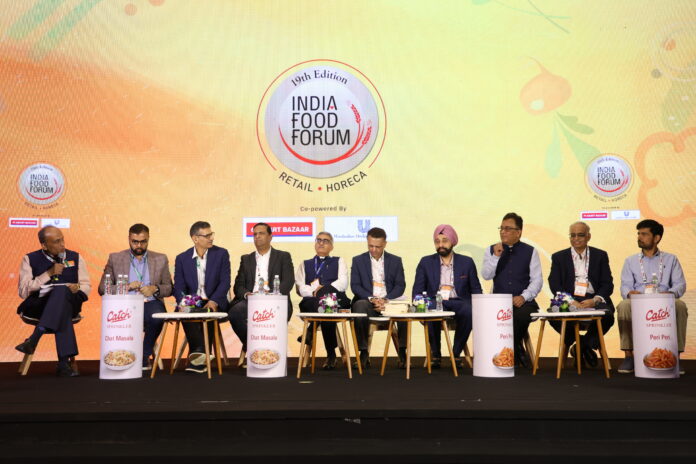
The biggest names shaping India’s food, retail and HoReCa businesses came together today at the 19th edition of India Food Forum 2026, hosted by IMAGES Group at the Jio World Convention Centre, Mumbai. Taking place on September 22–23, the two-day forum is bringing together 3,000+ attendees, 500+ brands, 300+ industry experts and 100+ exhibitors, creating a common platform for the Retail, HoReCa and Tech Solutions communities.
Built around the theme “The Triple Bottomline of Food: Health | Sustainability | Scale,” India Food Forum 2026 is examining how the industry can balance consumer wellbeing and responsible growth with the need to build businesses that can scale. Day One set the tone with high-stakes conversations on changing consumer behaviour, food and grocery retail, brand–retailer partnerships, Bharat consumption, quick commerce, technology and the evolving routes to market.
Nikhil Behl, CEO – Food, IMAGES Group, in his welcome address, positioned the Forum as more than an industry gathering, saying: “India Food Forum is, at its heart, a meeting place for the entire food ecosystem — where brands, retailers, foodservice players and business leaders come together to discover, connect and create opportunities.” He added that the Forum was designed around a simple belief: “Business should happen here — a conversation should lead to a partnership, an insight to action, and a product discovery to a new opportunity.”
A Platform For The Next Phase of Food
Chairman (India Food Forum) Damodar Mall, CEO, Grocery, Reliance Retail, framed the wider transformation around the changing relationship between consumer desire and consumption. According to Mall, the Indian consumer has always been omnichannel, moving between stores, home delivery, e-commerce, quick commerce and other formats depending on the need and occasion.
He highlighted how quick commerce has shortened the distance between desire and consumption, while emphasising that convenience is only one part of the equation, with range, price, service, experience and trust continuing to influence consumer choices.
The larger opportunity, he noted, lies not in choosing one channel over another but in understanding how different formats can coexist and evolve to serve consumers better.
As India Food Forum moves into Day Two, the agenda will continue to bring together the foodservice, retail and technology ecosystem around emerging opportunities, innovation, sustainability, scale and the future of the Indian food economy.
With its combination of conferences, roundtables, fireside conversations, exhibition, networking, product discovery, food experiences, innovation and recognition, the 19th India Food Forum is positioning itself as a business platform for an industry that is itself rapidly changing.
The Consumer Reset Takes Centre Stage
The inaugural session, “The Great Consumer Reset: Reimagining How India Consumes,” explored how consumers are rapidly redefining expectations around choice, value, convenience, experience and relevance. Leaders from the consumer ecosystem highlighted the need for businesses to respond with greater agility, innovation, opportunity, relevance, curiosity, precision marketing and speed.
Hemant Malik, Divisional Chief Executive – Foods, ITC Ltd., pointed to the increasing role of science and nutrition in food innovation: “Food is becoming more science-led as consumers demand healthier, more functional choices, pushing brands to innovate across nutrition, ingredients, quality and everyday consumption.”
The discussion also highlighted a more nuanced approach to snacking and indulgence. Prashant Peres, GM, Mars Snacking, observed: “Consumers are becoming more mindful and intentional about what they eat, but they still want to indulge, creating opportunities for brands to make snacking healthier, smarter and more relevant.”
From a retail perspective, Rahul Nayak, CEO, SPAR India, noted that consumers are making choices that go beyond simple price or pack-size calculations: “Consumers are not simply optimising for pack size or price; they are balancing budgets, aspirations and category choices to maximise what they can experience and enjoy.”
From Transactions to Food Growth Partnerships
The session “The New Food Alliance: Building the Next Food Growth Partnership” turned the spotlight on an increasingly important part of India’s retail landscape — mid-sized and small modern retail chains.
While these retailers have invested in systems, technology and POS infrastructure, discussions highlighted continuing challenges around distributor service levels, fill rates, communication, visibility, data access and support from brands. The conversation focused on moving beyond transactional relationships towards partnerships built around data, assortment, category development and scalable growth.
Chetan Damji Sangoi, CEO, Sarvodaya Supermarket, called for a more scalable partnership model: “Partnerships must go beyond bridging gaps; they should create scalable models that help retailers grow from one store to ten.”
For Rahul Khandelwal, COO, Weikfield, data can become a significant bridge between brands and retailers. “Brands and retailers must collaborate on data, turning shared insights into stronger category development, test markets and locally relevant products,” he said.
The importance of consultative selling was emphasised by Amitabh Singh, Senior Vice President, Patanjali Foods Ltd.: “Transactional relationships do not work long-term; consultative partnerships, backed by our own-store experience and data, help retailers build the right assortment.”
Prabhat Singh, Head Modern Trade, Dabur India Ltd., similarly called for both sides to invest in the relationship: “We need to move from transactional launches to a growth mindset, with both brands and smaller retailers investing in the journey.”
The Next Million Consumers and the Next Routes to Market
Beyond these two anchor conversations, Day One’s agenda broadened the lens to some of the most consequential questions facing food and grocery businesses. “Winning the Next Million Consumers” examined where future growth will emerge and how businesses can address increasingly diverse consumer cohorts beyond the traditional urban markets.
“AI-Powered Route-to-Market” explored the potential of technology to transform sales, distribution and retail execution, while “The FMCG Growth Dilemma” looked at the pressures facing brands as they balance growth, profitability, changing consumer expectations and increasingly fragmented routes to market.
The conversation then moved “From Shelf to Scale,” examining how brands can move from product discovery and distribution to sustainable growth. Another major focus was “Retail in the Age of Quick Commerce,” reflecting on how rapid delivery is reshaping grocery missions, consumer expectations, assortment and the economics of retail.