


India’s alcobev story is no longer about scale alone. It is about shift. A consumer base once driven largely by availability and affordability is now evaluating provenance, process, and positioning. Premium is no longer aspirational theatre; it is a measurable expectation. Into this recalibrated market steps Ardent Alcobev — not with a single-label gamble, but with a portfolio strategy anchored in origin authenticity and calibrated pricing.
India, Then and Now: A Market Ready to Premiumise
India’s evolution is visible not just in skylines, but in shelves. The last decade has seen steady premiumisation across categories, including spirits. Consumers are more travelled, more exposed, and more willing to experiment. As Debashish Shyam, Co-Founder, Ardent Alcobev, notes, “We feel the market is right for consumers to move on to the best the world has to offer.”
The ambition is not to replace IMFL loyalty overnight, but to create a credible bridge — an upgrade path that feels rational rather than indulgent. The opportunity lies between entry-level domestic labels and prohibitively priced imports. That middle is expanding.
The Investor Who Looked Beyond the Balance Sheet
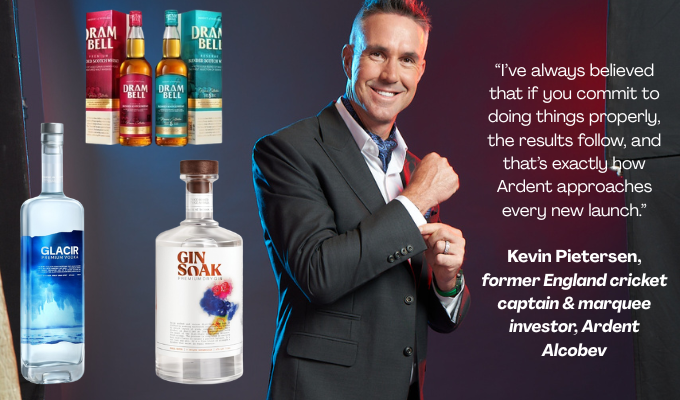
Kevin Pietersen’s involvement is positioned as strategic, not symbolic. Reflecting on his decision, he has said, “When you get asked to invest, you ask a lot of questions around the business opportunity. I’m very aware of where India is and where India will be in five, ten, fifteen years.”
His conviction stems from long familiarity with the country. “I’ve been coming to India since 2003. I’ve seen the growth. It’s an incredible opportunity.”
Importantly, he frames his role beyond capital deployment. “Can I add value? Am I genuinely interested? Or do I just put money in and see what happens in five years?” For Pietersen, the answer lay in active participation — sitting at the table, discussing blends, packaging, and long-term brand architecture. “This is our brand,” he emphasises. The intent is stewardship, not endorsement.
Dram Bell: Built for the Indian Palate
Dram Bell, bottled in Scotland, is offered in Premium and a 5-year-old Reserve. The Reserve, notably, positions itself against 3-year-old competitors at similar price levels — a deliberate disruption.
The flavour profile was consciously engineered. As Master Blender Iain Forteath explains, “The best way to judge whisky for a market is to look at the cuisine and the culture.” With Indian food often rich in spice, the blend avoids peat and heavy smoke. Instead, it leans into honeyed sweetness, toasted nuts, caramel, and soft fruit.
“It was designed to be complex and interesting, but the mouthfeel and the finish had to be smooth,” Forteath notes. The objective was clarity without aggression: a Scotch that holds its own whether consumed neat, on the rocks, or with soda.
The Ch(V)oice of Youth: Glacir Vodka and Gin Soak
With Indian alcobev growth skewing younger and more urban, white spirits are no longer secondary to whisky. They represent experimentation, social versatility, and cocktail-led consumption. Glacir Vodka and Gin Soak enter this space not as novelty additions.
Glacir Vodka is distilled and bottled in Russia using water sourced from Lake Baikal, the world’s largest freshwater lake by volume. The liquid undergoes triple distillation and charcoal filtration, processes associated with enhancing smoothness and removing impurities. The resulting profile is clean and neutral with subtle wheat-grain sweetness and a velvety mouthfeel — characteristics that make it adaptable across straight pours, highballs, and contemporary cocktails. Priced at Rs 1,640 for 700 ml, it sits within the accessible premium bracket, targeting consumers trading up from mass vodka labels.
Gin Soak operates in a category experiencing disproportionate growth among urban millennials and Gen Z consumers. Bottled at 47% ABV, it caters to a segment seeking bolder flavour intensity. The gin uses a twice-soaked botanical distillation process and features Sagan Dali, a rare botanical sourced from Russia’s Altai Highlands, alongside nine total botanicals. The process is designed to retain aromatic oils while preserving clarity, resulting in a dry, herb-forward profile with notes of wild herbs and dry berries and a crisp finish. At Rs 1,940 for 700 ml, it competes within the premium imported gin bracket while remaining below ultra-luxury price bands.
Responsible Drinking, Responsible Branding
As consumption rises and premiumisation accelerates, the real differentiator is not how loudly a brand speaks, but what it chooses not to say. Ardent’s stance is clear: participation without provocation.
The company avoids the familiar industry playbook of glamour-led excess. There is no glorification of binge culture, no visual language built around volume. Instead, the communication focuses on provenance, process, and flavour integrity. The message is straightforward — if one chooses to drink, choose well.
Responsible branding, in this context, is also about transparency. Bottled-in-origin claims are not marketing embellishments; they are traceable production choices. Age statements are declared. Processes are articulated. The consumer is trusted with information rather than seduced by abstraction.
Equally significant is tone. The narrative does not position alcohol as aspiration in itself. Instead, it positions quality as the aspiration. There is a difference. The former drives impulse; the latter encourages evaluation.
In a country where regulatory frameworks restrict direct advertising, many brands resort to surrogate tactics. Ardent’s approach appears more restrained. The spotlight remains on the liquid, not lifestyle theatrics. That restraint signals confidence.
Iain Forteath’s Blueprint for a Culturally Tuned Scotch
Iain Forteath, the master blender behind Dram Bell’s premium scotch, does not begin with barrels or botanicals. He begins with context. His approach to India has been deliberate. Having travelled to the country consistently since 2015, Forteath studied not just the market, but the environment in which whisky is consumed. For him, designing a blend for India required cultural understanding as much as technical precision. He believes the best way to judge a whisky for any market is to look at its cuisine. Indian food, he observes, is layered, complex, and spice-forward. When strong alcohol meets intense spice, the result can amplify heat in an unpleasant way. That became a central design consideration. The whisky had to marry with the food, not fight it.
He is careful with the word “approachable.” In his vocabulary, it is not a compromise. It is engineering. The whisky needed complexity and body, yet it had to remain inviting, something that could introduce consumers to Scotch without overwhelming them. Flavourful, but not sharp. Structured, but not heavy.
Consumption rituals in India also shaped his thinking. He quickly recognised the dominance of whisky and soda — a pairing more culturally embedded here than almost anywhere else in the world. Rather than resist it, he accepted it as part of the landscape. The blend was therefore crafted to hold its character whether enjoyed neat, on the rocks, or lengthened with soda.
Yet Forteath’s reflections extend beyond liquid. He notes that in India, whisky is often tied to grand occasions — weddings, banquets, milestones. His personal view is subtly different. A good bottle, he suggests, should create its own moment. It does not require ceremony. It requires conversation. For him, whisky is less about volume and more about experience. Open the bottle. Share it. Discuss the flavours. There is no need for excess, only appreciation.