

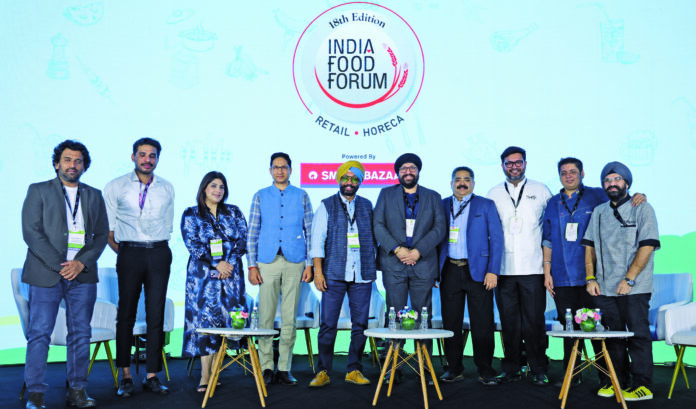
Setting the tone for a high-energy, pre-lunch session, Harpreet Tibb, promoter of Tibbs Frankie and the session’s moderator, framed the discussion with characteristic candour.

“We have chefs, restaurateurs, and ingredient companies on one stage. This is where the real picture of Indian food emerges—from those who actually run kitchens and businesses.” Joining him as co-moderator, Harpal Singh Sokhi quickly pushed the panel beyond nostalgia into foresight. “How do we look at 2026, 2028, even 2030—when Bharat is rising? What food trends will define the next decade?” The answers that followed revealed a rare consensus: Indian dining is not fragmenting—it is layering.
Automation, Consistency, and the Science Behind Scale

From the ingredient ecosystem, Pramod Francis, Chief Visionary Officer at Perfetto Naturals, brought a pragmatic lens to the table. “Chefs have magical hands—but only two of them. When you scale, automation and standardisation are inevitable.” He argued that the next phase of Indian food would rely heavily on intelligent ingredient systems. “Standardised recipes, the right functional compounds, smart preparation—this is how authenticity travels at scale.” For Francis, technology is not dilution—it is preservation.
The Return to Basics—and Why Fusion is Being Reconsidered

Chef voices echoed a deeper culinary recalibration. Chef Rohit Gujral observed that after years of experimentation, diners are gravitating back to fundamentals. “Modern Indian had its moment. But now people want proper quantity, proper quality, and authenticity. Fusion will take a backseat.”

That sentiment was sharpened by Chef Sanil Bhinde, who linked menu design to diner awareness. “Guests want to know where ingredients come from—who made the burrata, whether it’s in-house, even who the fromager is.” The future menu, he argued, will be simpler—but more transparent. “No fancy jargon. Just honest ingredients and clear storytelling.”
Regional India Reclaims the Spotlight

Perhaps the most resounding theme was the resurgence of regional cuisines—not as novelty acts, but as anchors of identity. Chef Ishjyot Singh Surri framed this evolution with nuance. “Regional cuisine is coming back—not just in food, but in how it’s presented. Chefs today are tested on how they merge technique with memory.” Visual appeal, he said, is no longer optional. “We eat with our eyes first. But if mouthfeel fails, nothing survives.” That balance between experimentation and familiarity defines what stays—and what doesn’t.
Personalisation, Protein, and the Conscious Indian Diner

From an ingredient and consumer lens, Arvind Kumar, COO, Sauces and Condiments Business at AWL Agri Business, highlighted a fundamental shift in Indian households. “Earlier, one dish fed forty people. Today, four people want four different meals.” This hyper-personalisation, he noted, is driving demand for protein-forward and authentic ingredients. “Protein will be the next big trend—especially for vegetarians. Parents want nutrition, not fantasy.”
Global Inspiration, Local Soul

Chef and culinary educator Chef Rakhee Vaswani connected food trends to travel, social media, and aspiration. “People travel, experience food abroad, and want to bring that inspiration back—without losing the desi touch.” From café culture to global desserts, she stressed discernment. “Global formats work only when they’re grounded in local sensibility. Otherwise, it’s just noise.”
Stories on the Plate: The Power of Experience

For restaurateur Nagasamy Dhanabalan, MD, Thalapakatti Biriyani, food without story is incomplete. “Young diners want legends, authenticity, and experience. They want biryani on a banana leaf—not just on a plate.” Regional storytelling, he argued, now often outperforms global trends.
Taking South India National—and Global

Representing the new wave of scalable Indian formats, restaurateur Raghavendra Rao, Founder & CEO, Rameshwaram Café, spoke about South Indian food’s national appeal. “South Indian food is no longer regional—it’s Indian food.” He emphasised respect for regional grains and cooking traditions. “Rasam rice needs South Indian rice. Culture and cuisine must travel together.” From dosa to idli, he framed tradition as India’s global calling card.
Ingredients That Will Define Tomorrow
- When asked about breakout ingredients, the panel delivered clarity over hype:
- Protein as a nutritional priority
- Dietary fibre, rediscovered with scientific awareness (Pramod Francis)
- Specialty and fermented coffee as India’s next beverage wave
- Black rice from the Northeast, praised by Chef Sanil Bhinde for its texture and flavour
- Samba rice for biryani, championed by Dhanabalan as an antidote to basmati fatigue
“Basmati boredom is real. Samba rice brings character back to biryani,” Dhanabalan noted.
One Word to Describe Indian Cuisine

As the session closed, each panelist summed up Indian cuisine in a single word: Heritage; Divine; Culture; Soul; Roots; Heart.
Harpreet Tibb concluded succinctly: “Indian food doesn’t need invention. It needs respect, authenticity, and the courage to tell its own story.”