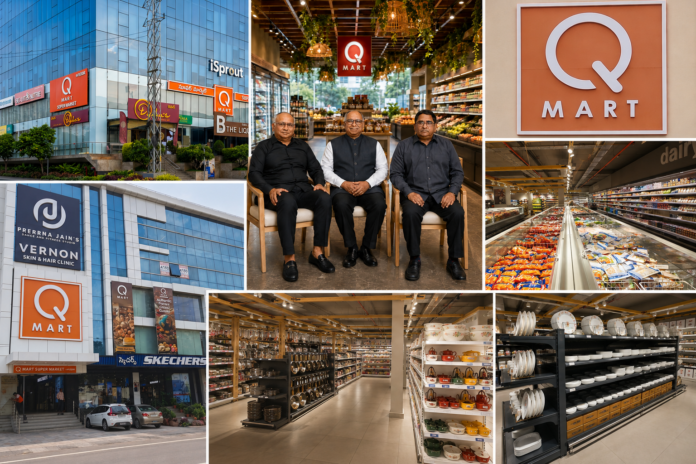

On a typical Saturday morning at Q-Mart, Hyderabad’s culinary universe unfolds aisle by aisle.
Near the fresh produce section, a young software professional examines hydroponically grown lettuce. Across the aisle, a family debates between French Brie and Dutch Gouda. At the bakery counter, customers queue for freshly baked artisanal sourdough. A staff member patiently explains the differences between extra-virgin olive oils to a first-time buyer, while another recommends specialty ingredients for an upcoming dinner party.
To a visitor experiencing it for the first time, this scene may seem perfectly normal. Yet nearly three decades ago, almost none of these products—or shopping experiences—existed in Hyderabad.
The idea that consumers would willingly drive across the city to buy imported cheeses, organic vegetables, gourmet sauces, artisanal breads, specialty teas or exotic fruits would have sounded improbable in the late 1990s. Grocery shopping was largely functional. Consumers bought what they needed, not what they wanted to discover. Food retail revolved around availability and convenience rather than aspiration and experience. But that is precisely the future Q-Mart helped create.
Today, Hyderabad is widely regarded as one of India’s most cosmopolitan food markets. International cuisines are mainstream. Consumers actively seek organic products, premium ingredients, wellness foods and artisanal offerings. Yet long before these categories entered the vocabulary of modern retail, Q-Mart was quietly introducing them to the city.
The retailer’s story began in 1997, at a time when organised retailing itself was still in its infancy. Modern supermarkets were only beginning to emerge. Imported foods were difficult to source and even harder to find. Consumers who wanted specialty products often depended on friends travelling abroad or occasional supplies through hotel networks. For most retailers, the market simply wasn’t ready. The promoters of Q-Mart saw it differently. Having been exposed to international retail formats and evolving consumer lifestyles overseas, they recognised a shift that was beginning to take shape among India’s urban consumers. Hyderabad was transforming. International travel was increasing. Exposure to global cuisines was expanding. The city’s growing population of professionals, entrepreneurs, NRIs and expatriates was developing tastes and aspirations that traditional retail channels were unable to serve.
“We saw an opportunity to cater to a growing aspirational consumer profile. We wanted to create a destination where consumers could explore a curated selection of exclusive product offerings that mirrored international food retail trends,” says BVK Raju, Managing Director, Q-Mart Retail.
What followed was not simply the launch of a retail store. It was the creation of an entirely new category. The challenge was formidable. Imported products were difficult to source. Cold-chain logistics were underdeveloped. Supply chains were fragmented. Customs procedures created uncertainty. Product pricing fluctuated constantly. Most importantly, customers were unfamiliar with many of the products Q-Mart wanted to introduce, with frequently asked questions including:
- – What exactly was Brie cheese?
- – Why was extra-virgin olive oil different from regular cooking oils?
- – What made organic produce worth paying more for?
- – Why should consumers care about provenance, artisanal production or specialty ingredients?
These were not questions that could be answered through advertising alone.
Q-Mart realised that success would depend as much on education as on retailing. Every new category required explanation. Every unfamiliar product required storytelling. The retailer invested heavily in customer engagement, staff training and product demonstrations. Sampling sessions encouraged experimentation while a no-questions-asked returns policy reduced the risk of trying something unfamiliar. The strategy required patience.
Categories that today generate significant business often took years to gain acceptance. Yet Q-Mart persisted, introducing products gradually, educating consumers and allowing adoption to happen organically. Over time, customer behaviour began to change.
Consumers who initially visited out of curiosity returned with confidence. Shopping evolved from a transaction into an experience. Product discovery became part of the attraction. In many ways, Q-Mart became Hyderabad’s unofficial culinary classroom.
Long before wellness became a dominant consumer trend, the retailer was building assortments around healthier food choices. Long before hydroponic vegetables entered mainstream retail, Q-Mart was educating customers about freshness and sustainability. Long before specialty cheese counters appeared in modern trade, the retailer was helping consumers understand European varieties and their uses.
Many of the categories that are commonplace today were first encountered by thousands of Hyderabad consumers within the aisles of Q-Mart. The timing could not have been better.
As Hyderabad evolved into one of India’s leading technology and business hubs, consumer expectations evolved alongside it. Rising incomes, international exposure and changing lifestyles created demand for products that extended beyond conventional grocery shopping. Food became an expression of identity, aspiration and lifestyle. Q-Mart evolved with its customers.
The definition of premium retail itself changed dramatically during this period. In the late 1990s, premium largely meant access to imported products. Today, it encompasses wellness, sustainability, authenticity, quality, provenance and experience.
Recognising these shifts, Q-Mart broadened its interpretation of premium retail. International products were complemented by local artisanal offerings. Organic produce sat alongside imported ingredients. Gourmet bakery products shared space with specialty foods sourced from around the world. The result was not merely a store, but an ecosystem that connected global food trends with local consumer aspirations. This approach continues to define the business today.
Unlike many retailers that pursued aggressive expansion, Q-Mart focused on deepening relationships with customers and refining its proposition. Growth came not from opening dozens of stores but from building trust, increasing customer loyalty and strengthening its reputation as a curator of quality. That strategy has delivered remarkable resilience. Over the past decade, the company has consistently recorded annual growth of 8-12 percent, driven primarily by rising basket sizes and customer lifetime value rather than aggressive geographic expansion.
More importantly, it has created something that many retailers struggle to achieve: relevance across generations. Customers who discovered imported foods at Q-Mart in the late 1990s now shop alongside younger consumers searching for plant-based alternatives, wellness products and globally inspired ingredients. The store continues to serve both audiences because its role has never been limited to selling products. It has always been about discovery.
Nearly three decades after opening its doors, Q-Mart remains one of the clearest examples of how retail can shape consumer behaviour rather than simply respond to it. The company did not wait for Hyderabad’s gourmet culture to emerge. It helped create it.
Many retailers sell products. A few create categories. Even fewer influence how an entire city shops, cooks and eats. That may ultimately be Q-Mart’s most enduring achievement.
“We were not simply opening a store. We were building a category and creating a destination where consumers could discover products and experiences that were previously unavailable to them,” says BVK Raju.
THE CURATION MACHINE
How Q-Mart Built Hyderabad’s Most Trusted Gourmet Ecosystem
If the first chapter of Q-Mart’s story was about creating demand, the second was about mastering supply. Every premium retailer can create an attractive store. Far fewer can consistently source products that customers cannot find elsewhere. For Q-Mart, the real challenge was never merchandising shelves—it was building the ecosystem behind them. In the late 1990s, importing specialty foods into India was far more complex than it is today. Reliable suppliers were scarce, import volumes were often too small to interest large distributors, and cold-chain infrastructure was still evolving. Products frequently faced delays, costs fluctuated dramatically and availability was often unpredictable.
Rather than accepting these constraints, Q-Mart set about building its own network. Relationships were forged with specialty suppliers across multiple countries. Consolidators capable of handling smaller quantities were identified. Existing hospitality supply chains were leveraged to bring products into Hyderabad while maintaining quality standards.
“We had to build an efficient sourcing and logistics ecosystem virtually from the ground up. There was no established gourmet supply chain available to us,” BVK Raju explains.
Over time, those relationships became one of the company’s strongest competitive advantages. Today, Q-Mart offers more than 30,000 SKUs sourced from over 500 global and domestic brands. Yet the company’s philosophy has never been about carrying the most products. It has been about carrying the right products.
Every item on the shelf is expected to earn its place. This discipline has helped Q-Mart avoid a trap that affects many retailers: confusing assortment size with assortment quality. Instead of overwhelming customers with endless choices, the company focuses on relevance, uniqwueness and quality. Sales data, customer feedback and emerging global trends all influence assortment decisions, but human judgement remains central to the process.
The promoters continue to travel extensively, attending international food exhibitions, studying retail concepts and identifying emerging categories before they become mainstream. This combination of global scouting and local understanding has allowed Q-Mart to consistently stay ahead of the curve.
Specialty cheeses, hydroponic vegetables, organic foods, gourmet bakery products, wellness foods and plant-based alternatives all appeared on Q-Mart shelves years before they became widely available elsewhere.
Being first, however, carries its own risks. Introducing unfamiliar categories requires customers to change habits, learn new products and often pay premium prices. Q-Mart therefore adopted a gradual approach to category building. Products were introduced in small quantities, supported by demonstrations, tastings and staff recommendations. Rather than forcing adoption, the retailer focused on creating understanding.
The strategy transformed product launches into learning experiences. When specialty cheeses were first introduced, customers were educated about origins, flavours, pairings and serving suggestions. Similar efforts accompanied organic foods, hydroponic produce and plant-based alternatives. The objective was never simply to sell a product but to build confidence around it.
This commitment to education remains central to the Q-Mart model today. The company’s sourcing philosophy has also evolved alongside consumer preferences. In its early years, premium retail was synonymous with imported products. International origin itself carried prestige. Today’s consumers are more discerning. They value authenticity, craftsmanship and provenance irrespective of geography.
Q-Mart responded by creating a balance between global sourcing and local excellence. Today, imported products contribute approximately 55 percent of sales, while Indian artisanal and specialty producers account for the remaining 45 percent. This blend allows the retailer to offer global variety while supporting local entrepreneurship and craftsmanship.
Some of the most successful examples of this approach come from exclusive partnerships. Q-Mart’s collaboration with Hyderabad-based Cravin Bakers created a range of artisanal sourdough products that has become one of the retailer’s destination categories. Similarly, partnerships with premium import specialists have enabled the company to offer specialty cheeses and gourmet ingredients that remain difficult to find elsewhere.
Exclusivity, however, is not pursued for marketing value alone. It reinforces the perception that a visit to Q-Mart will lead to discovery. Customers know they are likely to find products unavailable in mainstream retail channels. Perhaps the most unusual aspect of the company’s strategy is what it has chosen not to do. At a time when retailers increasingly rely on private labels to improve margins, Q-Mart has consciously stayed away from the category. Management believes that its role is not to compete with the brands it stocks but to identify and curate the best products available.
That decision strengthens the retailer’s position as an independent curator.
Customers trust that products are chosen because they meet Q-Mart’s standards rather than because they generate higher margins. In a premium retail environment, that credibility can be more valuable than a private label portfolio.
The retailer’s product mix reflects the same philosophy. Approximately three-fourths of sales come from fresh and gourmet food categories including dairy, produce, bakery, imported foods and specialty ingredients. The balance comes from carefully selected non-food categories such as cookware, crockery and lifestyle products.
These categories are not viewed as separate businesses. Together they support a broader lifestyle proposition. A customer shopping for pasta may discover olive oils, serving platters and gourmet accompaniments nearby. Someone buying artisanal bread may encounter preserves, spreads and specialty kitchenware. The objective is not simply to increase basket size but to create a complete culinary experience.
Nearly three decades after it first introduced Hyderabad to gourmet retail, Q-Mart continues to operate with the same guiding principle: curation creates value. In a marketplace crowded with choices, customers increasingly rely on trusted retailers to help them decide what is worth buying. Q-Mart’s success suggests that the future of specialty retail may belong not to those who stock the most products, but to those who select them best.
“Our focus has never been on stocking more products. It has always been on identifying the right products and presenting them in a way that creates confidence, trust and discovery for our customers,” says BVK Raju.
TRUST, LOYALTY & THE FUTURE
Why Q-Mart Chose Depth Over Scale
Retailers often spend enormous sums attracting customers. Q-Mart spent nearly three decades earning them. That distinction explains much about the company’s success. In an industry increasingly dominated by discounts, promotional campaigns and convenience-driven competition, Q-Mart has quietly built one of the strongest loyalty-driven businesses in Indian food retail. The company has done so without relying on deep discounting, loss leaders or aggressive price-led customer acquisition strategies that have become commonplace across modern retail. Its philosophy has always been simple: if customers trust the quality of products, appreciate the curation and value the experience, they will return.
The strategy has proven remarkably effective.
Over the past decade, Q-Mart has consistently delivered annual revenue growth of 8-12 percent despite operating within a single city. Much of that growth has been driven not by increasing store count but by increasing customer lifetime value and basket size. Today, the retailer’s Average Transaction Value is estimated to be between 2.5 and 3 times higher than that of mainstream supermarkets, reflecting both customer confidence and the premium nature of its assortment.
The numbers tell only part of the story.
Walk through any Q-Mart store and the source of this loyalty becomes immediately apparent. Staff members are encouraged to become advisors rather than salespeople. Conversations revolve around ingredients, recipes, dietary preferences and product recommendations. Regular customers are often recognised personally. Preferences are remembered. Suggestions become increasingly tailored over time.
The experience feels less like a supermarket and more like a trusted neighbourhood specialist. This human connection has become increasingly important as retail becomes more automated. While technology plays an important role in operations, management remains convinced that emotional loyalty cannot be replaced by algorithms.
“Customer service means going over and above giving the best products. It means relating with customers on a personal level.”
That belief was tested during one of the most disruptive periods in modern retail history. The Covid-19 pandemic transformed consumer behaviour across categories. While footfalls initially declined, customers consolidated purchases and became more selective about where they shopped. Quality, trust and reliability suddenly became more important than proximity.
For Q-Mart, the result was a significant increase in basket sizes, which rose by more than 40 percent during the period. Demand accelerated across organic foods, wellness products, immunity-supporting ingredients, premium frozen foods and gourmet cooking essentials. Many of these habits have remained long after the pandemic subsided.
The experience reinforced a lesson that continues to guide the company today: when uncertainty increases, consumers gravitate towards brands they trust. That trust also shapes Q-Mart’s approach to digital commerce.
The rise of quick commerce has altered the competitive landscape of grocery retail. Consumers increasingly expect products delivered within minutes, and many retailers have embraced aggregator platforms to achieve scale. Q-Mart has taken a different route.
Management believes that premium products require premium handling. Specialty cheeses, gourmet bakery products, fresh produce and imported foods demand strict quality control and reliable cold-chain management. Rather than surrendering that control to third-party platforms, the company has invested in its own delivery ecosystem.
Today, home delivery contributes approximately 12.5 percent of revenue, largely driven by high-value repeat customers. The emphasis remains on maintaining product integrity and customer experience rather than chasing delivery speeds.
This measured approach reflects a broader philosophy that increasingly distinguishes Q-Mart from many of its peers. While much of the retail industry has pursued rapid expansion, Q-Mart has consistently prioritised quality over quantity. The company could have entered multiple cities years ago. Markets such as Bengaluru, Chennai and Pune appeared natural opportunities for a premium retailer with strong credentials. Yet management deliberately chose a slower path. The reason lies in the nature of specialty retail itself.
Unlike conventional grocery formats, premium food retail depends heavily on curation, sourcing expertise, customer relationships and service standards. These capabilities cannot be replicated overnight. Expanding too quickly risks weakening the very characteristics that make the business successful.
That philosophy has shaped the company’s growth strategy from the beginning. Rather than chasing national visibility, Q-Mart focused on strengthening its ecosystem within Hyderabad. The approach has allowed the company to deepen supplier relationships, build stronger customer loyalty and refine its operating model. The next phase of growth will follow the same principle.
“Ultimately, our trajectory will be guided by sustainable growth that never compromises the premium quality, distinctive experience and emotional connection we have built with our customers,” says Raju.
Instead of immediately entering multiple cities, the company’s next major milestone is the upcoming store at GMR Interchange near Hyderabad’s Rajiv Gandhi International Airport. The location provides access to travellers, professionals, airport employees and rapidly growing residential communities while allowing the company to remain close to its core market. It represents expansion without dilution. The move also positions Q-Mart to participate in the next wave of premium food consumption. Wellness products, plant-based foods, premium convenience meals, artisanal foods and functional nutrition are all expected to gain further momentum in the years ahead. Having pioneered many of these categories in Hyderabad, Q-Mart is well positioned to benefit from their continued growth.
Yet perhaps the most remarkable aspect of the company’s journey is not its ability to identify trends. It is its ability to remain relevant while staying true to its original values. The retailer that introduced imported cheeses now offers wellness foods and plant-based alternatives. The company that began as a single gourmet store now operates multiple formats. The business that built its reputation through discovery now combines physical retail with direct-to-consumer delivery.
But the core proposition remains unchanged.
- Curate thoughtfully.
- Serve personally.
- Build trust.
- Create discovery.
Nearly three decades after opening its doors, Q-Mart stands as a reminder that sustainable growth is not always driven by scale. Sometimes it is built through consistency, patience and an unwavering commitment to customers. The company may expand further in the years ahead. It may enter new cities. It may evolve into a larger regional or national brand. Yet its most enduring achievement may already be secure. Q-Mart did not simply build a successful retail business. It helped transform how Hyderabad shops, cooks and experiences food.