


India is already Nestlé’s highest-performing market globally; FY26 revenue Rs 23,155 crore; total sales Rs 23,071.5 crore; PAT Rs 3,544.6 crore; Q1 FY27 revenue Rs 6,378 crore, up 25.2%; PAT Rs 959 crore, up 48.3%; 9 factories, with a 10th coming up in Odisha; 5.2 million outlets; 10,000+ distributors; 100,000+ farmers; exports to 28 countries.
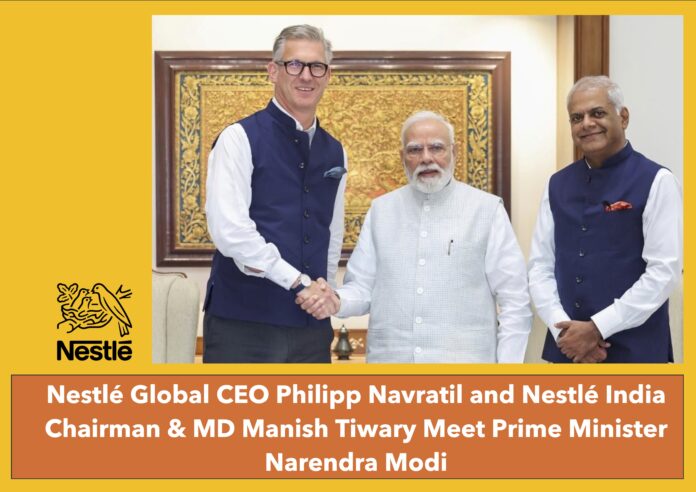
India is moving rapidly from being one of Nestlé’s important markets to becoming one of the Swiss food giant’s most important growth, manufacturing and sourcing hubs. That is the larger significance of Nestlé Global CEO Philipp Navratil and Nestlé India Chairman & MD Manish Tiwary meeting Prime Minister Narendra Modi, as the company signals a substantially bigger India ambition.
Tiwary, sharing a photograph of the meeting, described it as an honour to meet the Prime Minister alongside Navratil and said: “India at our core. Always.” He described India as a country with which Nestlé is committed to “growing with India, and for India.” The meeting comes as Navratil makes his first India visit as global CEO and, in a series of interactions, makes it clear that the country is no longer simply a large emerging market for Nestlé. India is already among its top 10 markets globally, was its highest-performing market in the first half of 2026 and, according to Navratil, becoming one of the group’s top five markets by revenue is now “on the horizon”.
More importantly, Navratil says Nestlé wants to increase manufacturing capacity in India and develop the country as a production hub for exports. The company currently exports from India to 28 countries.
That gives the Modi–Navratil meeting significance well beyond FMCG sales. The opportunity spans food processing, manufacturing, agriculture, farmer livelihoods, exports, employment, nutrition and rural development — precisely the areas in which Nestlé has been building its Indian ecosystem for decades.
Rs 23,155 Crore Business — And Accelerating
The financial performance explains the confidence.
Nestlé India’s FY26 revenue from operations was Rs 23,154.6 crore, while total sales stood at Rs 23,071.5 crore and standalone net profit at Rs 3,544.6 crore. EBITDA was 23% of sales, with cash generated from operations at Rs 5,047.6 crore.
The latest quarter provides an even stronger snapshot. In Q1 FY27, revenue from operations rose 25.2% year-on-year to Rs 6,378.18 crore, while net profit increased 48.3% to Rs 958.68 crore. EBITDA grew nearly 40%, with the EBITDA margin at about 24.2%.
The growth is broad-based. Nestlé India reported strong momentum across prepared dishes and cooking aids, milk products and nutrition, confectionery and beverages, with e-commerce and quick commerce also becoming increasingly important channels.
For Navratil, however, the more important measure is not simply price-led revenue growth. He has emphasised volume-led growth, deeper consumer penetration, the right value proposition across price points and innovation. India, he says, is leading Nestlé’s growth across emerging markets in Asia, Latin America and Africa.
Top Five is No Longer a Distant Ambition
India is already among Nestlé’s top 10 markets worldwide. But Navratil’s statement that India’s rise into the top five is “on the horizon” changes the scale of the opportunity.
He specifically points to India’s enormous consumer base, urbanisation, the expanding middle class and Nestlé’s ability to serve consumers through deep distribution and an appropriate value proposition. He also describes India as a “very attractive” market in which Nestlé sees plenty of room for further growth.
The important point is that India does not need to wait for another decade to become more strategically important. Navratil explicitly said the top-five ambition is not something 20 years away; it is a near-term opportunity that the team is working towards.
For a company whose portfolio includes Maggi, Nescafé, KitKat, Milkmaid, Cerelac and numerous other brands, the headroom is substantial because household penetration remains far from universal even for some of its biggest brands.
From Nine Factories to an India Manufacturing Hub
The next phase will require more than selling more products. It will require more products to be made in India.
Nestlé India currently has nine manufacturing facilities at Moga, Choladi, Nanjangud, Samalkha, Ponda, Bicholim, Pantnagar, Tahliwal and Sanand. A 10th factory is being set up in Odisha.
The company has also signed an MoU with the Ministry of Food Processing Industries to accelerate greenfield and brownfield investments in Odisha and its existing manufacturing locations over the next two to three years. Nestlé India said these projects are expected to create direct and indirect employment while strengthening its food-processing footprint.
Navratil has now gone a step further, saying Nestlé should do more to see India as a production hub to export, rather than simply a country in which it manufactures for Indian consumers. Nestlé India exported products to 28 countries in FY26, and exports accounted for 4.1% of turnover.
The company’s FY26 report says its exports reached 127 million equivalent consumer units, with new markets and products added across countries including the Maldives, Papua New Guinea, UAE, Saudi Arabia, Singapore, New Zealand, UK and US.
That makes the manufacturing opportunity considerably larger than the domestic market.
Almost 100% of What India Sells is Made Here
Nestlé’s localisation story is already deep.
The company has said almost 99% of its products sold in India are made in India, supported by a wide network of local suppliers and farmers.
It works with more than 100,000 farmers across dairy, coffee, spices, wheat, sugarcane and rice, in addition to its supplier partnerships. Its products reach consumers through 10,000 distributors and redistributors and approximately 5.2 million retail outlets.
This is the infrastructure that makes India’s top-five opportunity possible. Nestlé is not trying to build its Indian business from scratch. It already has one of the country’s deepest food and beverage ecosystems — from farmers and suppliers to factories, distributors, retailers and consumers.
Moga: Where Nestlé Built a Milk Economy
Perhaps nowhere is this ecosystem more visible than in Moga, Punjab, where Nestlé began its dairy-development journey in India.
On 15 November 1961, Nestlé collected just 511 kg of milk from four villages on its first day of procurement. Today, its Moga factory collects more than 1.3 million kg of milk a day during the flush season, with more than 110,000 farmers across India selling milk to Nestlé.
The Moga model was never simply about buying milk. Nestlé established what it calls a fresh milk district model, with direct procurement, milk collection centres, logistics and quality testing designed to ensure that milk reaches the factory quickly and in good condition.
Alongside procurement, Nestlé provides farmers technical support on animal nutrition, breeding, animal health, farm management and productivity.
This is effectively a supply chain built from the village upwards.
From Dairy Procurement to Sustainable Dairy
Nestlé’s dairy programme has evolved significantly from its original productivity-and-procurement model.
Its Sustainable Dairy Project, launched in 2022–23, addresses feed and fodder, animal health, farm infrastructure, productivity and greenhouse-gas emissions. More than 1,100 farmers accelerated their sustainability transformation during 2024–25.
One of the most interesting interventions is manure management. Nestlé has supported the installation of more than 5,800 small and 200 large biodigesters, turning cattle manure into renewable energy and bio-fertiliser while reducing methane emissions.
This is an important transition: the same farmer ecosystem that secures Nestlé’s milk supply is now becoming part of its climate and sustainability strategy.
Women are Central to the Dairy Ecosystem
Nestlé has also worked extensively with women in dairy villages through its Village Women Dairy Development Programme.
The initiative trains women in animal feeding and breeding, animal care, sustainable agriculture, water conservation, personal health and hygiene, while also encouraging economic independence.
Nestlé reported that the programme had trained more than 70,400 village women by December 2018. Because this is a dated programme figure, it should not be presented as the current number; nevertheless, it demonstrates the scale and longevity of Nestlé’s intervention in dairy communities.
The larger point is that Nestlé’s farmer model increasingly looks at the household economy, rather than just milk volumes.
And it Goes Far Beyond Dairy
Nestlé’s agricultural sourcing extends across rice, wheat, sugarcane, coffee and spices, among other commodities.
Its responsible-sourcing programmes work with farmers on soil health, water management, crop productivity, input efficiency, residue management and climate resilience. The company has, for example, worked with more than 800 paddy farmers under its Sustainable Paddy Project and approximately 900 smallholders through its Sustainable Wheat Project.
Its regenerative agriculture work with sugarcane farmers covers approximately 1,400 farmers across three sugar mills.
And through the NESCAFÉ Plan, Nestlé works with more than 5,000 coffee farmers in India, supporting productivity, livelihoods and environmental stewardship.
The MAGGI Spice Plan similarly works with suppliers and their farmer networks, with agronomists supporting Integrated Pest Management, traceability and food-safety standards. Nestlé says 10 key spices are 100% traceable under this system.
It is important, however, not to describe all of these initiatives simply as “contract farming”. Nestlé’s model comprises direct procurement, supplier backward integration, farmer-development programmes and responsible sourcing. That distinction matters because these are broader and more sophisticated relationships than conventional contract farming.
Project Vriddhi: Nestlé’s Village-Development Model
This is perhaps the least appreciated part of the Nestlé India story.
Project Vriddhi, Nestlé India’s integrated village-development programme, is designed to build more self-reliant rural communities rather than simply fund isolated CSR projects.
The programme works across nutrition, education, water and sanitation, waste management, environment, livelihoods, agriculture and village infrastructure, typically in partnership with NGOs and community-based organisations. It also builds local institutions so that the interventions can become community-led and sustainable.
And the programme has now reached a substantial scale.
During FY26, Project Vriddhi transformed 31 villages across four states and impacted more than 49,500 beneficiaries.
The programme had earlier begun in Nuh, Haryana, and was subsequently extended to villages in other states, including Sonbhadra in Uttar Pradesh. It includes interventions such as water conservation, sanitation, school infrastructure, nutrition awareness, agriculture, livelihoods and community institutions.
This is effectively a village-adoption model, but with a critical difference: the objective is to create systems that communities can eventually manage themselves.
The Wider Social Footprint is Enormous
Nestlé India’s CSR and Creating Shared Value programmes extend well beyond villages directly connected to its sourcing operations.
In FY26, the Nestlé Healthy Kids Programme reached approximately 191,950 adolescents and parents across 22 states.
Its Feeding Support Programme, aligned with the PM Poshan scheme, served approximately 5 million meals across four states, benefiting almost 50,000 students.
Project Jagriti, focused on women, young couples and adolescents and covering hygiene, nutrition, prenatal and postnatal care, breastfeeding and family planning, reached approximately 638,000 people across eight states and one Union Territory during FY26.
Nestlé India has said its societal initiatives have touched more than 16 million lives through nutrition awareness, education, waste management, clean drinking water, sanitation, feeding programmes, livelihood support and other interventions.
This gives considerable substance to the company’s Creating Shared Value philosophy.
5.2 Million Outlets: The Other Competitive Advantage
For all the discussion around brands, factories and farmers, Nestlé’s biggest competitive moat in India may still be its distribution.
5.2 million retail outlets and 10,000-plus distributors and redistributors give the company an enormous ability to take new products into the market quickly and build scale behind existing brands.
And the network is increasingly being supplemented by modern trade, e-commerce and especially quick commerce.
Nestlé India’s FY26 annual report says e-commerce continued to grow strongly, led by quick commerce, improved availability and platform-specific packs and interventions.
That combination is becoming particularly powerful in India: deep traditional distribution for mass reach, organised retail for visibility and premiumisation, and quick commerce for convenience and impulse consumption.
India is Also Becoming an Innovation Hub
Nestlé’s India R&D operation adds another layer to the opportunity.
Its R&D Centre at Manesar, Gurgaon, established in 2012, serves as a global innovation hub for noodles and spices, combining scientific and culinary expertise to develop products for Indian and global markets.
This is an important strategic shift. India is increasingly not just a market where Nestlé takes global products and localises them. It is becoming a place where the company can develop products and capabilities that can travel beyond India.
The same is happening with exports. During FY26, Nestlé India expanded products such as Nescafé Sunrise, Maggi seasoning mixes, KitKat and Milkmaid into additional overseas markets.
Maggi, Nescafé and KitKat Still Have Plenty of Runway
The growth opportunity also lies within Nestlé’s existing brands.
Maggi remains one of the company’s biggest franchises in India, while Nescafé has been gaining from the rapid expansion of India’s coffee culture. KitKat has also become a major growth engine.
The lesson from these brands is that Nestlé does not necessarily need a completely new category to create growth. It can increase household penetration, add consumption occasions, premiumise selectively and take familiar brands into new geographies and channels.
That is exactly the kind of volume-led growth Navratil is talking about.
The Regulatory Conversation Matters Too
Navratil’s India visit also comes as the country moves towards greater scrutiny and transparency around packaged-food nutrition.
He said Nestlé welcomes front-of-pack labelling, arguing that consumers should have greater transparency about what they consume. But he also believes the system should be scientifically designed and suggested that portion-based information, rather than simply grammage, should be considered. Nestlé is prepared to share its experience from other countries with the government.
This is an important conversation for a company whose portfolio spans instant noodles, chocolates, coffee, dairy and nutrition products.
Nestlé’s response is increasingly to reformulate products where possible while maintaining taste and affordability, alongside expanding products positioned around different nutritional needs.
For India, the regulatory dialogue could therefore become another area of collaboration between government and the global food major.
From “Made for India” to “Made in India for the World”
This is where the Modi–Navratil meeting becomes particularly interesting.
Nestlé’s India story began more than a century ago as an importer and seller of products. It then evolved into local manufacturing. Today, almost 99% of the products sold in India are made locally, supported by farmers, suppliers and nine factories.
The next stage is different again.
Make more in India. Source more from Indian farmers. Build more capacity. Develop more products here. And export more from India to the world.
Nestlé already exported to 28 countries in FY26, and Navratil has explicitly said India should increasingly be viewed as a production hub for exports.
That makes India’s opportunity within Nestlé far larger than its domestic Rs 23,000-crore-plus business.
The opportunity behind the Modi–Navratil meeting
There is no specific new investment agreement announced from the Prime Minister’s meeting with Navratil and Tiwary. It would therefore be wrong to portray the meeting itself as a fresh capex announcement.
But the context around it is exceptionally strong.
Nestlé’s global CEO is in India saying the country is its highest-performing market in the first half of 2026 and that entry into the group’s top five markets is now on the horizon. He is talking about increasing manufacturing capacity and making India a larger export hub.
Nestlé India has nine factories, a 10th coming up in Odisha, more than 100,000 farmers, 10,000-plus distributors, 5.2 million outlets and exports to 28 countries. (Nestlé India)
It has just delivered Rs 23,155 crore of revenue from operations and Rs 3,544.6 crore of standalone PAT in FY26, followed by Q1 FY27 revenue growth of more than 25% and PAT growth of more than 48%.
And beyond the P&L, its footprint extends into 31 villages and 49,500-plus beneficiaries through Project Vriddhi in FY26, 191,950 adolescents and parents through Healthy Kids, 638,000 people through Project Jagriti and 5 million meals through its feeding-support programme.
That is why the Nestlé opportunity in India is no longer just about Maggi, Nescafé, KitKat and the next billion consumers.
It is about building a much larger India food ecosystem — from farmer to factory, from village to supermarket, from R&D to global export.
For Narendra Modi, the opportunity is greater investment, food processing, agricultural linkages, manufacturing, employment and exports. For Philipp Navratil, it is a market capable of moving into Nestlé’s global top five while simultaneously becoming a more important production base. For Manish Tiwary and the India team, the challenge is to turn that enormous headroom into sustained, volume-led growth.
India is already at the core of Nestlé India’s business. The Modi–Navratil meeting comes at a moment when it is increasingly moving towards the core of Nestlé’s global growth strategy.