


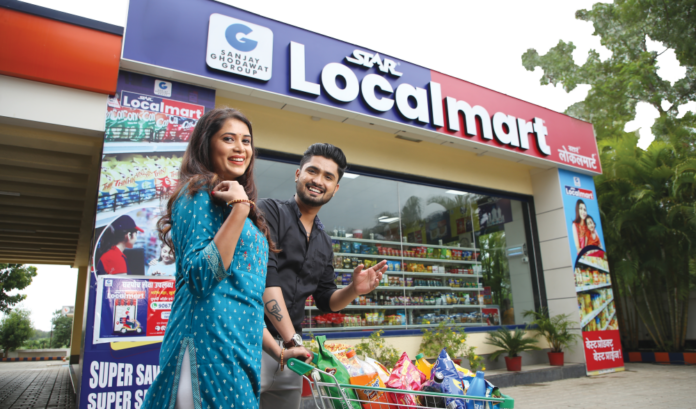

In a Star Localmart store in Kolhapur, nothing feels
hurried—and nothing feels accidental. The First thing
you notice isn’t the signage or the price boards. It’s
the rhythm. A woman in a cotton saree pauses at
the staples bay, comparing two rice brands like she’s
done this every week for years. A college student darts in for
a snack and a beverage, already tapping his phone for UPI
before the cashier has scanned the last item. A store associate
adjusts a price strip, ensuring the shelf label matches
the billing screen exactly. There is no loud promotion, no
aggressive discount signage, no sense of spectacle. And yet,
this quiet precision is precisely what makes Star Localmart
interesting.
At a time when India’s retail discourse is dominated by speed,
scale, and disruption, Star Localmart is pursuing a different
ambition: to build a neighbourhood supermarket chain that
works—reliably, repeatedly, and profitably—in the small towns
and semi-urban markets where most Indians actually live.
For Shrenik Ghodawat, Managing Director of the Sanjay
Ghodawat Group, the parent company behind the brand, Star
Localmart is not an extension of an existing business but a considered retail expression of the Group’s broader consumer-
facing ambitions. Built as a distinct neighbourhood grocery format and shaped by the Group’s deep experience in FMCG
manufacturing and supply-chain orchestration, Star Localmart
was designed speciβically for Tier 2 and 3 India—where local
shopping habits demand familiarity, and modern retail must
earn trust before it earns scale.
“Star Localmart was never meant to be a chain that merely
extends into Tier 2 and 3 India. It was conceived as a format
designed for these markets—one that respects local shopping
habits while bringing in the discipline of modern retail,” avers
Shrenik. Elaborating further, he adds: “We were very clear from
the beginning. Star Localmart was not about transplanting a
metro model into smaller towns. It was about understanding
how people actually shop in these markets—and then building
a system that serves them better, every single day.” That
philosophy—tested through expansion, reset, and refinement—
has shaped Star Localmart into one of the most deliberate
neighbourhood retail stories unfolding in India today.
In less than five years, Star Localmart has evolved from a
promising concept into a powerful retail ecosystem that is
reshaping how small-town India shops, works, and aspires.
It is not just a chain of stores — it is a story of how one company decided to rewrite the rules of grocery for Bharat, by blending modern trade discipline with the intimacy of the kirana.
A Retail Idea Rooted in Reality
Star Localmart opened its first store in 2020, in Kolhapur. The timing was instructive. Consumption was moving beyond metros, digital payments were gaining traction, and households
in smaller towns were becoming increasingly comfortable with organised retail formats. But the expectations
of these consumers were often misunderstood.
Early insights surprised even a group as diversiβied and operationally seasoned as the Sanjay Ghodawat Group. “The
βirst few months were a revelation,”
Shrenik recalls. “People in Tier 2 and 3 towns were not chasing discounts. They were looking for reliability—fixed pricing, consistent quality, and stores that respected their time.”
That insight became foundational. Star Localmart would not compete by constantly changing offers or deep discounting. Instead, it would focus on predictability, transparency, and
trust—qualities that matter deeply in neighbourhood retail.
Growth Surge and the Lessons
Between 2020 and 2022, Star Localmart expanded rapidly—from a single store to 70 outlets across Maharashtra and Karnataka. Encouraged by early traction, the company pushed further in 2023, expanding opportunistically, experimenting with franchising, and briefly touching a peak of 90 stores.
On paper, it looked like momentum. On the ground, it exposed complexity. Some stores performed exceptionally well. Others struggled—not because the concept was flawed, but because location quality, catchment understanding, and operational readiness varied sharply.
Rather than attributing the mixed performance to external volatility, Star Localmart treated it as data. “That phase
forced us to confront uncomfortable truths,” says Shrenik. “Growth isn’t just about numbers. It’s about relevance—
whether a store genuinely fits the community it serves.” What followed was a decision many retailers resist mid-
flight: a reset.
The Reset Redefined the Model
Underperforming stores were shut or relocated. Expansion was paused. The network was deliberately consolidated to around 50 stores. To an outsider, it may have looked like contraction. Internally, it was sharpening.
The reset changed how Star Localmart thought about growth entirely. Expansion logic shifted from availability-led to catchment-led, supported by deeper data analysis and performance metrics. Every new store would now open with a clear path to profitability. “We stopped asking, ‘Can we open a store here?’ and started asking, ‘Should we?’” Shrenik explains.
“That one question changed our entire approach.” The outcome is visible today.
Where the Footprint Stands
As of September 2025, Star Localmart operated 167 company-owned-and-operated (CoCo) stores across Maharashtra and Karnataka, with Goa added to the network and Andhra
Pradesh and Telangana identified as future growth markets. An important operational milestone within this footprint has been the integration of 40 DusMinute outlets into the Star
Localmart network.
DusMinute was conceived as a hyper-local, proximity-led grocery format, designed to serve dense neighbourhoods with a tighter assortment and faster fulfilment for everyday essentials. Over time, Star Localmart recognised that while the DusMinute format addressed immediacy and access, running it as a parallel brand diluted operational focus and scale efficiencies. The decision was therefore taken to fold DusMinute outlets
into the Star Localmart ecosystem, rather than operate them as a standalone chain.
This integration allowed StarLocalmart to extend its physical reach deeper into neighbourhoods while bringing DusMinute stores under a single operating framework—covering
procurement, pricing discipline, technology systems, inventory planning, and brand experience. From a consumer standpoint, the stores retained their proximity advantage; from an operational standpoint, they benefitted from Star Localmart’s centralised sourcing, SAP-led backend, and standardised execution.
As Shrenik Ghodawat explains, the move was not about adding store count for headline scale, but about simplifying the network and strengthening unit economics. By integrating DusMinute into the main chain, Star Localmart was able to sharpen assortment relevance, improve supply-chain
efficiency, and maintain consistency across formats—while continuing to serve neighbourhood-level convenience
without fragmenting the brand or the balance sheet.
The footprint reflects a careful balance:
1. Compact neighbourhood stores in smaller towns
2. Larger formats in district hubs
3. Uniform experience across locations
Behind the numbers lies a larger ambition: a long-term runway of up to 3,000 stores by 2030. But unlike the first expansion phase, this ambition is now anchored in discipline, not haste.
Beyond the Home Markets
If Maharashtra and Karnataka are Star Localmart’s proving grounds, the next chapter is about taking the model into
neighbouring markets without losing its local pulse. The company has begun expanding into Goa and is planning entry
into Andhra Pradesh and Telangana, staying broadly aligned to its earlier roadmap.
Andhra Pradesh and Telangana are being positioned as the next
scale markets for neighbourhood supermarkets—built around local needs but executed with Star Localmart’s
“hallmark efficiency and curated product mix.” The emphasis is on accessibility: making sure even smaller towns beneβit
from modern retail experiences. Goa, they acknowledge, is a different play. It’s not merely “another state.” Its customer base can be more cosmopolitan, and the retail environment
is shaped by both residents and tourists.
The brand’s stated strategy there is to blend local preferences with a standardized brand promise—so the store feels right for the market without becoming inconsistent with the chain’s
identity.
Across these new markets, the company’s priorities are as much organisational as they are geographic:strengthening regional teams, investing in local talent, and customizing offerings to reflect regional tastes. In other words, expansion is being framed less like conquest and more like careful
translation—taking a playbook and rewriting it in a new dialect without losing the meaning.
The Franchise Question
In 2020–22, Star Localmart experimented with franchising as it
chased footprint. But in Shrenik’s current narrative, franchising is not the headline. Control is.
Star Localmart began with COCO stores to build a strong foundation, test systems, and lock in a consistent
customer experience. That model, they say, has proved scalable and has allowed confident expansion across regions. COCO outlets also serve a second function: they are described as
“innovation and training hubs” that help maintain operational standards and a uniform brand experience. At the same time, the company has built a framework for partner-led stores—even if the core model remains predominantly COCO. The support stack they outline is significant: training programs covering operations, customer service, inventory control, and financial
management; centralized procurement; SAP backend; 6Dx POS; marketing support (regional campaigns, local activations, digital promotions); and regular audits and on-ground mentorship from the operations team. This duality is important. It signals that Star Localmart wants scale—but not at the cost of experience. The store is still treated as a controlled system, not a loose federation.
Small-town Retail has Changed
Star Localmart’s strongest tailwind is not just its own execution; it’s the behavioural shift in the markets it serves.
Over the last three years, Tier 2 and 3 consumers have accelerated adoption of digital payments and online shopping—
even among demographics historically comfortable with cash and in-person purchases. Convenience and speed are
now top priorities.
The pandemic also reshaped expectations: health, wellness, hygiene, and product quality became more central, increasing demand for branded packaged goods and fresh produce. Star
Localmart says it saw a surge in footfall at neighbourhood supermarkets as customers sought trusted local options
with broad assortment and hygienic environments.
Quick commerce created another kind of pressure: it reset delivery-time benchmarks and forced traditional retailers to strengthen last-mile capability. But Star Localmart’s interpretation is nuanced: consumers still value personalized service as much as convenience, and they are now more
open to trying new products and brands.
This is where the brand tries to place itself: not as the fastest, but as the most dependable neighbourhood choice.
Who Shops and How they Buy
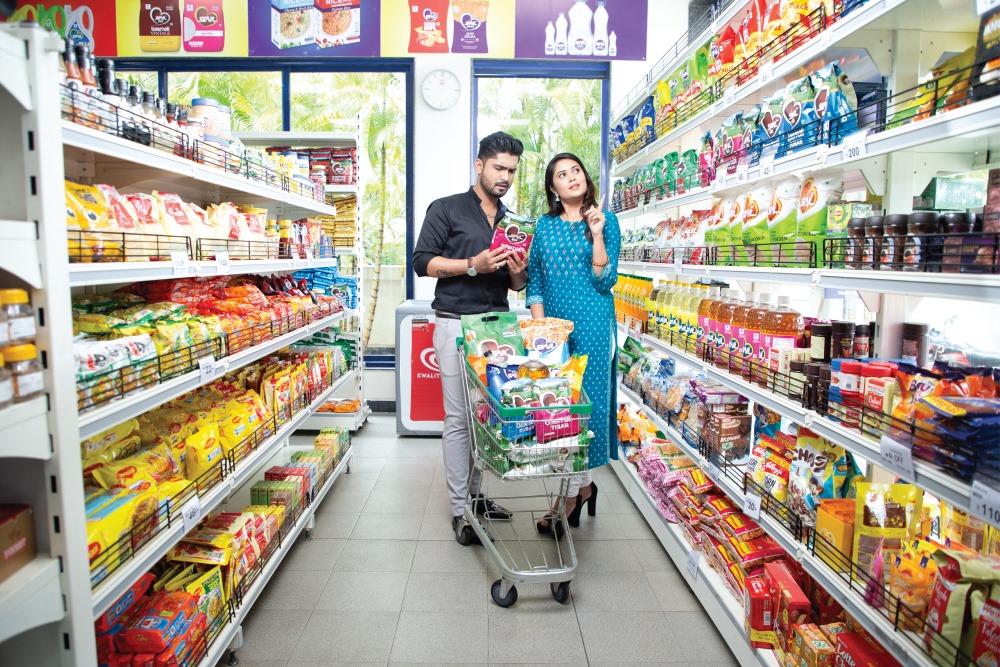
Star Localmart describes its customer base as a mirror of evolving semi-urban and rural India. Nearly 65 percent of shoppers fall in the middle-income bracket (Rs.3–8 lakh annual household income), with a growing share of aspirational lower-middle and young working-class consumers. Millennials (25–40) account for around 55 percent of customers, while Gen Z (under 25) is emerging as a fast- influencing segment—tech-savvy, brand-conscious, value-driven.
One can see the split in the basket: Gen Z and younger millennials experiment more with packaged foods, beverages,
and home care products; older customers maintain a strong preference for staples and fresh produce. The throughline is that quality, hygiene, and convenience now sit alongside price as decision drivers—and that shift has increased trust in organized neighbourhood retail.
The average ticket size is around Rs.300. That’s not a trivial figure: it tells you this is everyday retail, not occasional bulk shopping. It’s a store designed for frequency, not spectacle.
Differentiation
Ask Star Localmart what it is competing against, and you get a three-way answer: kiranas, national chains, and quick commerce. Its differentiation pitch is essentially “the bridge.” It
aims to combine the familiarity and personal touch of kiranas with the efficiency, variety, and quality standards of organized retail. It promises wider range and transparent pricing compared to kiranas, while positioning itself as more locally rooted and tailored than large national chains. And while quick
commerce sells speed, Star Localmart says it sells trust, convenience, and value—without delivery premiums.
It’s an elegant positioning—but it has to show up in operating detail to be believable. That’s where the numbers matter.
Category Mix
Food staples contribute nearly 55 percent of revenue, led by rice, pulses, wheat βlour, and edible oil. Packaged FMCG
contributes around 19 percent (snacks, beverages, dairy, impulse). Home and Personal Care contributes 16 percent. Fresh produce and bakery are around 5 percent, and general merchandise accounts for the remaining 5 percent. This is a mix built for frequency: staples bring the household in regularly; FMCG and HPC deepen the basket and support margins. Each store carries 3,000+ SKUs. Average store size is 1,300–2,000 sq. ft., suggesting compact, neighbourhood-first boxes rather than destination hypermarkets. Total retail area across the network is 183,289 sq. ft. And the footprint is wide inside the two core states—down to a detailed city list across
Maharashtra and Karnataka, reflecting how deep into Tier 2 and 3 clusters the chain has gone.
Own Brands, Private Labels
One area that warrants clear distinction is the role of in-house brands in Star Localmart’s assortment strategy. The retailer’s portfolio includes group-backed FMCG brands under the Ghodawat Consumer umbrella, which together are
expected to contribute nearly 32 percent of sales in FY26. This contribution is led primarily by staples—such as rice, wheat
flour, pulses, and edible oil—where the brands offer consistent quality and strong value pricing.
Importantly, Star Localmart does not position these products as conventional “private labels.” Instead, they are established FMCG brands developed and manufactured within the broader
group ecosystem and supplied through formal commercial arrangements. This distinction allows Star Localmart to
combine the pricing and supply-chain advantages typically associated with private labels, while retaining the credibility and scale of branded FMCG offerings. Either way, the commercial
advantage is clear—and the company makes that case strongly.
Backward Integration
Backward integration is described as a cornerstone of operational efficiency. In-house sourcing and processing of
rice, edible oil, and select snack lines have reduced input costs by 8–10 percent, helping maintain stable margins even
during volatility. Beyond costs, Shrenik emphasizes “complete visibility” across procurement, quality control, and distribution—allowing price consistency and improving freshness and availability.
It strengthens competitiveness against both kiranas and large chains, especially in inflationary environments, and allows greater agility in responding to regional demand shifts. This is how Star Localmart tries to win without becoming addicted to discounting: by making the supply chain do more of the heavy lifting.
Newer FMCG and Home-care Additions
Since 2022, the group has diversified its FMCG portfolio with ready-to-cook and ready-to-eat products, and regional snack
varieties targeted at health-conscious consumers. On the home and personal care side, new sub-brands in dishwash liquids, detergents, and surface cleaners have expanded reach. Star Localmart explicitly links these innovations to higher basket value and its positioning as a “complete household solution provider.”
This is a subtle but meaningful evolution: the store is not only a staples destination; it is becoming a wider household
replenishment platform.
Omnichannel
In 2022, Star Localmart was testing a hyperlocal e-commerce platform. Today, the company’s position is clear: it has not
yet launched the platform, but plans to launch it soon as a fully integrated omni-channel model across towns—allowing customers to browse inventory, place orders, and choose doorstep delivery or store pickup.
Digital is expected to contribute about 8–10 percent of total sales initially and grow as internet penetration deepens. Integration with CRM and loyalty is expected to enable personalized offers, digital billing, and wallet-based payments, with online complementing offline visits for Gen Z and millennials. The phrasing matters: they are not pitching digital as disruption of stores; they’re pitching it as extension
of neighbourhood convenience.
The Tech Backbone
Star Localmart’s stated technology backbone includes SAP Business One, WMS, and 6Dx POS. SAP is described as deeply integrated across inventory and supply chain systems for real-time visibility, accurate demand forecasting, and efficient replenishment—helping minimize wastage and maintain
optimal stock levels across stores.
Beyond SAP, the company is leveraging advanced analytics and
digital tools to improve customer experience—personalized promotions, faster billing, and improved store management—aiming to deliver “the reliability of a national chain with the
agility of a neighbourhood store.”
They also explicitly state that AI- driven analytics has been embedded across assortment planning, pricing optimization, and customer engagement—analysing regional consumption patterns and seasonal trends to fine-tune assortments so
each outlet reflects local demand dynamics. This is one of the strongest examples of “organized retail thinking” being applied to small-town contexts without making the experience feel
impersonal.
Employment, Talent, and the “Viksit Bharat” Lens
Star Localmart places its growth narrative alongside a national
development frame: aligning with the Government of India’s ‘Viksit Bharat 2047’ vision through employment generation, skill-building, and access to quality goods and services in rural
India.
The specific initiatives matter because they move the claim from aspiration to action: recruiting and training local management trainees from regional colleges, launching employee referral programs, and using social media to
attract young talent. The intent is to address talent and employability gaps in rural areas while building a skilled
workforce for the future.
Scale-wise, the company emplys more than 1,000 employees and claims to have generated more than 5,000 employment opportunities to date. This is the human infrastructure behind 165 stores: the chain isn’t just a network of shelves; it’s a network of livelihoods.
Local Brands: The Store as a Launchpad
One of the most interesting parts of Star Localmart’s model is how it describes its relationship with local and regional brands. Local SMEs, Shrenik says, see Star Localmart as a launchpad to scale beyond district boundaries. Examples include regional snack and spice brands from Kolhapur and Dharwad reporting
3–5X sales increases after being listed .
Local dairy and bakery producers benefit from stable recurring orders through Star Localmart’s standardized supply chain.
The support is not just shelf space. Star Localmart says it collaborates with partners on packaging, quality enhancement, and branding support—helping them professionalize while
retaining local authenticity. This is where the “neighbourhood” claim becomes economic: the store is positioned as an ecosystem builder, not only a retailer.
Unit Economics
Star Localmart says most stores now break even within 14–18 months, ahead of its earlier two-year target. Average store EBITDA margins are stated at 22 percent supported by efficient cost structures and disciplined inventory management. The company also notes that average monthly sales per store have grown over the last two years, validating the evolved format
and assortment strategy, with each new opening guided by detailed catchment analysis and cost optimization.
In practical terms, this tells you Star Localmart is trying to build a retail engine that is replicable across towns, not dependent on one-off high-footfall luck.
The Next Five Years
Looking ahead, Star Localmart frames its next phase as a pivotal growth chapter.
A Rs.3,500 crore target is presented as more than a revenue goal—it is tied to empowering rural communities, supporting local entrepreneurs and farmers, and driving inclusive economic
growth.
The roadmap emphasizes strategic expansion into towns and semi-urban areas, creating jobs within the vicinity, and strengthening positioning within India’s modern retail landscape by combining local insights with disciplined execution.
This is where the story comes full circle: the early expansion taught them that footprint without relevance is fragile. The next expansion is being framed as relevance at scale—building a
future-ready network without losing the “neighbourhood” soul.