


With 11.5 million daily orders and quick commerce accounting for nearly 70% of digital grocery spending, India’s food retail industry is undergoing a fundamental transformation. But while order volumes are soaring, profitability, fresh-food economics and distribution efficiency are emerging as the real differentiators.
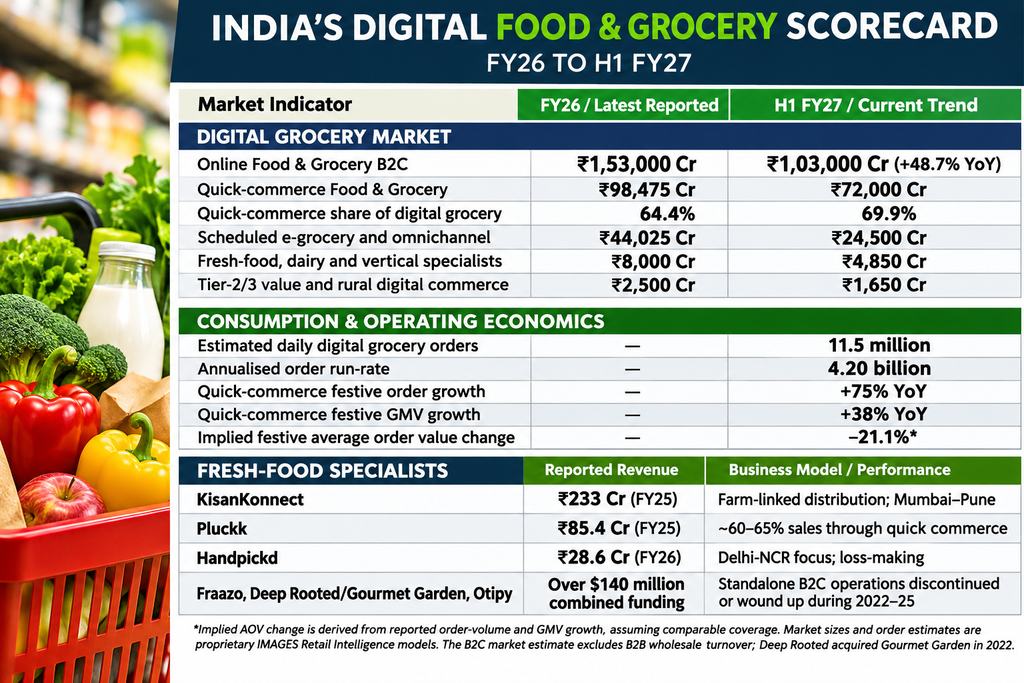
India’s online Food & Grocery B2C market reached an estimated Rs 1.53 lakh crore in FY26, expanding to Rs 1.03 lakh crore in H1 FY27 alone, up 48.7% year-on-year. With approximately 11.5 million daily orders—equivalent to 4.20 billion at an annualised pace—and quick-commerce capturing nearly 70% of digital grocery spending, the sector is rapidly changing how Indian households purchase everyday essentials.
These findings emerge from IMAGES Retail Intelligence’s proprietary bottom-up research covering 30 operating groups across digital grocery, quick commerce, fresh-food specialists, dairy subscriptions, omnichannel retail and B2B food distribution. The market estimate covers B2C grocery spending and excludes B2B wholesale turnover.
The transformation is not merely about faster deliveries. It is reshaping food consumption frequency, product discovery, fresh-produce distribution, FMCG route-to-market strategies and the economics of neighbourhood grocery retail.
Quick-Commerce is Reshaping the Household Grocery Basket
IMAGES Retail Intelligence estimates quick-commerce Food & Grocery spending at Rs 98,475 crore in FY26, rising to Rs 72,000 crore in H1 FY27. Its share of online grocery spending increased from approximately 64% to nearly 70% over the two periods.
Scheduled e-grocery and store-backed omnichannel platforms remain important for planned household purchases, accounting for an estimated Rs 44,025 crore in FY26 and Rs 24,500 crore in H1 FY27. Fresh-food specialists, dairy subscriptions and value-oriented digital platforms address other purchasing occasions.
This segmentation reflects a major change in consumer behaviour. A household that once placed a large monthly grocery order may now supplement it with frequent purchases of milk, bread, eggs, fruits, vegetables, snacks and immediate-need essentials.
For food manufacturers, that means more opportunities for consumption-led product discovery. For retailers, it means managing smaller, more frequent orders without allowing picking, packaging and delivery costs to erode margins.
The operational challenge is substantial. Blinkit, Zepto and Swiggy Instamart together reported 5,130 dark stores at their respective disclosure dates, while Flipkart Minutes operated approximately 1,200 micro-fulfilment hubs. These are not identical formats, but their combined scale illustrates the investment being made in proximity-based retail.
The Profitability Divide: Scale is No Longer Enough
The competitive race is increasingly being decided by fulfilment productivity and financial performance rather than geographical expansion alone.
Blinkit reported Rs 20,940 crore in Net Order Value in Q2 FY27, alongside Rs 184 crore in positive adjusted EBITDA, demonstrating progress towards stronger platform economics. However, adjusted EBITDA is not equivalent to statutory net profit, and profitability remains uneven across the industry.
BigBasket’s decision to rationalise its geographical footprint from approximately 76–80 cities towards 40 core markets reflects another approach: concentrating operations where customer density and fulfilment economics offer better prospects.
Meanwhile, Swiggy Instamart’s expansion to 133 cities and Flipkart Minutes’ presence across more than 150 cities demonstrate that geographical growth remains an important competitive strategy.
The divergence points to a fundamental industry question: can rising order frequency generate sufficient merchandise contribution and operational efficiency to justify increasingly dense delivery networks?
Fresh-Food Specialists Face a Tougher Test
Fresh produce, dairy and proteins offer attractive repeat-purchase opportunities, but their operating economics are considerably more demanding than those of shelf-stable packaged foods.
Four prominent venture-backed specialists—Fraazo, Deep Rooted, Gourmet Garden and Otipy—collectively attracted more than $140 million in funding, with Deep Rooted having acquired Gourmet Garden in 2022. These businesses subsequently discontinued or wound up their standalone B2C operations between 2022 and 2025, highlighting the difficulties of perishable inventory, wastage, customer acquisition and last-mile fulfilment.
Other specialists are pursuing differentiated models.
KisanKonnect reported FY25 revenue of Rs 233 crore, supported by a farm-linked distribution network concentrated around Mumbai and Pune. Pluckk, with FY25 revenue of Rs 85.4 crore, routed approximately 60%–65% of sales through quick-commerce platforms, reducing its dependence on proprietary last-mile delivery. Handpickd, focused on Delhi-NCR, reported FY26 revenue of Rs 28.6 crore but continued to incur substantial losses.
The emerging distinction is between businesses capable of translating product quality into repeat purchases and efficient distribution, and those whose fulfilment costs overwhelm their merchandise margins.
Digital Grocery Is Opening New Routes for Indian Food Brands
One of the most consequential changes is taking place on the digital shelf.
Emerging food brands can increasingly use quick-commerce platforms and online marketplaces to introduce products, test consumer demand and expand into new catchments without first building extensive physical distribution networks.
Brands such as Farmley, The Whole Truth, iD Fresh Food, Slurrp Farm, Let’s Try, TagZ Foods, boba Bhai and Skippi Ice Pops illustrate the growing importance of differentiated propositions spanning healthy snacking, refrigerated convenience foods, children’s nutrition and specialty products.
However, digital visibility does not automatically translate into profitable growth. Platform commissions, promotional spending, advertising costs, fulfilment charges and customer retention remain critical.
For established FMCG manufacturers, digital grocery is becoming an increasingly important channel for assortment innovation, impulse consumption and faster product discovery. For emerging brands, the opportunity lies in building a sustainable balance between digital reach and wider offline distribution.
Festive Shopping Reveals a Frequency-Driven Market
The October–November 2026 festive shopping period reinforced the changing dynamics of digital consumption.
Across the broader online retail market, festive gross sales reached approximately Rs 1.41 lakh crore over 34 days, up 17% year-on-year.
Quick-commerce order volumes increased approximately 75%, while GMV grew 38%. If measured on comparable bases, these growth rates imply an approximately 21% decline in average order value, suggesting that transaction frequency is growing faster than spending per order.
The separate reported 13% decline in average online card transaction value relates to broader e-commerce, not grocery specifically.
For food retailers and brands, the festive opportunity increasingly extends beyond traditional bulk purchases to urgent replenishment, confectionery, beverages, snacks, dry fruits, gifting hampers and celebration-related consumption.
The business opportunity is significant, but it also requires careful management of seasonal inventory, delivery capacity and margins.
Beyond Metros: The Opportunity for Regional Grocery Retailers
Digital grocery’s next phase will not be determined solely by the number of dark stores opened in Tier-2 and Tier-3 cities.
Regional supermarket chains, neighbourhood grocers, dairy specialists and farm-linked suppliers may have advantages in local sourcing, customer familiarity and existing physical infrastructure.
A supermarket capable of serving walk-in customers while fulfilling local digital orders from shared inventory can potentially offer a more capital-efficient alternative to standalone fulfilment infrastructure in selected markets.
JioMart’s access to Reliance Retail’s physical grocery network and the continuing evolution of store-backed omnichannel models illustrate the strategic importance of integrating retail infrastructure with digital convenience.
B2B food-distribution networks, including Hyperpure, Udaan, ElasticRun, Jumbotail, DeHaat and Ninjacart, are also contributing to changes in sourcing, wholesale distribution and supply-chain efficiency. Their wholesale revenues, however, are distinct from the B2C digital grocery market estimate.
For food manufacturers, these developments create opportunities to strengthen regional distribution while using digital platforms for targeted customer access and product discovery.
The Rs 1.21 Lakh Crore Question: Digital-First Versus Store-Led Grocery
As physical and online grocery converge, the distinction between digital transactions and genuinely separate retail spending becomes increasingly important.
IMAGES Retail Intelligence estimates approximately Rs 32,000 crore of store-led omnichannel overlap within its FY26 online Food & Grocery B2C market model. Adjusting the Rs 1.53 lakh crore estimate for this overlap produces approximately Rs 1.21 lakh crore in net digital-first spending.
This is equivalent to 29.5% of the modelled Rs 4.10 lakh crore organised Food & Grocery market. The comparison is a proprietary research-model indicator, not an audited market share or a measure of economically incremental consumption.
The distinction matters because the same household may increasingly shop through supermarkets, delivery apps, subscription services and hyperlocal platforms.
What Comes Next?
India’s digital Food & Grocery economy has entered a phase in which the quality of growth matters as much as its speed.
For quick-commerce operators, the priorities are order density, merchandise productivity and profitable fulfilment. For fresh-food specialists, they are procurement efficiency, inventory turnover and repeat purchasing. For FMCG brands, the challenge is to convert digital discovery into sustainable distribution. And for physical grocery retailers, the opportunity lies in combining local strengths with digital convenience.
The next winners in Indian food retail may not necessarily be those delivering the fastest or operating the largest networks, but those capable of serving increasingly frequent household needs while protecting margins and capital efficiency.
Source: IMAGES Retail Intelligence proprietary research, company disclosures and compiled industry data. Market-sizing estimates are modelled; company financial and operating metrics refer to their respective reported periods.