


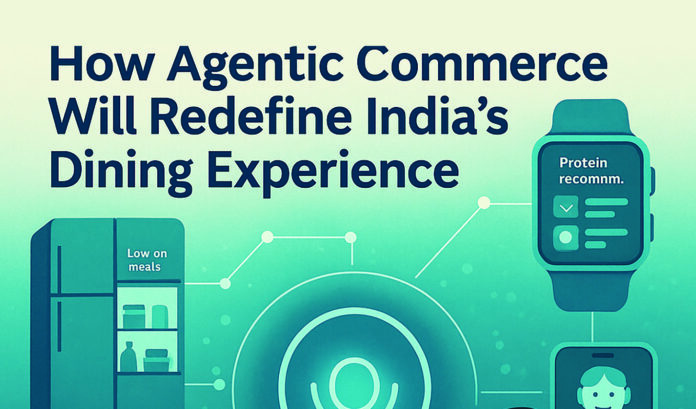

When you think of ordering food, you think of typing, scrolling, and searching. But what if, in the near future, you didn’t have to? What if your digital assistant already knew when you’d be hungry, what you’d crave, and which restaurant nearby could make it exactly the way you like it — without you lifting a finger?
Welcome to the age of Agentic Commerce — where intelligent systems don’t just display choices; they act on behalf of the customer, learning from preferences, routines, and moments.
In India’s food industry, this could be transformative. Imagine a world where:
• Your fridge tells your favorite restaurant you’re running low on fresh meals.
• Your health app recommends protein-heavy lunch options based on your week’s activity.
• Your AI companion automatically reorders your go-to thali from a local eatery when you’re working late.
For restaurants, this means demand becomes predictive, not reactive. For consumers, it means dining becomes effortless and intuitive.
But it also raises a crucial shift: in the era of agentic commerce, ownership of the customer relationship becomes the ultimate asset. Aggregators and delivery apps may no longer control the front door — intelligent, direct-brand connections will.
Forward-thinking restaurateurs are already testing “AI-first” loyalty programs, personalized meal recommendations, and phygital menus that respond to time, weather, and past orders. The restaurant of the future won’t wait for orders; it will anticipate them.
And that’s where solutions like RetailGPT come in — helping food brands and restaurants build agentic experiences that combine AI-driven personalization with human warmth. RetailGPT enables restaurants to design campaigns and customer journeys that learn, adapt, and act automatically — ensuring the chef’s craft meets the diner’s craving, before either even asks.
The future of dining in India won’t be about faster delivery. It’ll be about intuitive connection — food that finds you, not the other way around.
As India’s digital-native population crosses 900 million smartphone users, this shift toward agentic behaviour becomes even more meaningful. With millions of daily micro-interactions — from step counts and sleep patterns to payment histories and location trails — AI systems now have the contextual intelligence to interpret not just what consumers want, but why they want it. This transforms food-service from a one-way transaction into a dynamic, multi-layered engagement where every preference, constraint, and occasion is understood at a granular level.
For restaurants, this opens a new operational frontier. Kitchens will become semi-autonomous, with forecasting engines adjusting prep in real time to cut waste and optimise ingredients. Smart inventory systems will trigger procurement the moment demand spikes — whether it’s paneer dishes on a rainy day or healthy bowls after New Year fitness pushes. Human roles will shift from routine tasks to craftsmanship, hospitality, and supervising intelligent systems.
Consumer expectations will also rise. Personalisation will be the default, with diners expecting restaurants to remember spice levels, allergens, portions, delivery timings, and even mood-based cravings. Brands that use AI ethically and transparently will earn deeper trust, especially as data privacy becomes central to loyalty. Those that don’t will risk fading out in a world where digital agents, not humans, drive discovery.
This shift doesn’t replace human judgment — it strengthens it. Chefs, servers, and managers become even more intuitive when supported by real-time insights. Agentic commerce delivers a level of precision and foresight manual systems cannot match. In a country as diverse as India, this fusion of intuition and intelligence could unlock a new era of culinary innovation.