

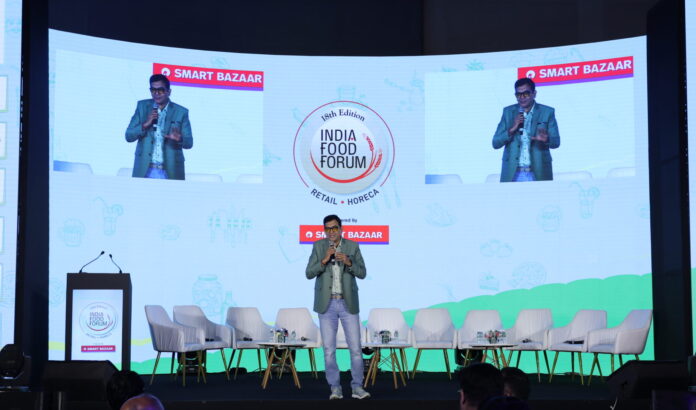

The conference hall at the Jio World Convention Centre in Mumbai had already been energised by a spirited opening session when Padma Shri Chef Sanjeev Kapoor took the stage. Instead of launching straight into doctrine or disruption, he began with appreciation—acknowledging the quality of dialogue that had preceded him and applauding the people who make such platforms possible. India Food Forum, he reminded the audience, exists for a reason: an industry as fragmented as food needs collective strength far more than isolated excellence. That idea—collective power over individual silos—would quietly anchor everything that followed.
Chef Kapoor spoke not just as India’s most recognisable culinary figure, but as someone who has seen the food business from every angle: from kitchens to consumers, from restaurants to retail, from tradition to transformation. And as he framed it, the HoReCa and food service ecosystem now stands at a moment where change is no longer optional, gradual, or theoretical.
Change is not a Choice—Only Your Response is
Every industry talks about change. Food service, according to Chef Kapoor, often discusses it nostalgically—comparing where it has come from rather than preparing for where it is headed. Change, he argued, presents itself in only two ways. You can cause it, initiating small ripples that grow into meaningful transformation. Or you can participate in it, adapting as it unfolds around you. What you cannot do is resist it. Change happens regardless—this is evolution, not disruption theatre. For food service professionals, the real question is no longer whether the industry will change, but whether they are ready for the form that change has already taken.
Redefining “Service”: The Most Overlooked Transformation
Much of the food conversation, Chef Kapoor observed, still revolves around cuisine—authenticity, recipes, chefs, ingredients. These are important, but they are no longer the axis on which the business turns. The most significant shift, he said, lies in how the industry understands the word “service.”
“Food service once meant something very specific: an out-of-home experience. A physical destination—a restaurant, a café, a QSR—where the consumer travelled to be served. That definition held true for decades. It no longer does,” noted Chef Kapoor. Today, the same food can reach the consumer in multiple ways:
- Cooked or assembled and delivered to the home
- Ordered and consumed at the workplace
- Picked up while travelling
- Carried as takeaway
- Delivered through quick commerce models, often faster than traditional dine-in timelines
Each of these, Chef Kapoor stressed, is not a separate business—it is a different service touchpoint of the same food offering.
The Era of Omni-Channel Food Service
This multiplicity of touchpoints leads to one unavoidable conclusion: food service is now omni-channel by default. Fresh food, wherever it is cooked or served, must recognise this reality. And while there will always be exceptions—destination restaurants, experiential dining, hyper-specialist formats—Chef Kapoor estimated that nearly 80% of food service businesses by both value and volume cannot afford to ignore omni-channel presence. Resistance, he warned candidly, may feel principled today but will appear costly tomorrow. His confidence was not rhetorical bravado. It was grounded in lived experience—both in food and beyond.
Being Where the Consumer is—Not Where You Want Them to Be
Chef Kapoor drew a parallel from his entrepreneurial journey with Wonderchef, which began long before omni-channel retail was fashionable. The principle guiding that venture, he shared, came from his father: never expect the consumer to be dependent on you; your business must go where the consumer already is. That philosophy, he suggested, applies even more urgently to food service today. “Consumers will not adjust their habits to suit your format. The burden of adaptation rests entirely with the business.”
Focus in an Omni World: Knowing Where Not to Go
At first glance, omni-channel expansion appears to contradict another principle Chef Kapoor considers critical: focus. Quoting his brother, a strategy consultant, he reminded the audience that if you try to go everywhere without clarity, you risk reaching nowhere. “Omni-channel does not mean omnipresent chaos. It demands intentional choices about formats, brands, price points, and execution models.”
Reaching everywhere, he clarified, may require multiple brands, differentiated formats, or segmented strategies—but what cannot be compromised is clarity of direction. The urgency is not tomorrow. It is today. The earlier businesses start, the greater their chance of shaping outcomes rather than reacting to them. He cited examples like Wow! Momo as early movers who recognised this reality and acted decisively—illustrating how focus and omni-reach can coexist when strategy is clear.
Reframing Authenticity: A Thought for the Chefs
As he closed, Chef Kapoor addressed a topic close to many hearts in the room: authenticity. Authenticity, he suggested, is often misunderstood as historical purity. In reality, much of what we consider “authentic” today was once innovation. “Authenticity is not about someone else’s grandmother’s recipe—it is about being truthful to what you claim and delivering on that promise.” Consumers, he said, are far more perceptive than the industry often assumes. They understand authenticity not as nostalgia, but as consistency between promise and experience.
The Power of Coming Together
Before stepping down, Chef Kapoor returned to where he began—collective strength. The presence of top retail leaders in the room, he noted, was itself proof of what collaboration can achieve. Food service, he urged, must expand that circle. Meet more. Talk more. Bring more voices in. The future will belong not to isolated stars, but to industries that move together.