



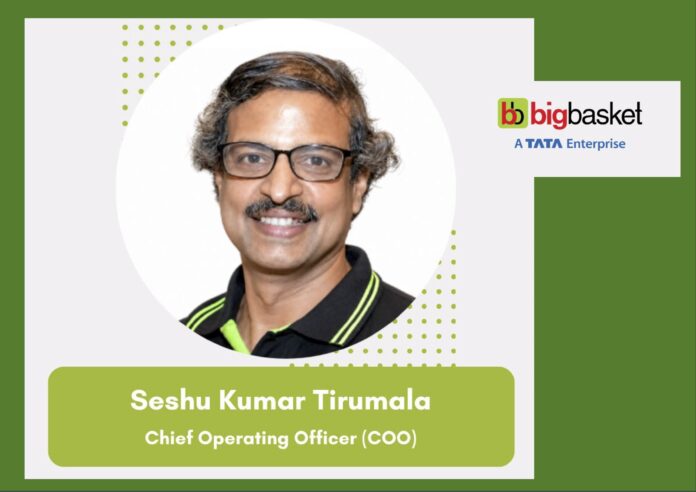
As Tata Group-backed online grocery major BigBasket pushes through one of the most critical transformation phases in its history, the company has elevated long-time merchandising and sourcing veteran Seshu Kumar Tirumala as its new Chief Operating Officer (COO), placing him at the centre of its next growth and profitability agenda.
The appointment comes at a defining moment for bigbasket, which spent FY26 aggressively restructuring itself from a legacy scheduled-delivery grocery platform into a full-scale quick commerce player capable of competing with hypergrowth rivals such as Blinkit, Swiggy Instamart and Zepto.
Under the new mandate, Seshu will lead operations while overseeing the company’s agri, sourcing and supply ecosystem — areas increasingly becoming decisive battlegrounds in India’s rapid-delivery economy.
In a statement following his elevation, Seshu said:
“I’m excited to take on this role and continue building on the strong foundation we’ve created over the years. Having driven the growth and evolution of our sourcing and merchandising capabilities, my focus will now be on driving excellence across operations, strengthening our agri and supply ecosystem and executing with greater speed, quality, and impact.”
BigBasket’s FY26 Reset: Growth at Scale, But With Profitability Discipline
FY26 marked a strategic reset year for BigBasket.
After consolidated operating revenue declined 2% year-on-year in FY25 to ₹9,866.7 crore, the company entered FY26 with an ambitious target of achieving 50–60% revenue growth while simultaneously rebuilding its quick commerce infrastructure and operational architecture.
However, unlike the hyper-aggressive “growth-at-any-cost” playbook dominating the sector, BigBasket’s leadership gradually shifted toward a more calibrated strategy focused on unit economics and dark-store profitability.
The company’s rapid quick-commerce expansion had sharply impacted profitability, with consolidated net losses crossing ₹2,006 crore due to infrastructure investments, fulfilment costs, dark-store expansion and customer acquisition spending.
By mid-2026, BigBasket leadership openly acknowledged that profitability would take precedence over pure market-share pursuit.
Co-founder Vipul Parekh publicly stated that the company was willing to cede some market share if required in order to improve dark-store level economics and build a more sustainable operational model instead of burning excessive capital to chase growth.
The strategic shift reflects a broader maturation underway in India’s quick commerce sector, where investors are increasingly rewarding operational efficiency, repeat customer quality and contribution margins rather than only Gross Merchandise Value (GMV) expansion.
The Operational Engine Behind BigBasket’s Transformation
This is precisely where Seshu Kumar Tirumala’s elevation gains significance.
Over the past 11 years at BigBasket, Seshu has been one of the principal architects behind the company’s merchandising, sourcing and category-management systems.
Beginning as National Head – Buying & Merchandising and later becoming Chief Buying and Merchandising Officer, he played a central role in building:
- large-scale sourcing networks,
- fresh produce supply chains,
- private label expansion,
- regional assortment strategies,
- vendor partnerships,
- and category profitability frameworks.
Industry executives credit him with helping create some of BigBasket’s strongest differentiation levers — particularly in fresh foods, staples and private brands.
Today, BigBasket’s private label portfolio — including brands such as Fresho and BB Royal — contributes nearly 36–37% of total turnover, among the highest private-label mixes in Indian grocery commerce. The company is now targeting expansion of private-label contribution to nearly 40%, given the segment’s significantly superior margins and customer stickiness.
His operational understanding across sourcing, merchandising and category economics is expected to become increasingly critical as BigBasket attempts to balance growth with profitability.
Rapid Dark Store Expansion and 10-Minute Delivery Push
During FY26, BigBasket dramatically accelerated its quick commerce infrastructure buildout.
Its dark-store network reportedly expanded from nearly 700 locations to around 1,200 stores, enabling the company to offer standardised 10-to-15-minute deliveries across a larger set of urban markets.
The company also integrated rapid prepared-food deliveries into its ecosystem by leveraging Tata Group synergies through brands such as Starbucks and Qmin, allowing dark stores to improve order density and basket economics.
Alongside grocery, BigBasket also expanded aggressively into higher-ticket and higher-margin non-grocery categories. Electronics — including mobile phones and small appliances delivered instantly — now reportedly contribute 7–8% of platform revenue, reflecting the widening scope of quick commerce beyond daily essentials.
Competing in an Intensely Crowded Market
Despite its scale, strong Tata backing and leadership in online grocery, BigBasket has struggled to match the hyper-growth pace of newer quick-commerce-first competitors.
Industry estimates tracking GMV suggest that BigBasket’s BB Now vertical currently holds roughly 7% share of India’s quick commerce market, compared with:
- Blinkit: 46%
- Swiggy Instamart: 27%
- Zepto: 21%
Management has attributed part of this gap to the operational complexity of transforming a traditional slotted-delivery grocery business into a hyperlocal instant-delivery network.
Yet analysts argue that BigBasket’s deep sourcing capabilities, strong fresh-food backbone, large private-label business and Tata ecosystem integration continue to provide meaningful long-term strategic advantages.
The company is also pursuing a long-term ambition of scaling revenues to nearly $3 billion (approximately ₹25,000 crore) while targeting EBITDA margins of 4–5% as it gradually prepares the groundwork for a future IPO.
A Retail Veteran Built for Complex Scale
Seshu’s appointment also reflects BigBasket’s preference for institutional continuity during a period of operational transition.
An MBA graduate from Indian Institute of Management Ahmedabad and a mechanical engineering graduate from Andhra University, Seshu brings more than three decades of retail and consumer-sector experience.
Before joining BigBasket, he spent over a decade at ITC Limited, where he headed the rural hypermarket business “Choupal Saagar,” a pioneering model integrating agri procurement and rural retail consumption.
Earlier in his career, he also worked with Fabmall, helping establish some of Bengaluru’s earliest grocery supermarket formats while participating in India’s early online grocery evolution.
His professional journey additionally includes stints at KSA Technopak, Walt Disney India Ltd and Asian Paints.
As India’s grocery and quick commerce ecosystem enters a more disciplined phase focused on sustainable growth, Seshu Kumar Tirumala’s elevation signals BigBasket’s intent to place operational depth, supply-chain intelligence and execution discipline at the core of its next chapter.