

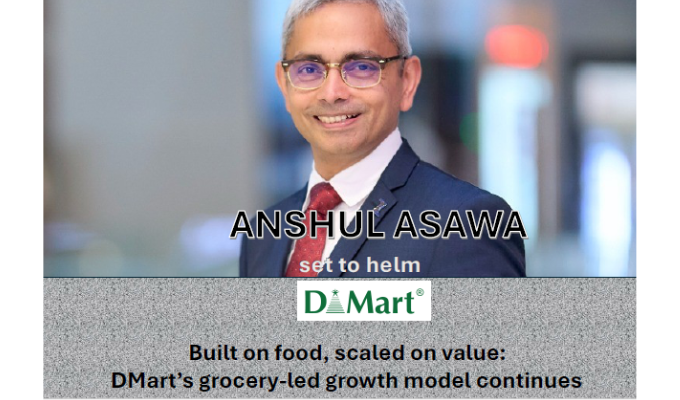

When Anshul Asawa formally takes over as Chief Executive Officer of Avenue Supermarts from February 1, 2026, and later assumes the role of Managing Director from April 1, 2026, he inherits not just one of India’s most admired retail companies—but one of the country’s most disciplined food and grocery engines.
With a market capitalisation of nearly Rs. 2.5 lakh crore, 442 stores across India, and FY25 revenues of ~Rs. 57,790 crore, DMart today sits at the heart of India’s consumption story—anchored firmly in food and grocery, the category that continues to define its scale, footfalls, and relevance.
Food & Grocery: The Core of DMart’s Business Model
Unlike many diversified retailers, DMart’s growth story remains fundamentally food-led. Groceries, staples, and food essentials consistently account for 56–58% of total revenues, making this the single largest contributor to the business. This basket includes staples, packaged foods, dairy, beverages, frozen foods, fruits, and vegetables—categories that drive daily footfalls and high-frequency shopping.
Non-food FMCG—primarily home care and personal care—adds another 20–21%, while general merchandise and apparel contribute 22–23% of revenues. This mix is deliberate: food pulls customers in; higher-margin discretionary categories improve overall profitability.
Margins: Thin Where It Matters, Smart Where It Counts
DMart’s food and grocery dominance comes with a clear trade-off. The company’s Everyday Low Price (EDLP) strategy keeps margins intentionally thin in core categories:
- Grocery and FMCG margins typically range between 4–8%
- Fresh produce and select private-label staples, however, deliver significantly higher margins—up to 50% in fruits and vegetables and as high as 80% in certain private-label food staples
The real strength of the model lies in cross-subsidisation. High grocery-led footfalls enable DMart to drive sales in apparel and footwear (20–30% margins) and home essentials (15–20%), helping the company sustain profitability without diluting its value promise in food.
Scale, Discipline, and Real Estate Advantage
What continues to set DMart apart in food retail is cost control beyond the shelf. A significant portion of DMart’s stores operate from self-owned properties or long-tenure leases, insulating the business from rental inflation—a critical advantage in a low-margin, high-volume category like food.
The retailer’s cluster-based expansion strategy further sharpens supply-chain efficiency, reduces logistics costs and improves inventory turns—especially vital in fresh and perishable categories.
As of December 31, 2025, DMart had expanded to 442 stores, adding 10 new stores in Q3 FY26, with a strong presence in Maharashtra, Gujarat, and Telangana, and increasing focus on North India as the next growth frontier.
Recent Performance: Growth with Near-Term Pressure
Financially, DMart continues to grow, though not without challenges. In Q3 FY26, the company reported:
- Revenue of Rs. 17,613 crore, up 13.3% YoY
- PAT of Rs. 923 crore, up ~18% YoY
For FY25, Avenue Supermarts posted:
However, analysts have noted pressure on earnings growth entering FY26, with recent quarters among the weakest in years, leading to short-term softness in share prices. Slower discretionary demand and food price volatility have tested margins, even as volumes remain steady.
- Revenue: ~Rs. 57,790 crore
- PAT: ~Rs. 2,927 crore
E-commerce: DMart Ready Scales, Carefully
DMart’s digital arm, DMart Ready, continues to expand methodically rather than aggressively. In FY25, online grocery sales reached ~Rs. 3,502 crore, a 21% YoY increase. The platform leverages existing stores as fulfilment hubs, staying aligned with DMart’s cost-first philosophy—though digital operations remain margin-dilutive in the near term.
Leadership Transition: Continuity over Disruption
Asawa succeeds Ignatius Navil Noronha, under whose stewardship DMart scaled nationally, executed a landmark IPO in 2017, and institutionalised Damani’s philosophy of long-term thinking, frugality, and operational rigour.
With nearly 30 years at Unilever, Asawa brings deep expertise across FMCG, distribution, brand building, and digital commerce. The expectation is not a reinvention of DMart’s food business—but a sharpening of execution, especially as food inflation, quick commerce, and omnichannel competition reshape consumer behaviour.
Looking Ahead
For the food and grocery ecosystem, DMart remains a benchmark: a retailer that proves scale can coexist with value, and that disciplined execution still matters in a market increasingly obsessed with speed and convenience.
As Anshul Asawa steps in, the real question is not whether DMart will chase new retail trends—but how it will protect and evolve India’s most resilient food-first value retail model, without compromising the principles that built it.