



Akshayakalpa Organic is scaling a farmer-led dairy model with measured expansion, deeper urban markets and a growing portfolio built around quality, traceability and trust.
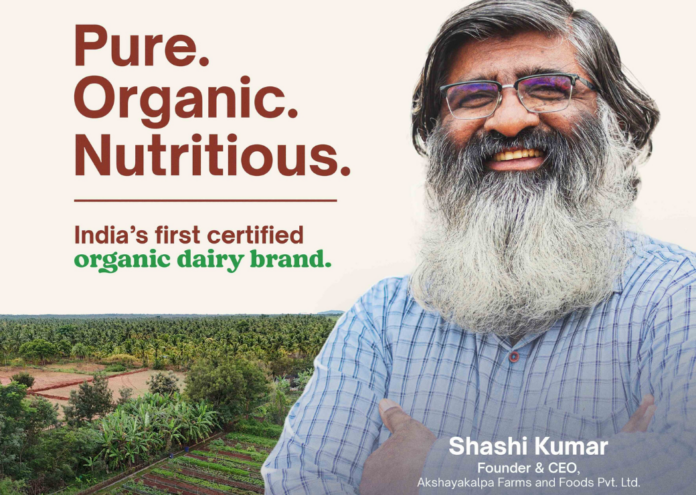
Founded in 2010 by Shashi Kumar, Akshayakalpa Organic began with a vision to build a more sustainable and farmer-centric dairy ecosystem, starting with a network of just three farmers. Over the years, the brand has built its portfolio around everyday dairy consumption, gradually expanding into value-added formats.
Milk and milk products remain the backbone of the business, contributing approximately 80% of total revenue, while paneer, cheese and Greek yoghurt have broadened its presence across the dairy basket. Its recent entry into high-protein dairy, including high-protein milk in vanilla, elaichi and strawberry variants, reflects the growing role of nutrition-led products in everyday consumption.
The brand has deliberately maintained a focused portfolio of fewer than 15 core SKUs, choosing to build depth in selected categories rather than pursue every emerging opportunity. This approach is closely linked to its farmer-led sourcing model, with Akshayakalpa training and monitoring farmers for 12–18 months on organic farming practices and production standards. The emphasis remains on maintaining quality, traceability and consistency from farm to product, while value-added dairy continues to create room for newer consumption occasions around protein, convenience and differentiated formats.
Scaling the Farm, Sustaining the Model
Akshayakalpa’s farmer-led sourcing model has remained central to its growth, with expansion paced by the development of the underlying farm and supply infrastructure. Rather than building the brand first and sourcing milk through conventional channels, the company developed a standardised, high-investment farm model focused on 20–25 cow enterprises, better animal care, farm-grown fodder and scientifically managed farming practices. On-site milk processing further strengthens control over quality and reduces dependence on third-party collection centres.
Scaling this model has required a long-term approach. The Tiptur cluster took 15 years to reach approximately 1,700 farms, while Chennai took seven years, and Telangana continues to be in the procurement-building phase. The company has also expanded into Mumbai and Pune and is developing a new organic farming cluster in Maharashtra’s Ahilyanagar district, which is expected to begin commercial production by 2030 with an initial capacity of around 50,000 litres per day.
This supply-led strategy has meant consciously limiting the pace of growth, historically to around 20–25% annually, with a longer-term ambition closer to 10%, while prioritising farmer profitability, operational depth and consistency. After nearly a decade of investment, the company is now EBITDA positive.
This approach also shapes how Akshayakalpa thinks about pricing and accessibility. Its model is designed to balance consumer value with sustainable economics for farmers, rather than treating premium pricing in isolation from the supply chain.
“Our initial farm model was designed to bring production costs to approximately Rs 22 per litre while ensuring farmers received Rs 38 per litre. This changed the economics of dairy farming for participating farmers, with average farmer income rising to more than Rs 80,000 per month. Direct-to-consumer distribution then became important because it helped us protect farmer pricing while maintaining greater control over quality and the consumer experience,” explains Shashi Kumar, CEO & Founder, Akshayakalpa Organic.
Bengaluru Leads the Revenue Base
Akshayakalpa’s business remains concentrated across a select set of markets, reflecting its supply-led approach to geographic expansion. Bengaluru is currently the largest revenue contributor, accounting for approximately 75% of the company’s monthly revenue. The business generates around Rs 60 crore in monthly revenue, translating to an annualised revenue run rate of approximately Rs 720 crore. Bengaluru, Chennai and Hyderabad are the three core markets, delivering more than 80,000 orders every morning.
“This scale has been built gradually rather than through rapid geographic expansion, because our ability to enter a market depends on building the required farm and procurement infrastructure. We are also expanding into the Mumbai and Pune markets gradually. The broader philosophy is that we do not measure success simply by the number of cities we enter. Our focus remains on building strong supply ecosystems and ensuring farmer profitability and customer retention as we expand,” highlights Kumar.
From Home Delivery to Modern Trade
Akshayakalpa’s distribution model has been built around direct consumer engagement, with subscriptions playing a key role in creating predictable demand and stable unit economics. The company moved towards direct home delivery after encountering challenges with unorganised milk agents, including payment delays and limited process control. It subsequently introduced home delivery through its own app, initially priced at Rs 60 per litre, strengthening its direct relationship with consumers.
Today, the channel mix has expanded beyond the subscription model. Quick commerce contributes approximately 40% of revenue, the company’s own digital platform accounts for another 40%, while modern retail contributes the remaining 20%. The business records an average order value of above Rs 90, while customer retention stands at approximately 40%, highlighting the importance of repeat consumption in its food-focused D2C model.
The Supply-Led Playbook
Akshayakalpa’s expansion strategy is fundamentally supply-led, with both geographic and product expansion guided by the strength of its underlying ecosystem. The brand enters new markets only after establishing the farming base, onboarding and training farmers, completing the organic transition and building the infrastructure required to maintain quality and consistency.
Product expansion follows a similar approach, focusing on categories where its farmer-led sourcing and quality standards can create genuine value. This has driven entries into paneer, cheese, Greek yoghurt and the high-protein range, alongside India’s first certified natural buffalo milk. High-protein milk now contributes nearly Rs 10 crore in monthly revenue, while high-protein paneer sales have reached nearly three tonnes a day.
Traceability from Farm to Consumer
- Farmer-led sourcing: Direct engagement with farms forms the foundation of the traceability model, supported by farmer training, organic transition programmes and standardised farming practices.
- Controlled farm practices: Farms follow a controlled model covering farm-grown fodder, animal health and welfare, and scientifically managed farming practices.
- On-site processing: Milk is processed at the farm level, reducing dependence on third-party collection centres and enabling greater control over quality across the supply chain.
- Consumer transparency: The Farm Visit Programme gives consumers a first-hand view of animal care, fodder, soil practices and processing. More than 45,000 consumers have visited the farms to date.
- Beyond labelling: Traceability is viewed as more than a product label, with the objective of helping consumers understand where their food comes from and how it is produced.
- Awareness-led approach: The brand also conducts label-reading workshops to build food awareness among children and families.
- Disciplined expansion: New clusters are developed carefully so that growth does not outpace the supply infrastructure required to maintain quality, consistency and traceability.
Akshayakalpa Organic’s next phase of growth will focus on strengthening existing markets rather than rapid geographic expansion. The brand plans to deepen its presence in Bengaluru, Chennai and Hyderabad, while selectively developing Mumbai and Pune. It is also building a new organic farming cluster in Maharashtra’s Ahilyanagar district, expected to begin commercial production by 2030.
“For us, growth is ultimately about putting more value in farmers’ hands, strengthening consumer trust and building resilient supply ecosystems—not simply adding more cities,” concludes Kumar.