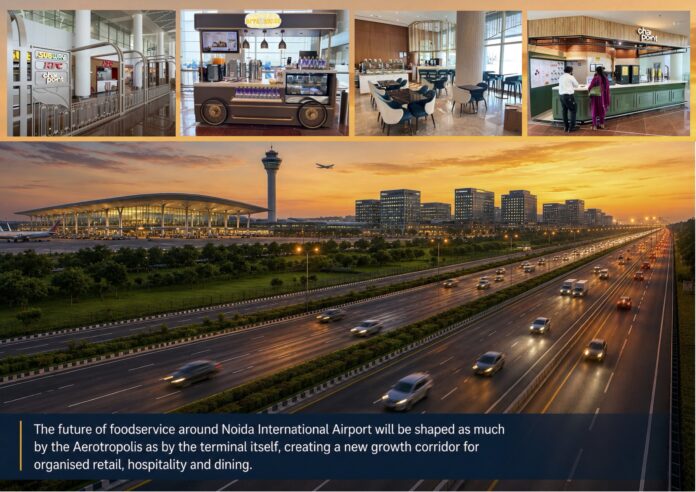

When KFC, Subway, Costa Coffee, Chai Point, Chaayos, Smoor, Flying Bites and Urban Food Market (UFM) opened their outlets at Noida International Airport, they became much more than the airport’s first foodservice tenants. Collectively, they offered the first glimpse of a much larger opportunity that is beginning to unfold along the Yamuna Expressway.
Most airport stories revolve around aircraft, passenger traffic and connectivity. For the organised foodservice industry, however, the more important story starts after passengers leave the terminal. Around the airport, an entirely new urban ecosystem is taking shape—one that could eventually support cafés, quick-service restaurants, food courts, destination dining, hotel restaurants, cloud kitchens and drive-thrus on a scale rarely seen in a greenfield development.
The Airport Is Only the Beginning
Across the world, successful airports have evolved into far more than transport hubs. They have become magnets for investment, attracting hotels, convention centres, corporate offices, logistics parks, retail developments and residential communities. Foodservice is invariably one of the earliest beneficiaries because every new business, hotel or neighbourhood creates fresh dining occasions.
Noida International Airport appears to be following the same trajectory.
While the airport itself is designed to serve millions of passengers, the larger opportunity lies in the 5,100-hectare Aerotropolis planned by the Yamuna Expressway Industrial Development Authority (YEIDA). As commercial districts, hospitality projects and urban infrastructure gradually emerge, the airport will evolve from a point of transit into the centre of a new consumption economy.
For restaurant operators, that distinction changes everything. Instead of evaluating the airport as a standalone location, they must begin looking at it as the anchor of an expanding metropolitan market.
Two Food Economies, One Airport
Every airport creates a captive dining market inside its terminals, but the world’s most successful airport cities generate a second, much larger food economy outside their boundaries.
The first is driven by travellers. It rewards brands that deliver speed, familiarity and operational efficiency within highly regulated environments. Compact kitchens, standardised menus and rapid service are essential because passengers value convenience above almost everything else.
The second economy grows more gradually but ultimately becomes far more significant. Hotels create breakfast, banqueting and all-day dining demand. Office districts generate weekday consumption. Residential neighbourhoods produce repeat local business, while logistics parks and entertainment venues keep foodservice active well beyond traditional meal periods. Together, these diverse demand drivers transform airport retail into a full-fledged urban food ecosystem.
It is this second economy—not the terminal itself—that deserves the closest attention from the foodservice industry.
A Carefully Curated Beginning
The airport’s initial foodservice mix offers important clues about the commercial strategy being adopted.
Rather than filling every available space, the airport has opted for a carefully curated portfolio managed by specialist concessionaires. Travel Food Services (TFS) and HMSHost India (Avolta) oversee the terminal’s food and beverage programme, while TajSATS is establishing a 40,000 sq. ft. in-flight kitchen to support airline catering, airport lounges and selected food operations.
The choice of brands reflects the changing preferences of today’s travellers. Global QSRs sit alongside premium coffee, Indian tea specialists and grab-and-go concepts, creating a balanced portfolio designed around convenience, consistency and throughput rather than sheer variety. It is a strategy increasingly adopted by leading international airports, where operational efficiency is considered as important as culinary choice.
For established foodservice companies, these early openings are significant not merely because they occupy premium airport locations, but because they signal the beginning of a much broader commercial ecosystem.
Looking Beyond the Terminal
Winning an airport concession has traditionally been regarded as the ultimate milestone for restaurant brands. At Noida International Airport, it may prove to be only the first step.
As hotels, commercial districts, logistics hubs and residential communities emerge around the airport, the opportunities for organised foodservice are likely to multiply far beyond the terminal itself. The brands that establish an early presence across this evolving ecosystem—rather than focusing solely on airport retail—could ultimately be the ones that shape North India’s next major foodservice destination.
THE REAL PRIZE LIES BEYOND THE RUNWAY
The first wave of foodservice investment at Noida International Airport is already visible inside the terminal. The second—and potentially far larger—wave will be determined by what happens outside it.
Unlike conventional airports that function largely as transport hubs, Noida International Airport has been conceived as the centrepiece of an integrated Aerotropolis. As hotels, office districts, logistics parks, retail developments, educational institutions and residential communities emerge over the coming years, each will create its own foodservice demand. Collectively, they will transform the airport from a passenger destination into a year-round consumption ecosystem.
For organised foodservice, that distinction is fundamental. Passenger numbers may trigger the opportunity, but they will not define its long-term scale.
Why the Aerotropolis Changes the Rules
Airport terminals are designed for operational efficiency. Every square foot is carefully planned, security protocols are stringent and restaurant formats are optimised for speed and throughput. Outside the terminal, the rules change completely.
The Aerotropolis offers space to build destination restaurants, signature cafés, entertainment-led food courts, neighbourhood dining hubs, hotel restaurants, drive-thrus and even central production kitchens. Unlike airport concessions, which operate within fixed commercial parameters, these developments allow brands to create long-term assets and stronger customer relationships.
More importantly, they generate recurring business. A traveller may pass through an airport once every few months, but an office employee buys coffee every morning, a hotel hosts conferences every week and a residential community creates demand every day. That recurring demand is what turns airport-led development into a sustainable food economy.
A Market That Grows with the City
Perhaps the most compelling aspect of the Yamuna Expressway corridor is that the foodservice market will expand alongside urban development. Every new hotel increases breakfast and banqueting demand. Every office tower creates opportunities for cafés, quick-service restaurants and food courts. Residential neighbourhoods support neighbourhood dining, while convention centres and entertainment venues generate premium dining occasions.
This creates a diversified customer base that extends well beyond airline passengers. Instead of depending on a single source of demand, foodservice operators will be able to serve travellers, business visitors, airport employees, logistics professionals, office workers, local residents and expressway commuters—all within the same geographic corridor.
That diversity is one of the defining characteristics of successful airport cities around the world.
Who Stands to Benefit Most?
Coffee chains are likely to be among the earliest beneficiaries because they naturally serve multiple customer segments throughout the day. Quick-service restaurants will continue to thrive on speed, familiarity and operational consistency, while food courts are expected to become anchors of future mixed-use developments.
Hotels will expand opportunities for premium dining and banqueting, while drive-thrus along the Yamuna Expressway can cater to increasing inter-city traffic. At the same time, cloud kitchens and central commissaries will have an opportunity to build efficient supply networks serving airport outlets, hotels and nearby commercial developments from shared production facilities.
For shopping centre developers, the implications are equally significant. Foodservice is increasingly becoming the primary reason consumers visit retail destinations. Around the Aerotropolis, restaurants, cafés and entertainment-led dining precincts are likely to become destination anchors that enhance footfall, extend dwell time and strengthen the commercial viability of mixed-use projects.
The First Movers Will Shape the Market
One lesson is common to every successful airport city—from Amsterdam and Singapore to Dubai and Delhi Aerocity. The companies that establish an early presence are often the ones that define the market.
Early entrants secure the best locations, develop supply chains ahead of competitors and build brand familiarity before surrounding development reaches maturity. More importantly, they have the opportunity to grow alongside the city rather than enter after the market becomes crowded.
For foodservice companies, this means thinking beyond a single airport outlet. The stronger strategy may be to build an integrated network comprising airport restaurants, neighbourhood cafés, hotel dining, food courts, drive-thrus and cloud kitchens, creating multiple revenue streams from one rapidly developing region.
A New Foodservice Geography
The significance of Noida International Airport extends far beyond aviation. It represents the emergence of a new geography of consumption where airports, hospitality, commerce and urban development reinforce one another.
Whether the Yamuna Expressway ultimately evolves into North India’s next ₹10,000-crore foodservice corridor will depend on the pace of development across the Aerotropolis. Yet the direction is already evident. The airport has created the catalyst; the surrounding ecosystem will determine the scale.
For foodservice companies, hospitality operators and shopping centre developers, the opportunity is no longer confined to winning space inside an airport terminal. It lies in recognising that an entirely new market is taking shape—one where the greatest rewards may belong not to those who arrive first at the gate, but to those who establish themselves across the airport city before it reaches cruising altitude.