


India’s fast-growing RTE and RTC category is being rewritten as health-conscious consumers push brands to rethink ingredients, innovation and value.
India is witnessing a promising surge in the Ready-to-Eat (RTE) and Ready-to-Cook (RTC) market. As per a report from MarkNTel Advisors, a market research company, the India RTC food market size was valued at $1.41 billion in 2025 and is projected to grow from $2.14 billion in 2026 to $8.21 billion by 2032, exhibiting a CAGR of 25.12% during 2026-32. The report further stated that by product type, the frozen ready-to-cook foods segment represented a significant share of about 38% in the India Ready-to-Cook food market in 2026.
Once dominated by instant meals and frozen snacks, the category is increasingly evolving into a space where consumers are looking for products that offer the convenience of packaged food without compromising on ingredient quality, taste or nutritional value.
At the same time, consumers are becoming more selective about what goes into their meals. Concerns around preservatives, artificial ingredients and highly processed foods are prompting a shift toward cleaner labels and products that feel closer to homemade food. As a result, brands are rethinking product development, focusing on shorter ingredient lists, preservative-free formulations, high-protein offerings and recipes that align with evolving wellness goals.
Leading brands such as MTR Foods, ITC Limited, Licious, McCain Foods, and iD Fresh Food are increasingly focusing on products that combine convenience, nutrition, and quality to meet evolving consumer expectations. As lifestyles become busier and health awareness continues to rise, companies are re-imagining product portfolios, ingredient choices, and manufacturing processes to deliver offerings that align with modern consumption patterns.
The market is also witnessing a growing emphasis on transparency, cleaner ingredient labels, and trust-driven brand communication. These shifts are creating new opportunities across the convenience food landscape, positioning health-focused innovation and consumer-centric product development as key drivers of growth in India’s expanding ready-to-eat and ready-to-cook segments.
Convenience Alone is No Longer Enough
While speed and ease of preparation were once the primary purchase drivers, today’s consumers are increasingly evaluating products based on ingredient quality, nutritional value and authenticity. Growing awareness around health, wellness and food labels has made shoppers more selective about what they bring into their homes. Industry players say the evolution of consumer preferences is reshaping innovation across the RTE and RTC categories.
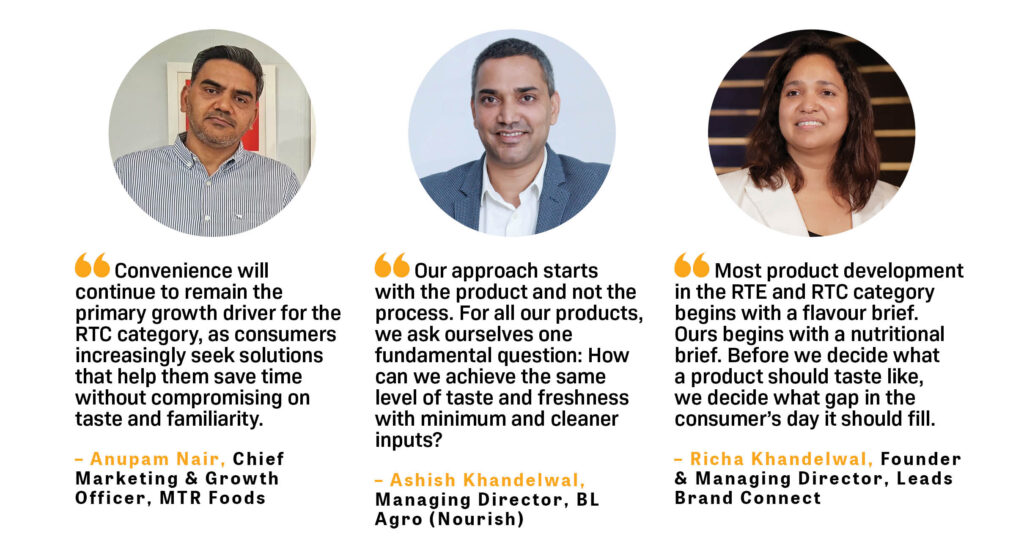
Consumers now expect packaged foods to not only save time but also align with their broader health and lifestyle goals. “Consumers are evolving, and so are their expectations. MTR was among the early brands to recognise the growing need for convenient food solutions, introducing offerings such as the MTR 3-Minute Range. Today, consumers are looking beyond convenience alone. They seek products that combine convenience with quality, permissibility, authenticity, and great taste,” shares Anupam Nair, Chief Marketing and Growth Officer, MTR Foods.
According to Nair, younger urban consumers are increasingly seeking products that fit fast-paced modern lifestyles while continuing to offer familiar flavours and trusted food traditions. “Particularly among younger urban consumers, there is a growing preference for solutions that fit modern lifestyles while continuing to deliver the trusted flavours and food heritage that MTR is known for,” he adds.
The shift is also being felt by brands focused on everyday staples and meal solutions. Ashish Khandelwal, Managing Director, BL Agro, the parent company of Nourish, a brand that makes RTC/RTE products like Poha, Vermicelli, Dalia, Macaroni and more, believes consumers are becoming more conscious of what goes into their food and are increasingly associating convenience with trust.
“Consumers today want convenience but are also paying closer attention to ingredients and nutrition. We are witnessing that consumers are no longer just buying convenience; they are buying trust,” says Khandelwal. He noted that the company is focusing on cleaner formulations and reducing reliance on artificial preservatives while maintaining taste and consistency. “Our approach starts with the product and not the process. For all our products, we ask ourselves one fundamental question: How can we achieve the same level of taste and freshness with minimum and cleaner inputs?” states Ashish.
This consumer shift is encouraging brands to rethink product development, with healthier convenience increasingly emerging as a key battleground in India’s fast-growing RTE and RTC market.
Nutrition-Led Innovation Gains Momentum
For Amazonika Mundi, a brand focused on plant-based and health-oriented food products that also serve RTC foods, changing consumer expectations are reshaping the way new products are developed. Richa Khandelwal, Founder and Managing Director, Leads Brand Connect, which works closely with Amazonika Mundi on brand strategy and communications, says consumers today are approaching ingredient lists very differently from just a few years ago.
“Five years ago, the ingredient list was marketing real estate. Today, it is due diligence. That single shift has redrawn the rules of innovation in our category, and most brands haven’t fully acknowledged it yet,” she says. This change in consumer behaviour has fundamentally influenced Amazonika Mundi’s innovation process. Rather than starting with flavour profiles, the company begins product development by identifying a specific nutritional need.
“Most product development in the RTE and RTC category begins with a flavour brief. Ours begins with a nutritional brief,” she notes. The company is increasingly focusing on products that offer measurable nutritional benefits. “Our Veggie Kofta carries 18.67gm of dietary fibre and 10.12gm of protein per serving. The Burger patties and balls deliver up to 16.43gm of fibre and 15.81gm of protein. These are not garnishes on the pack — they are the reason the product exists,” Richa adds.
The Future of Convenience Is Getting Healthier
As awareness around wellness, preventive health and lifestyle diseases continues to rise, products that combine convenience with cleaner labels, higher nutritional value and greater transparency are gaining traction. For brands, this represents a broader shift in consumer priorities. Nair explains that convenience will continue to be the category’s biggest growth engine, but evolving consumer awareness is adding new dimensions to purchase decisions.
At the same time, he further notes that consumers are becoming more interested in understanding what goes into their food. “While health-focused and clean-label attributes are likely to become increasingly important considerations for consumers, they will complement rather than replace the core demand for convenience,” he states. According to him, the products that succeed in the future will be those that strike the right balance between convenience, taste, quality and transparency.
For Ashish, the shift towards healthy convenience is no longer a future trend but a present-day reality. “It has already arrived in India, especially in urban areas, and is slowly making its way to Tier 2 and 3 markets,” he says. He attributes this shift to a combination of factors, including greater health awareness after the pandemic, rising exposure to global wellness trends and growing concerns around lifestyle diseases such as diabetes, obesity and hypertension. “Brands that will win are the ones that will build their products around healthy eating,” he adds.
Richa believes healthy convenience has already moved beyond the wellness niche and entered the mainstream. She elucidates that consumers today increasingly view food as an important contributor to their overall well-being rather than simply a source of sustenance. She also points to growing demand from working professionals, young families, flexitarians and traditional consumers who are seeking convenient products that do not feel overly processed.
“What we are witnessing is not the rise of a niche but the redefinition of the default,” Richa notes. She also sees significant opportunities for brands through format expansion, foodservice partnerships and consumer education.
As India’s RTE and RTC markets evolve, the bigger question is what kind of convenience they are willing to embrace. Increasingly, the answer appears to be products that save time while offering cleaner ingredients, stronger nutrition credentials and greater transparency. In that sense, healthy convenience is not replacing convenience; it is redefining it.