
At Reliance Industries’ 49th AGM, the spotlight was on AI, Jio’s proposed IPO and the retail giant’s Rs. 3.7 lakh crore revenue milestone. But beneath the headline announcements lies a quieter yet potentially more transformative story: Reliance Retail’s food and grocery business has evolved into one of India’s largest consumption engines, with an estimated annual turnover of Rs 1.8–2.1 lakh crore and ambitions stretching from farms and food parks to quick commerce and global FMCG brands.
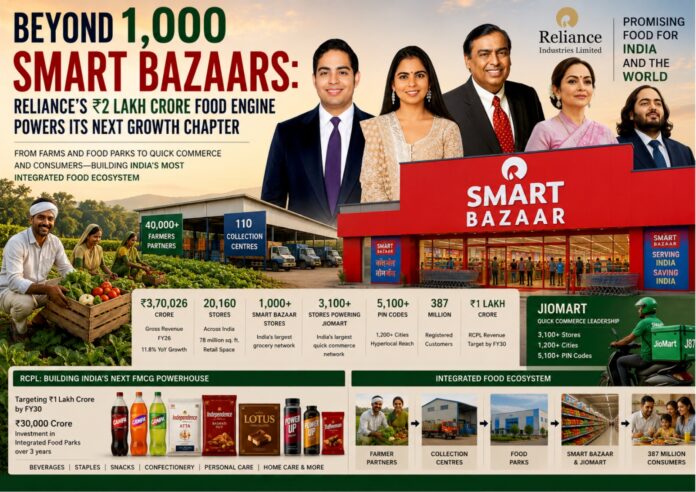
As Reliance Retail completed FY26 with gross revenue of Rs. 3,70,026 crore, EBITDA of Rs. 27,033 crore and net profit of Rs. 13,838 crore, the company also crossed significant milestones in the food and grocery business that increasingly sits at the centre of its growth strategy. Industry estimates suggest food and grocery now contributes nearly 50-60% of Reliance Retail’s overall revenues, making it by far the largest pillar within the group’s retail operations.
The scale of that business is reflected not only in revenues but also in the infrastructure that supports it. Reliance’s flagship grocery format, Smart Bazaar, has crossed the 1,000-store milestone, while the overall retail network has expanded to 20,160 stores serving 387 million registered customers across India. What was once a collection of supermarkets, hypermarkets and convenience stores is today emerging as an integrated food ecosystem spanning sourcing, processing, manufacturing, distribution and digital commerce.
The significance of the 1,000-store Smart Bazaar milestone becomes clearer when viewed through the lens of consumption rather than real estate. In an analysis published earlier this year by IndiaRetailing, Smart Bazaar was described as a nationwide consumption grid rather than merely a store network. Southern markets continue to anchor the format, led by Tamil Nadu, Andhra Pradesh, Karnataka and Kerala, while western and eastern states are becoming increasingly important growth corridors. This geographic spread mirrors India’s evolving consumption patterns, particularly in Tier-2 and Tier-3 cities where organised grocery retail continues to gain market share.
Smart Bazaar: Building India’s Consumption Grid
The store network is only one part of the story. Reliance disclosed at the AGM that it procured over 5.7 lakh metric tonnes of fresh produce during FY26 through a sourcing ecosystem that now connects more than 40,000 farmers across 110 collection centres. This positions the company among India’s largest organised buyers of agricultural produce and gives it unprecedented control over freshness, quality and supply-chain efficiency.
For years, grocery retail in India has been constrained by fragmented sourcing, multiple intermediaries and inconsistent quality standards. Reliance is attempting to address these structural inefficiencies by creating a direct farm-to-consumer model. The implications extend beyond retail. By linking farmers directly to organised distribution channels, the company is building the foundation for a much larger food manufacturing and FMCG business.
The strongest evidence of this shift can be seen in JioMart’s evolution. Once positioned primarily as an e-commerce grocery platform, JioMart has rapidly transformed into one of India’s largest quick-commerce networks. The company revealed that more than 3,100 stores are now functioning as hyperlocal fulfilment hubs, serving over 1,200 cities and 5,100 PIN codes. Unlike pure-play quick-commerce companies that rely heavily on dark stores, Reliance is leveraging its existing retail infrastructure. Every Smart Bazaar, Smart Point and grocery outlet can potentially serve as a fulfilment centre, creating a hybrid model that combines physical retail economics with the convenience of rapid delivery.
This integration of stores and quick commerce is especially important because grocery remains the most frequent consumer purchase category. As quick commerce becomes a daily habit for millions of Indian households, food and grocery orders are increasingly driving customer acquisition, frequency and retention. Reliance’s ability to combine store-based shopping, online ordering and hyperlocal delivery gives it a structural advantage that few competitors can match at national scale.
Yet the most ambitious food-related announcement at the AGM came from Reliance Consumer Products Ltd. (RCPL). Isha Ambani outlined a target that would have seemed unimaginable just a few years ago: building RCPL into a Rs. 1 lakh crore FMCG business by FY30. To support this ambition, Reliance plans to invest Rs. 30,000 crore over the next three years in integrated food parks that will manufacture beverages, chocolates, biscuits, staples and packaged foods using highly automated, AI-enabled production systems.
The scale of this ambition reflects Reliance’s growing confidence in its consumer brands portfolio. Over the past few years, RCPL has assembled an increasingly diverse stable of brands including Campa, Independence, Lotus Chocolates, RasKik, Spinner and several emerging food and beverage labels. Unlike traditional FMCG companies that spend decades building distribution networks, Reliance has the advantage of owning one of the country’s largest retail and digital commerce platforms. Every Smart Bazaar shelf, JioMart order and grocery store becomes a route-to-market for its expanding portfolio.
The strategy also aligns with consumption trends that are already visible across Smart Bazaar stores. As highlighted in my earlier Business of Food story https://www.businessoffood.in/1000-smart-bazaar-stores-anchoring-reliance-retails-%e2%82%b92-lakh-crore-grocery-play/ categories such as health and wellness, ready-to-cook foods, premium ingredients and regional specialties are growing faster than traditional staples. Brands such as Yoga Bar, Farmley, Gits, MasterChow, Moi Soi, Double Horse and Kaka Halwai, many of which have been recognised as Future Forward Brands at India Food Forum, offer a glimpse into the future of grocery consumption. These are precisely the categories where Reliance can leverage its scale to develop private labels, acquire brands or create new manufacturing capabilities.
The proposed food parks could become the missing link between sourcing and branding. Beyond production, they are expected to integrate procurement, processing, packaging and distribution into a single ecosystem. Such facilities would enable Reliance to standardise quality, improve food safety, reduce wastage and create export-ready products. This becomes even more significant when viewed alongside Mukesh Ambani’s broader vision of turning Reliance into a major manufacturing and export powerhouse with a target of $125-150 billion in exports by 2032.
Technology will play a central role in this transformation. Through its AI platform, JioBrain, Reliance is already embedding intelligence into inventory management, demand forecasting and supply-chain operations. In food retail, AI-driven systems are expected to monitor inventory movement from collection centres to store shelves, reduce wastage in fresh produce and optimise replenishment cycles across the network. Combined with the planned food parks, this could create one of India’s most sophisticated food supply chains.
The broader significance of these developments extends far beyond Reliance Retail’s financial performance. What is emerging is a fully integrated food ecosystem connecting 40,000 farmers, 110 collection centres, over 1,000 Smart Bazaars, 3,100 quick-commerce-enabled stores and 387 million consumers. Few companies globally operate across such a wide spectrum of the food value chain.
For the food industry, the message from Reliance’s 49th AGM was unmistakable. While quick commerce may dominate current headlines and AI may capture investor attention, the real long-term opportunity lies in food, grocery and FMCG. By combining sourcing, retail, manufacturing, technology and consumer brands under one umbrella, Reliance is positioning itself not just as India’s largest retailer but potentially as one of the country’s most influential food companies.
And if the company’s Rs. 1 lakh crore FMCG ambition materialises over the next four years, the food business may well become the defining growth story of Reliance Retail’s next decade.