
Friday, June 19, 2026

From Mainland China to Gong: How the Chatterjees Built India’s Most Diverse Restaurant House

spot_img
R S Roy
R S Roy
R S Roy serves as Editorial Advisor at IMAGES Group

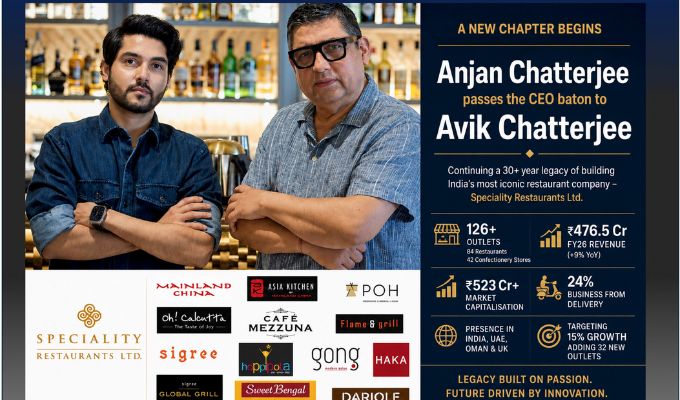
As Anjan Chatterjee hands over the CEO reins to Avik Chatterjee, the bigger story is how Speciality Restaurants created a multi-cuisine food empire spanning Chinese fine dining, Bengali heritage cuisine, grills, cafés, bars, cloud kitchens and confectionery—long before restaurant portfolios became fashionable.

When Anjan Chatterjee opened Mainland China in Mumbai in 1994, few could have imagined that the restaurant would go on to become one of India’s most influential food brands.

At a time when Chinese food in India largely meant neighbourhood eateries serving heavily Indianised dishes, Mainland China introduced consumers to a more authentic and premium dining experience. Elegant interiors, carefully curated menus, professional service and a consistent dining experience helped create what would eventually become one of the country’s most successful restaurant brands.

Three decades later, that single restaurant has evolved into Speciality Restaurants Ltd., India’s only publicly listed restaurant company, operating more than 126 outlets across restaurants, confectionery formats and cloud kitchens, with annual revenues approaching Rs. 500 crore.

Now, with founder Anjan Chatterjee passing the CEO baton to son Avik Chatterjee, the spotlight is not only on leadership succession but on the evolution of one of India’s most diversified restaurant portfolios.

THE MAINLAND CHINA PHENOMENON

For millions of Indians, Mainland China was their first introduction to premium Chinese dining.

The brand built its reputation around Cantonese, Sichuan and Hunan-inspired dishes adapted carefully for Indian palates without losing authenticity. Signature dishes such as Crispy Chilli Potato, Golden Fried Prawns, Burnt Garlic Rice, Exotic Vegetables in Hot Garlic Sauce and various dim sum offerings became category-defining menu items.

Typically positioned in the Rs. 1,200-2,500 per person spending range depending on market and occasion, Mainland China emerged as a preferred destination for family celebrations, corporate meals and special occasions.

Today, despite the arrival of international Asian dining chains and numerous independent operators, Mainland China remains one of India’s most recognised Chinese restaurant brands.

OH! CALCUTTA: PRESERVING A CULINARY HERITAGE

If Mainland China brought China to India, Oh! Calcutta brought Bengal to the rest of the country.

Widely regarded as India’s most successful regional cuisine restaurant brand, Oh! Calcutta transformed Bengali cuisine from a niche regional offering into a premium dining category.

Its menu celebrates heritage dishes such as Chingri Malai Curry, Kosha Mangsho, Bhetki Paturi, Daab Chingri and traditional Bengali sweets. Average spends typically range from Rs. 1,500-3,000 per person, positioning the brand firmly in the premium dining segment.

More importantly, Oh! Calcutta demonstrated that regional Indian cuisines could command national appeal when packaged with authenticity, storytelling and consistency.

ASIA KITCHEN: MAINLAND CHINA FOR A NEW GENERATION

As dining habits evolved, Speciality Restaurants realised younger consumers wanted faster, more casual and more affordable Asian dining experiences.

Asia Kitchen by Mainland China was born from this insight.

Offering pan-Asian cuisine spanning Chinese, Thai, Japanese and Southeast Asian influences, the brand targets younger urban diners with average spends ranging from Rs. 800-1,500 per person.

The format reflects a broader industry trend where consumers increasingly seek frequent dining occasions rather than only celebratory meals.

SIGREE AND GLOBAL GRILL: THE INDIAN BARBECUE STORY

Long before the explosion of buffet grill concepts across India, Sigree helped popularise interactive barbecue dining.

Built around North Indian kebabs, grilled meats, seafood and regional specialties, the brand became synonymous with family gatherings and celebrations.

Sigree Global Grill later evolved the concept by incorporating international grilling styles, live counters and wider buffet selections, competing directly in India’s rapidly growing experiential dining segment.

These formats typically attract groups and families, generating higher average ticket sizes while benefiting from predictable consumption patterns.

SWEET BENGAL: BEYOND RESTAURANTS

Perhaps one of the most underrated brands in the portfolio is Sweet Bengal.

Created to extend the company’s relationship with consumers beyond restaurant occasions, Sweet Bengal focuses on Bengali sweets, snacks and gifting.

From Rosogolla and Sandesh to Mishti Doi and festive assortments, the brand taps into India’s massive ethnic sweets market while creating recurring purchase occasions beyond dining out.

The confectionery business also offers significantly different economics compared to restaurants, helping diversify revenue streams.

CAFÉ MEZZUNA: THE URBAN EUROPEAN CAFÉ

Among the earliest projects closely associated with Avik Chatterjee, Café Mezzuna represents the group’s move into contemporary European casual dining.

The menu spans wood-fired pizzas, artisanal pastas, salads, steaks and comfort food favourites. Positioned for affluent urban consumers, the format bridges the gap between cafés and full-service restaurants.

With average spends ranging from Rs. 1,200-2,000 per guest, Café Mezzuna caters to consumers seeking international cuisine in a relaxed environment.

GONG: INDIA’S ANSWER TO ASIAN LUXURY DINING

If Mainland China defined the group’s first era, Gong arguably represents its future.

Developed as a contemporary Asian dining and cocktail destination, Gong targets affluent millennials and Gen Z consumers seeking immersive experiences rather than traditional restaurant visits.

The menu blends Japanese, Chinese, Thai and Southeast Asian influences with premium cocktails, stylish interiors and nightlife elements.

Average spends can exceed Rs. 3,000-5,000 per couple, placing the brand squarely in the premium lifestyle dining category.

For Avik Chatterjee, Gong has become a showcase for how experiential dining is reshaping urban consumption patterns.

THE NEW-GEN PORTFOLIO

Over the years, the company has expanded through brands such as Episode One, Haka, Flame & Grill, POH (Progressive Oriental House), Walter’s and several delivery-first concepts.

These brands reflect changing consumer behaviour:

• Smaller and more efficient footprints
• Higher focus on cocktails and experiences
• Younger demographics
• Digital-first customer acquisition
• Delivery integration
• Faster menu innovation cycles

Collectively, they represent the company’s attempt to remain relevant in a market where dining trends change faster than ever before.

THE AVIK ERA

While Anjan Chatterjee built brands around cuisine leadership, Avik Chatterjee’s challenge will be building brands around experiences.

The Indian restaurant market of 2026 is fundamentally different from the market of 1994. Consumers today are influenced by social media, international travel, food delivery platforms, global food trends and experience-driven spending.

This is where Avik’s experience with contemporary concepts, cloud kitchens, bars and new-age dining formats becomes increasingly important.

The next growth phase for Speciality Restaurants is likely to be driven not only by cuisine but by occasions, communities and experiences.

A HOUSE OF BRANDS, NOT A RESTAURANT CHAIN

What makes Speciality Restaurants unique is that it is no longer a restaurant company in the traditional sense. It has evolved into a food and beverage platform housing multiple cuisines, multiple price points and multiple consumer occasions.

From a Rs. 200 box of Bengali sweets at Sweet Bengal to a Rs. 5,000 celebratory dinner at Gong; from heritage Bengali cuisine at Oh! Calcutta to contemporary Asian experiences at Asia Kitchen; from family grill dining at Sigree to European café culture at Café Mezzuna—the company has built one of the broadest culinary portfolios in Indian foodservice.

As Anjan Chatterjee steps back from day-to-day executive responsibilities and Avik Chatterjee takes charge, the real question is not whether the legacy will continue. The question is how far this house of brands can expand as India’s foodservice market marches toward becoming one of the world’s largest dining economies.

spot_img
📝 Discover India Food Forum