
Monday, June 1, 2026

From Bubble Tea Craze to 100 Stores in 2.5 Years: How Boba Bhai is Building India’s Korean QSR Revolution

Must Read

R S Roy
R S Roy
R S Roy serves as Editorial Advisor at IMAGES Group

“100 stores in 2.5 years was never supposed to happen this fast.”

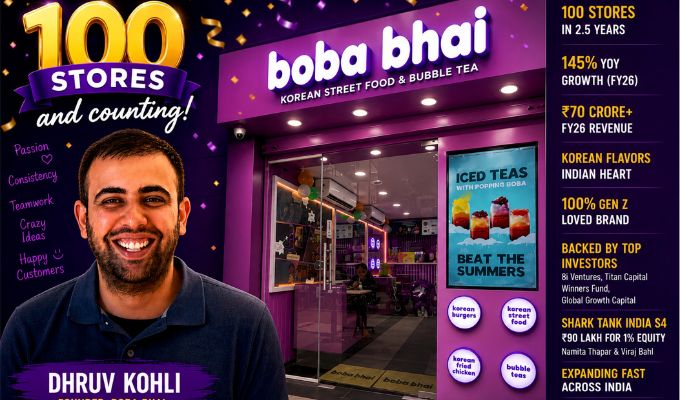
When Dhruv Kohli, Founder of Boba Bhai, shared that reflection ahead of the opening of the company’s 100th outlet at Whiteland, Gurugram on June 1, it captured the scale, speed, and ambition of one of India’s most remarkable Gen Z-focused food service success stories.

What began barely two-and-a-half years ago as a niche bubble tea experiment riding the Korean Wave has rapidly evolved into a full-fledged multi-category QSR brand spanning Korean gourmet burgers, fried chicken, Korean street snacks, bubble teas, desserts, and highly social-media-driven food experiences.

At a time when several food startups struggle to scale meaningfully beyond a handful of outlets, Boba Bhai has crossed the 100-store milestone while simultaneously building one of India’s fastest-growing Korean QSR ecosystems. More importantly, the company’s growth is no longer just about novelty or Instagram appeal. It is increasingly becoming a serious food service business backed by scale, investor confidence, digital traction, and sharp Gen Z positioning.

The numbers reflect that momentum clearly.

Boba Bhai Growth SnapshotFY 2024–FY 2026
Current Store Count 100 Stores
Time Taken to Reach 100 Stores~2.5 Years
FY24 Revenue Rs.5 Crore
FY25 Revenue Rs.30 Crore
FY26 Revenue Rs.70 Crore
FY26 YoY Growth~145%
ARR TargetRs.100 Crore+
Recent Funding RaisedRs.40 Crore
Shark Tank India DealRs.90 Lakh for 1% Equity
Key Investors8i Ventures, Titan Capital Winners Fund, Global Growth Capital
Core CategoriesBubble Tea, Korean Burgers, Fried Chicken, Korean Snacks

Boba Bhai’s revenue reportedly surged from around Rs.5 crore in FY24 to approximately Rs.30 crore in FY25, representing nearly six-fold growth within a year. More recently, the company indicated that FY26 revenues climbed to nearly Rs.70 crore, marking roughly 145 percent year-on-year growth. The company is now targeting annual recurring revenues exceeding Rs.100 crore as it scales both online and offline operations aggressively.

The rapid scale-up has naturally attracted investor attention. In March 2026, the company raised ₹40 crore in fresh funding led by existing investors including 8i Ventures, Titan Capital Winners Fund, and Global Growth Capital. The round reportedly came at almost five times the valuation of its previous funding stage. Earlier, Boba Bhai had also gained national visibility after securing Rs.90 lakh for 1 percent equity on Shark Tank India Season 4 from Namita Thapar and Viraj Bahl.

One of the biggest reasons behind Boba Bhai’s rapid expansion has been its ability to evolve beyond being perceived merely as a bubble tea company. While bubble tea helped create initial consumer curiosity, the company quickly diversified into Korean-inspired food formats and QSR products tailored for Indian tastes. According to the company, food and beverages now contribute almost equally to revenues, reflecting the success of its diversification strategy.

This transition is critical because beverage-led brands often struggle with repeat frequency and ticket-size limitations. By building a larger Korean QSR ecosystem around burgers, fried chicken, snacks, and desserts, Boba Bhai has significantly improved customer engagement, frequency, and average order values.

Among the company’s biggest differentiators are its Korean gourmet burgers, which fuse bold Korean flavors with classic burger formats while adapting them carefully for Indian consumers.

Unlike conventional burger chains competing around standard patties and global fast-food templates, Boba Bhai has carved out a highly differentiated niche through products inspired directly by Korean street-food culture and K-Pop-driven youth trends.

Its standout innovations include the Korean Honey Sriracha Burger, available across chicken, paneer, and aloo tikki variants, balancing fiery Sriracha heat with sweetness and creamy chipotle sauces. The Korean Honey Gochujang Burger has emerged as one of the company’s most viral products, using authentic Korean chili paste to create an intense sweet-spicy flavor profile that strongly resonates with younger spice-loving consumers.

The Yangnyeom Korean Fried Chicken Burger draws inspiration from Korea’s famous sweet-savory fried chicken glaze culture, while the quirky Cluck N Crunch or UFO Burger replaces traditional bread buns entirely with crispy fried chicken fillets sandwiching cheese and sauces.

Importantly, these burgers are intentionally designed to remain intensely flavorful yet approachable for Indian palates. The company smartly pairs them with cooling beverages such as Taro Lava Bubble Tea and Classic Milk Tea, encouraging combo-based consumption occasions that differentiate Boba Bhai from traditional burger chains.

Timing has also played a huge role in the company’s success. Few Indian foodservice brands have leveraged cultural trends as effectively as Boba Bhai. The company positioned itself at the intersection of K-Pop, K-Dramas, Korean street-food curiosity, bubble tea culture, Instagram-driven food discovery, and Gen Z consumption behavior.

As Korean entertainment exploded across India, Boba Bhai emerged as one of the earliest organized food brands to build an entire QSR identity around this cultural movement. Its store aesthetics, menus, packaging, communication style, and digital presence are all designed to appeal directly to younger consumers seeking globally inspired but approachable food experiences.

The brand’s expansion has also been driven heavily by social media. Unlike traditional restaurant chains that rely mainly on high-street visibility, Boba Bhai has built much of its awareness through Instagram visibility, influencer collaborations, viral food formats, user-generated content, and delivery-platform discovery.

Its colorful bubble teas, Korean burgers, quirky packaging, and visually engaging menu items naturally lend themselves to social sharing, allowing the company to build strong organic consumer recall without depending entirely on conventional advertising spends.

At an operational level, Boba Bhai has balanced online delivery growth with aggressive offline expansion. The company has rapidly scaled through high-street outlets, mall locations, compact QSR formats, and delivery-focused stores. Its latest 100th outlet at Whiteland, Gurugram reflects growing confidence in organized offline expansion even as Swiggy and Zomato continue driving large volumes of digital demand.

This omnichannel approach is increasingly important in India’s modern foodservice ecosystem, where discovery often happens online while long-term brand building still requires strong physical presence.

Several factors distinguish Boba Bhai from conventional QSR operators. Instead of competing directly with legacy burger players, it built an identity around Korean youth culture and Asian food curiosity. It has developed one of the sharpest Gen Z-focused food service identities in India, combining product innovation with social-media-first branding and rapid execution capabilities.

The company’s ability to scale from startup stage to 100 stores within roughly 2.5 years demonstrates unusually strong operational discipline for a young QSR brand.

Looking ahead, Boba Bhai now appears to be positioning itself not merely as a bubble tea startup but as a large-scale Korean QSR ecosystem. With fresh funding, rapidly rising revenues, growing investor confidence, and strong youth appeal, the next phase of growth will likely include Tier-2 city expansion, new Korean-inspired menu formats, delivery-led scaling, packaged offerings, and larger omnichannel distribution.

For now, however, the 100-store milestone represents something much larger than store count.

It signals the arrival of a new generation of Indian foodservice brands – brands that understand digital culture, social media, localization, pop-culture trends, and Gen Z aspirations perhaps better than many traditional QSR operators.

And if Boba Bhai’s journey so far is any indication, India’s Korean QSR opportunity may still be only getting started.

Latest News

CocoCart Introduces Four International Gourmet Powerhouses to India’s Luxury Retail Landscape

CocoCart, India’s premium omnichannel destination for chocolates, gourmet gifting and global confectionery, is bringing four globally loved gourmet brands...