


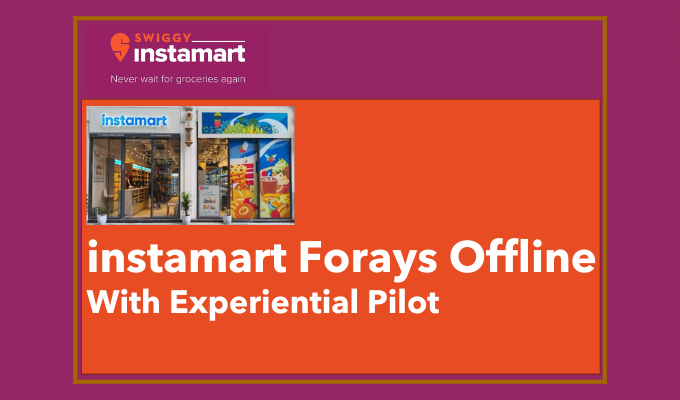
Swiggy’s rapid grocery delivery arm Instamart has quietly launched its first mini experiential store in Gurugram’s M3M 65th Avenue, marking a fresh offline experiment in India’s fast-evolving quick commerce sector. Rather than a full supermarket or dark store, this format blends digital reach with physical discovery, giving consumers a chance to touch and feel select products before purchase — a departure from the usual app-only experience.
A Physical Touchpoint in a Digital Category
Unlike Instamart’s core dark store model — which stocks tens of thousands of SKUs and fulfills orders via ultra-fast delivery — the Gurugram store carries a limited, curated assortment of around 100–200 SKUs, focused on categories where physical inspection matters most, such as fresh fruits and vegetables, pulses, new product launches and items from emerging direct-to-consumer (D2C) brands. Shoppers can walk in, explore products and make purchases directly at the outlet.
What makes this format distinct is that it is not a company-run retail outlet. Instead, it operates under a seller-owned and seller-operated model under the Instamart brand — similar in spirit to how independent sellers operate within the platform’s dark store network. In this setup, sales proceeds go directly to the sellers, rather than being routed through Swiggy’s payment system and settled after commission deductions, as is typical in the digital marketplace model.
Designed for Discovery, Not Fulfilment
Industry reports describe the Gurugram location as a mini experiential store rather than a traditional retail outlet, positioned in and around residential societies. It functions mainly as a product discovery and engagement point, not as a full inventory stop like a supermarket or dark store. This reflects a broader trend in quick commerce to test hybrid online-offline formats that complement delivery models with physical touchpoints.
The store’s compact footprint — estimated to be around 400 sq ft — and its curated SKU mix make it ideal for shoppers who want to visually assess fresh produce and other selected items before committing to purchase, even as the broader Instamart platform continues to fulfil orders with its extensive digital catalogue and last-mile delivery infrastructure.
Strategic Context in Quick Commerce
The launch comes at a time when players in India’s quick commerce category — including Instamart, Blinkit and Zepto — are sharpening focus on economics, assortment and long-term customer retention as the sector matures. Consumer behaviour is shifting from pure speed and convenience towards experiences and trust, particularly for perishables and higher-engagement categories.
Swiggy’s broader ecosystem has been under transformation in 2025. Instamart posted strong growth in recent quarters, with the platform’s gross order value reported to have risen significantly year-on-year, while the wider Swiggy business has been strengthening unit economics and expanding dark store networks across hundreds of cities.
However, neither Swiggy nor Instamart has issued a formal public statement outlining a large-scale offline rollout strategy, and leaders have not confirmed whether more such experiential stores will follow beyond the Gurugram pilot.
Possibilities
The Gurugram experiential store is being watched by industry observers as a test case for hybrid quick commerce retailing — a learning initiative rather than a strategic pivot toward traditional offline retail. By keeping the model seller-led and asset-light, Instamart can experiment with consumer touchpoints without substantially increasing capex or operational complexity.
As quick commerce platforms seek new ways to cultivate loyalty and differentiate their value propositions, such curated physical experiences may complement next-generation digital fulfilment, supporting deeper engagement for categories where touch, trial and product confidence are important.
This offline pilot underscores how quick commerce companies are increasingly exploring offline formats that intersect with digital delivery networks, especially in urban catchments. The ultimate success of such models will hinge on consumer acceptance, seller economics and how such formats can scale cost-effectively alongside fast delivery networks.