


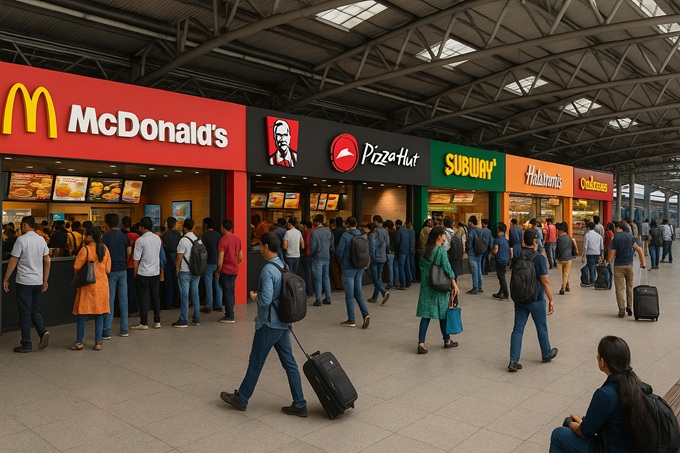
Indian Railways — a system that moves 3.5 crore passengers every day — has finally opened its concourses to major national and global QSR brands. With the Railway Board’s approval of premium, single-brand food outlets, chains like McDonald’s, KFC, Pizza Hut, Subway, and Haldiram’s are preparing to enter an environment unmatched in scale, density and consumption potential.
For decades, stations remained a captive market trapped in outdated catering structures. This new decision marks a decisive shift from a low-investment “chai–poori” stall model to a structured, audit-driven, QSR-ready retail ecosystem comparable to airports and global rail hubs.
Why This Decision Took So Long — The Real Factors Behind the Delay
1. A catering mindset — not a retail vision
Food at stations was treated as a compliance necessity, not a revenue engine. Legacy contractors operated on low CapEx and low hygiene standards, keeping organised players away.
2. Infrastructure wasn’t QSR-ready
Stations lacked essential back-end systems:
- power and exhaust capacity
- grease traps and drainage
- waste management
- clean back-of-house zones
- fire-safety compliant kitchen spaces
QSR-grade formats cannot scale without QSR-grade infrastructure.
3. The policy architecture needed modernisation
Railways functioned under zone-wise catering rules, unlike airports (concession model) or malls (retail leasing). A unified, retail-first policy came only with the November 2025 Railway Board circular.
4. Redevelopment had to come before retail
The last six years saw the rise of modernised stations like:
Rani Kamlapati (Bhopal), Gandhinagar Capital, Ahmedabad, New Bhubaneswar, and SMVT Bengaluru.
These upgrades demonstrated what world-class concourses and commercial zones could look like — creating the foundation for branded QSRs.
India’s Largest Untapped F&B Real Estate — Now Unlocked
The Indian Railways network is the single largest retail real estate portfolio in the country. The comparison below shows why the opportunity is unprecedented.
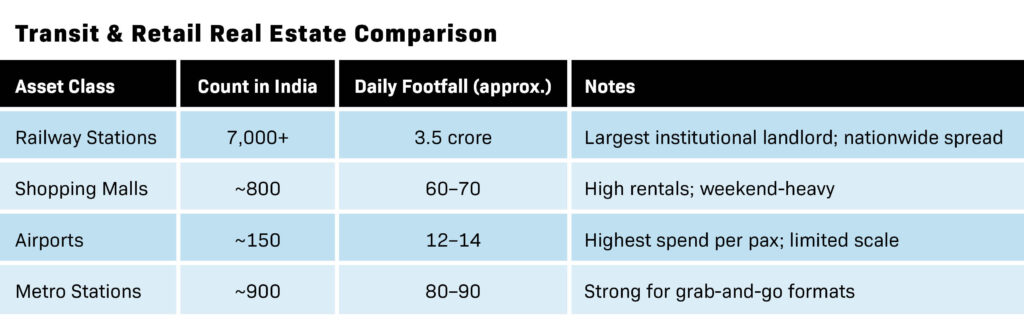
Railway stations → Largest network + highest daily footfall + widest geographic reach.
No other real-estate asset in India offers this level of throughput, consistency and natural demand.
Globally, travel hubs generate the highest F&B revenue per sq. ft. Indian Railways is finally aligning with this model.
The QSR Advantage: High Volume, Low CAC, All-Day Demand
Railway stations create a uniquely favourable business environment for QSRs:
- Near-zero CAC — passengers arrive organically
- Crores of daily footfalls
- High impulse-driven consumption
- Long dwell times during delays
- Family/group travel behaviour amplifies ticket size
- 24×7 operational potential
Even a 0.5% conversion at a major station can outperform many high-street locations.
Who Is Driving This Transformation?
The shift is being enabled jointly by:
- Railway Board — policy & category approval
- Commercial Department, Zonal Railways — site allotment, licensing
- IRCTC — e-auctions, food plazas, operational audits
This is the first time all three arms are aligned under a retail-centred approach, not a catering contract structure.
How Brands Can Enter Railway Stations — The New Process
QSR Application Pathway
- Track IRCTC/Zonal e-auctions for “Premium Brand Outlets”.
- Register as a vendor — PAN, GST, FSSAI, DSC, financials.
- Submit technical + commercial bid on e-procurement portals.
- Secure a 5-year licence with renewal based on performance.
- Execute fit-out per railway guidelines.
- Operate under continuous hygiene & service audits.
This marks the beginning of a formal, scalable, modern retail ecosystem inside stations.
High-Potential Stations for QSR Expansion
A mix of footfall, redevelopment status, traveller profile, and city-level consumption makes the following stations particularly strong candidates for branded F&B:
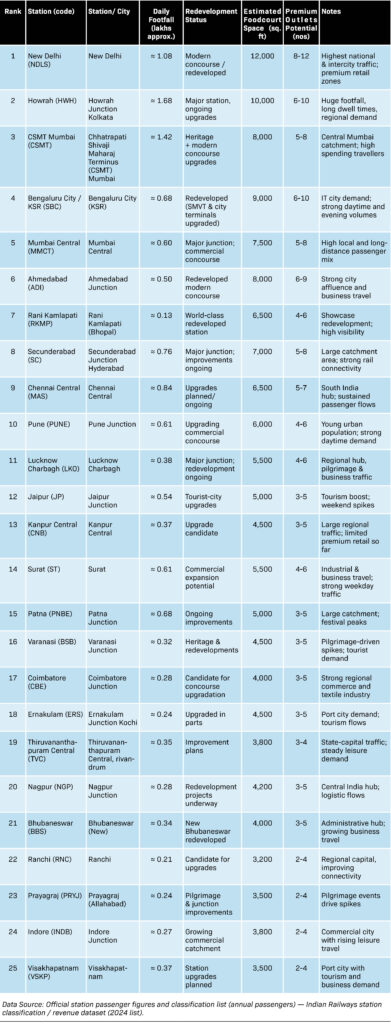
Data Source: Official station passenger figures and classification list (annual passengers) — Indian Railways station classification / revenue dataset (2024 list).
How Big Can This Market Become?
If even:
- the top 200 stations adopt premium-format F&B
- with 3–5 outlets per station
India instantly creates a pipeline of 600–1,000 new QSR outlets — equivalent to the full footprint of several established chains.
With hundreds of stations under redevelopment, the long-term potential is significantly larger.
Why This Marks a New Era for India’s F&B Industry
This development represents far more than the arrival of global QSR logos on railway concourses. It signals:
- the formalisation of India’s largest unorganised food market
- a decisive uplift in hygiene, safety and service standards
- the shift from legacy catering to airport-style concession economics
- the emergence of transit retail as a high-volume, mainstream F&B channel
- a fully open runway for national, regional and global brands to scale
Railway concourses are no longer functioning merely as transit corridors — they are evolving into India’s next major consumption arenas.
Indian Railways hasn’t just approved branded food outlets; it has unlocked the country’s largest, densest and most commercially powerful F&B real-estate ecosystem.
This marks the start of India’s third — and undoubtedly the largest — travel-retail wave.
The journey from “chai–poori on the platform” to modern, global-standard QSRs in the concourse has truly begun.