




Starbucks Chairman & CEO Brian Niccol’s India Visit Marks a New Blueprint for the Next 500
Niccol’s India visit — including a meeting over coffee with Tata Group Chairman N. Chandrasekaran — signals a decisive pivot in the company’s India playbook as it celebrates its 500th store milestone and lays the foundation for the next chapter of sustainable, profitable and purpose-led growth.
A Milestone Moment With a Deeper Meaning
Starbucks’ 500th India store, opening this week at Godrej GCR in Gurgaon, is more than a numeric milestone. It marks the midpoint of a long-held ambition first articulated by former global CEO Laxman Narasimhan, who publicly projected India as “a priority market” and set the tone for a 1,000-store trajectory.
Now, as the company reaches halfway, the baton passes into the hands of Brian Niccol — whose India visit this week reinforces a shift from aggressive scale to quality expansion, sustainability, and stronger unit economics.
Niccol met Tata Group Chairman N. Chandrasekaran at India’s first Starbucks Reserve® store in Mumbai, symbolically tying together Starbucks’ global leadership and Tata’s deep India presence. It was a quiet but strategic moment: a reset, a reaffirmation and a roadmap discussion over coffee.
“We’re partnering with Tata to shape the future of coffee in India,” Niccol said during his visit. “It’s a long-term commitment to build a stronger, more sustainable coffee ecosystem — from bean to cup.”
Reaching 500 Stores: The Story Behind the Milestone
Starbucks’ India journey began with its iconic Horniman Circle flagship in 2012, where queues curled around the block for a taste of global café culture. The brand’s expansion became a case study in balancing aspiration with affordability, and premium experience with mass adoption.
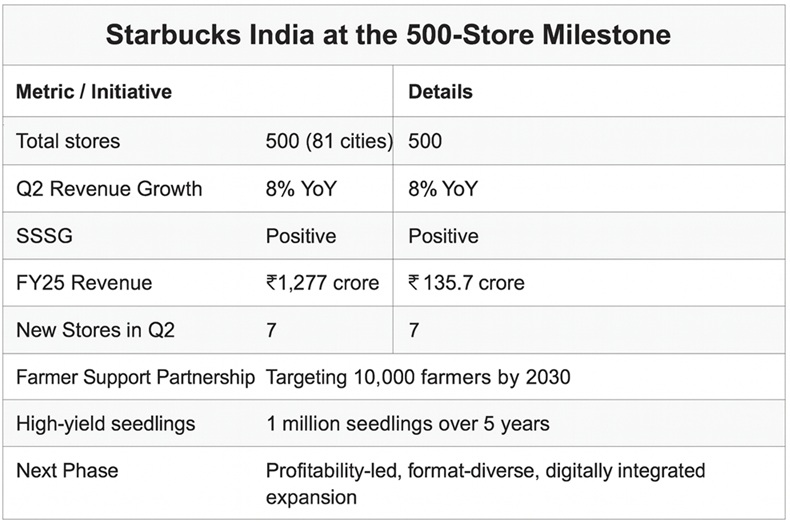
Today, with 500 stores across 81 cities, the joint venture has accelerated into new geographies, new formats and deeper local relevance. Q2 results reinforced this momentum:
- 8% YoY revenue growth
- Positive same-store sales growth (SSSG)
- Seven new stores added despite economic headwinds
- New experiential formats in Mumbai, Hyderabad and Chennai
- Local innovations such as the Pujo menu driving sharper regional penetration
Financially, the JV’s FY25 revenue reached ₹1,277 crore, while losses widened due to accelerated expansion and investment-heavy formats. But insiders acknowledge that this “valley of investment” is intentional — a bridge to a healthier next phase.
A New Strategic Anchor: Farmer Support Partnership (FSP)
One of the most significant announcements of Niccol’s visit is the launch of the Farmer Support Partnership (FSP) — a long-term agronomy, sustainability and value-chain strengthening initiative that aims to empower 10,000 Indian coffee farmers by 2030.
Starbucks Coffee Trading Company (SCTC) and Tata Starbucks will jointly run the FSP, based in Karnataka, supporting farmers across Karnataka, Tamil Nadu, Andhra Pradesh and Kerala through:
- Model farms to test sustainable solutions
- Global agronomy knowledge sharing
- New varietals and high-yield Arabica seedlings
- Digital agronomy training
- Regenerative agriculture guidance
Tata Starbucks CEO Sushant Dash called it “a meaningful step toward strengthening India’s coffee-growing community and securing the future of high-quality Arabica.”
Tata Consumer MD & CEO Sunil D’Souza added: “This initiative pairs Starbucks global agronomy expertise with Tata’s India footprint to drive tangible impact on the ground.”
This move positions Starbucks as not just a café brand but an origin-engaged institution, securing credibility for the next decade.
Niccol’s India Playbook: Quality Before Quantity
If Narasimhan gave India the scale ambition, Niccol is giving it discipline.
The current CEO’s approach places profitability, localization and digital intelligence at the centre of every new store. Expansion will continue — but every outlet must serve a clear purpose, audience and commercial logic.
Niccol is known globally for simplifying menus, improving service fundamentals and investing in partner (employee) experiences. His India visit restates this on-ground and signals that the next 500 stores will grow more thoughtfully than the first 500.
The Next 500: What Will Change
1. A Focus on Profitability, Relevance and Digital Optimization
Niccol’s insistence on making each store profitable, locally relevant and digitally optimised represents a fundamental shift. Stores will be evaluated on neighbourhood needs, customer flows, digital engagement and operating efficiency. AI-led beverage insights, personalised offers and operational digital tools will increasingly shape performance.
2. Format and Occasion-Led Innovation
The next 500 stores will look decidedly different:
- More Reserve locations for elevated coffee craft
- Drive-thrus along highways and dense metros
- Compact kiosks in airports, transit hubs and corporate zones
- Tier-3 and Tier-4 stores designed for leaner costs and higher throughput
This recalibration ensures Starbucks meets India’s contextual consumption patterns, not just its real-estate availability.
3. Deeper Localization
Starbucks will double down on food — the real frequency engine in India. More India-first beverages, festival specials, familiar snacking options and price-band adjustments will sharpen its everyday appeal.
4. Sustainability and Farmer Connectivity
The FSP becomes the defining pillar of Starbucks’ India strategy, embedding long-term agricultural equity, regenerative practices and supply-chain resilience.
The Next 500: A Strategic Pivot, Not a Celebration
Within Starbucks India, executives describe this milestone as a strategic fulcrum rather than a finish line. The second act will be:
- More digital: loyalty, personalisation, AI-driven beverage innovation
- More local: menus, store design, community programming
- More disciplined: clearer profitability targets
- More purposeful: farmer empowerment & sustainability
Narasimhan built the ambition; Niccol’s actions signal execution with maturity.
Industry Signals: What This Means for India’s Foodservice Market
Starbucks’ evolving strategy illustrates a larger shift in India’s café/QSR sector:
- Expansion is moving from footprint-led to value-led.
- Global brands are embracing native menu identity.
- Supply chains are shifting from import-driven to origin-integrated.
- Formats are diversifying into a true omnichannel presence.
Starbucks is now crafting a playbook others will inevitably study.
The Larger Meaning of the 500-Store Celebration
This milestone is not merely a ribbon-cutting ceremony in Gurgaon — it represents a strategic reset in how Starbucks engages with India. From premium café culture to agricultural investment, from metro-heavy presence to nationwide format diversification, from global uniformity to Indian relevance, Starbucks is re-architecting itself for long-term resilience.
The story of India’s first 500 Starbucks stores was one of discovery, aspiration and scale.
The story of the next 500 will be one of discipline, localisation, sustainability and purpose.
And with Brian Niccol’s India visit, the second act has officially begun.