


Fresh food leaves little room for error. Delays in transit or breaks in the cold chain can quickly impact quality and shelf life. By providing near real-time visibility into every stage of the supply chain, digital traceability helps businesses safeguard freshness, improve transparency, and build consumer trust.
Fresh food is one of the most sensitive categories in retail. When consumers pick up fruits, vegetables, milk, or meat, they want more than just a product – they want assurance. Assurance of where it came from, how it was handled, whether it is safe, and whether it reached them in time. For decades, freshness was judged by sight, like the colour of a tomato or the firmness of a leaf. Today, it is increasingly defined by a product’s digital history.
In fresh food, time is everything. A delay in transport, a missed cold chain check, or even a few hours outside the right temperature can change the product’s quality. Digital traceability captures this journey in near real time, so that every stakeholder knows the product’s freshness record.
India now generates around 80 million tonnes of food waste every year (2026 estimates), which is nearly one‑fifth of its total food production. Much of this loss is linked to poor storage and cold chain gaps. End-to-end visibility, combined with freshness monitoring, can directly reduce such wastage by ensuring timely interventions and preventing safe food from being discarded unnecessarily.
From Farm to Shelf
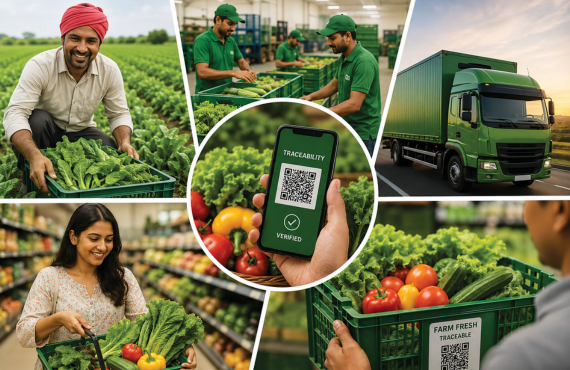
Digital traceability gives every product an accessible journey. With one scan, a retailer or consumer can see the source, the handling process, and also the freshness of the item. This simple act builds confidence and reduces uncertainty. Visibility is not limited to the retail counter. It extends to the consumer, who can access information from origin to disposal. End to end transparency reduces discrepancies, supports faster recalls, and ensures that quality checks are visible at every stage. Instead of discarding entire inventories when a safety issue arises, traceability enables precise recalls, removing only the affected batch and saving safe food from waste.
Bridging India’s Diversity
India’s food supply chain is vast and diverse. Produce often travels across states and climates before reaching a supermarket shelf. Traceability bridges this gap by giving each product a digital identity that records its journey.
This identity is more than compliance; it is proof of authenticity. Regulations ensure that checks are followed, but digital records make them visible and verifiable. A mango harvested in Maharashtra or seafood shipped from Kerala can carry its own digital trail, ensuring quality is retained across distances. For consumers, this means confidence in what they buy.
Digital Edge for Modern Retail
Quick-commerce and online grocery platforms depend on accurate, real-time product information. Consumers expect that what they see on an app is exactly what they receive at their doorstep. Traceability connects digital listings with physical products, reducing mismatches and protecting brand reputation. It also supports speed. When deliveries are promised within minutes, end-to-end visibility ensures that freshness and safety are not compromised in the rush.
Inaccurate or missing data such as harvest dates or temperature logs can turn fresh produce into a total loss. Traceability ensures that the digital record matches the physical state, protecting both consumers and businesses.
For example, cold chain monitoring systems use temperature sensors and data loggers placed in trucks, warehouses, and even retail freezers. These sensors continuously record and transmit data, triggering alerts if the temperature moves outside safe ranges.
A Future Built on Transparency
As shopping shifts further into digital channels, transparency will define how food systems operate. Connected supply chain records ensure that information about freshness, safety, and handling is available in real time. Instead of fragmented data, everyone works with the same trusted information, reducing waste and protecting health.
India is uniquely positioned to lead this shift. QR code scanning is already a daily habit for millions of consumers, whether for payments, promotions, or product information. When these QR codes are integrated with IoT sensors, they become far more powerful, providing accurate, real-time data about a product’s journey.
The future of India’s fresh food supply chain rests on this openness. By embedding digital traceability today, we create a system where every product carries proof of its journey.