


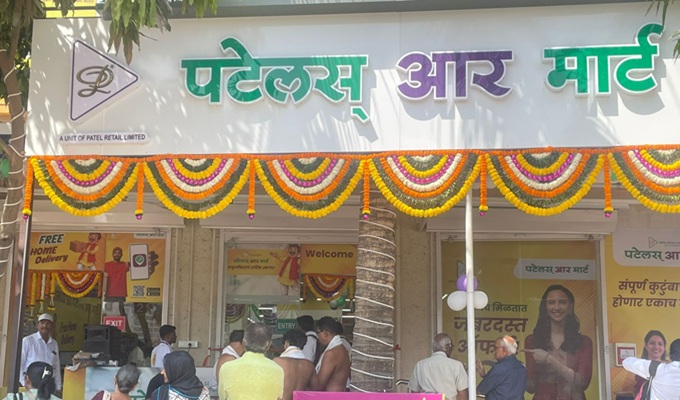

In Thakurli, a dense residential pocket in Thane, Patel Retail Limited has opened its 50th Patel R Mart supermarket—a milestone that reflects the steady build-out of a food and grocery network anchored in everyday consumption.
The location is deliberate. Neighbourhood catchments with consistent footfall form the backbone of the company’s model—where proximity, pricing, and availability drive repeat purchase behaviour.
From its early days, Patel Retail has focused on high-frequency categories—grocery, staples, fresh produce, and daily essentials. Over time, this has evolved into a multi-format structure that expands its presence across consumption occasions. Patel Fresh strengthens the fresh and perishables play, Patel Essential focuses on value-led assortment, and Indian Chaska extends into food consumption.
Business Snapshot
| Metric | Snapshot |
| Store Count | 50+ |
| Core Categories | Grocery, Staples, Fresh, Essentials |
| Geography | Maharashtra (MMR focus) |
| Store Size (Est.) | ~1,500–8,000 sq. ft. |
| Consumption Type | High-frequency, repeat-driven |
| Expansion Model | Cluster-based neighbourhood retail |
A Model Built on Frequency & Throughput
Food and grocery retail operates on a distinct economic logic—low margins, high volumes, and rapid inventory turns.
Patel Retail’s model aligns closely with this structure:
- Fresh-led footfall drivers: Fruits, vegetables, and staples anchor daily visits
- High inventory rotation: Critical for perishables and working capital efficiency
- Price-led positioning: Ensures competitiveness against both organised and unorganised retail
- Local sourcing linkages: Including farmer networks that support freshness and cost control
This combination allows the business to sustain throughput across stores while maintaining relevance in price-sensitive markets.
From Network Expansion to Operational Depth
The 50-store milestone signals a transition into a more execution-driven phase. In a recent interaction with store managers, Chairman & Managing Director Dhanji Patel outlined priorities around store-level efficiency, consistency in execution, and customer experience. The focus is on tightening operations across sourcing, merchandising, and store processes.
At this stage, scale begins to unlock structural advantages:
- Improved procurement efficiencies through aggregation
- Better logistics optimisation within clusters
- Scope for private label expansion in staples and essentials
- Higher store productivity through assortment refinement
Positioning in India’s Evolving Food Retail Market
India’s food and grocery market continues to be shaped by a mix of organised retail, kirana stores, and emerging regional chains. In this landscape, neighbourhood supermarket models are gaining traction by combining accessibility with structured retail experience.
Patel Retail’s focus on mid-sized stores in high-density residential areas positions it well within this shift. The format supports:
- Frequent shopping missions
- Smaller basket sizes with higher visit frequency
- Strong customer retention through proximity and familiarity
The Road Ahead: Deepening the Food Play
With 50 stores operational, the next phase of growth is expected to centre on:
- Deeper penetration across MMR and Maharashtra
- Expansion into Tier II and III consumption markets
- Strengthening the fresh and staples supply chain backbone
- Building scale efficiencies across sourcing and distribution
The opportunity lies in further integrating fresh, essentials, and value retail into a cohesive platform that captures a larger share of household food spending.
Everyday Retail, Built on Trust
At its core, Patel Retail’s growth reflects a simple principle—consistent delivery in everyday categories.
Each store functions as a neighbourhood food hub, built around reliability, value, and frequency. At 50 stores, the network has reached meaningful scale. The next stage will be defined by efficiency, supply chain strength, and deeper integration across formats—shaping its role in India’s rapidly evolving food retail ecosystem.