


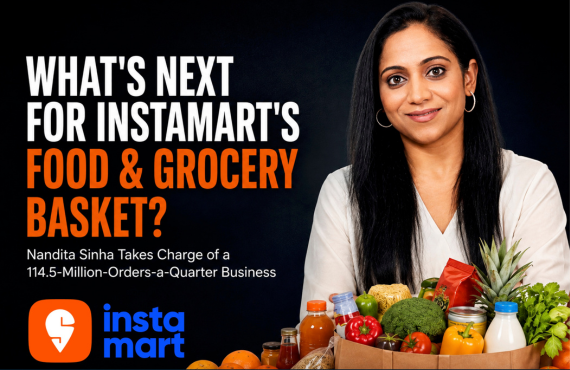
The former Myntra CEO takes charge on August 3 of Instamart, processing 114.5 million orders a quarter through 1,171 dark stores. But Swiggy is no longer chasing every customer or every SKU: it is curating daily-use categories, building proprietary food products, improving repeat behaviour and asking its existing network to work much harder.
When Nandita Sinha takes charge as CEO of Swiggy Instamart today, the most revealing number on her desk may not be its Rs 7,907 crore Q1 FY27 Gross Order Value.
It could be four million.
That is approximately how many unprofitable users Swiggy says it deliberately weaned away from Instamart over the past three quarters while rebuilding the economics of its quick-commerce business. Yet its retained consumer base has become stickier: one-month retention among transacting users increased to 61% from 55% in Q1 FY26.
For somebody whose career has moved through Hindustan Unilever and Britannia before Flipkart and Myntra, that is an interesting business to inherit. Sinha isn’t arriving at a grocery-delivery start-up searching for consumers. She takes charge of a large digital retail network processing 114.5 million orders in the June quarter, serving 13.5 million average monthly transacting users and operating 1,171 dark stores across 131 cities. Instamart’s active dark-store estate now covers 4.92 million sq. ft.
Her appointment, effective August 3 following Amitesh Kumar Jha’s resignation, was announced on July 28. Swiggy said Sinha would lead Instamart’s next phase of growth, building on assortment strategy while improving profitability, customer focus and operational efficiency. Sinha brings more than two decades of experience across consumer and digital businesses, including leadership roles at Hindustan Unilever, Britannia, Flipkart and, most recently, Myntra.
For Business of Food, however, the particularly interesting part of her appointment is the combination of those two worlds: FMCG and digital retail. Instamart is increasingly requiring both.
The Day-One Scorecard
Swiggy’s Q1 FY27 results, announced just four days before Sinha assumes charge, provide an unusually precise baseline against which her tenure can eventually be assessed.
INSTAMART: WHAT NANDITA SINHA INHERITS ON AUGUST 3
| Q1 FY27 Metric | Position |
| Gross Order Value | Rs 7,907 crore |
| YoY GOV Growth | 39.8% |
| Net Order Value | Rs 5,817 crore |
| Quarterly Orders | 114.5 million |
| Average Monthly Transacting Users | 13.5 million |
| Active Dark Stores | 1,171 |
| Cities | 131 |
| Dark-store Area | 4.92 mn sq. ft. |
| Orders / Dark Store / Day | 1,089 |
| Net AOV | Rs 508, +12.1% YoY |
| Contribution Margin | -0.2% of GOV |
| Adjusted EBITDA Loss | Rs 778 crore |
| Stores Contribution-Margin Positive | 45%+ |
| One-Month User Retention | 61% |
| Q2 Planned Store Additions | ~75 |
Source: Swiggy Q1 FY27 Shareholder Letter. GOV and NOV are different measures; Swiggy defines NOV as GOV less discounts.
These numbers tell a more interesting story than growth alone. Instamart’s GOV increased 39.8% year-on-year, but contribution margin improved by 440 basis points YoY to -0.2%, with the business actually achieving contribution breakeven during May. Adjusted EBITDA loss narrowed sequentially by Rs 80 crore to Rs 778 crore. More than 45% of the store network is now contribution-margin positive, up from 30% in the preceding quarter; 25% of stores operated at contribution margins of 3–5%, while five of Instamart’s seven largest cities turned contribution positive.
Those improvements were achieved before Sinha arrived and belong to Jha and the existing Instamart team. They also give the incoming CEO a clear starting line.
Food & Grocery Is Moving From Availability to Curation
Perhaps the most relevant development for Sinha is taking place inside the Instamart assortment.
Quick commerce was originally built around a straightforward consumer promise: if milk, vegetables, bread or another household essential was needed immediately, make it available nearby and deliver it quickly. Swiggy now believes the competitive value of simply offering more products is diminishing.
In its Q1 shareholder letter, management says speed has become table stakes, aggressive pricing is unsustainable, and competing assortments are increasingly similar. Its response is to treat assortment as a curation game rather than a volume game.
That thinking has already produced an initiative called “Switch to Better”. Instamart has partnered with more than 400 brands to create or curate alternatives across daily-use categories and completed the first phase across 50 key product categories. Swiggy says these products already contribute more than 15% of sales within the relevant categories.
Food is explicitly part of this strategy. Instamart is working with brand partners on high-protein staples, while its proprietary clean-food brand Noice is being expanded. Swiggy says consumers who have bought “Switch” SKUs show 30% higher retention than benchmark cohorts.
That is where Sinha’s earlier FMCG experience becomes particularly relevant.
At HUL and Britannia, the questions are about consumers, categories, brands, price points, packs and repeat purchase. At Flipkart and Myntra, the questions expand into digital discovery, personalisation, search, assortment, inventory and customer lifetime value.
Instamart increasingly sits at the intersection.
114.5 Million Orders—and Every Dark Store Has Limited Space
The food-and-grocery challenge becomes clearer when viewed from inside the dark store.
Instamart averaged 1,089 orders per dark store per day in Q1 FY27. Its 1,171 stores occupy 4.92 million sq. ft., yet management says overall store utilisation is only around 40%. That leaves considerable capacity within the existing network.
Swiggy is consequently not responding simply by opening stores everywhere. It expects to add around 75 stores during Q2, largely where high-growth neighbourhoods require additional capacity, while simultaneously trying to densify and improve utilisation of the existing network.
For food retail, that matters because every square foot has an opportunity cost. More milk may generate frequency; fresh produce adds a daily need-state but introduces perishability; packaged foods provide breadth; premium foods can increase basket value; an emerging health product may improve differentiation. Each SKU must ultimately justify the space it occupies.
Sinha’s challenge therefore includes something much more sophisticated than enlarging assortment: determining what should be available to whom, and where.
The Basket Is Already Changing
Instamart’s own data shows that this transition has begun.
Net average order value increased 12.1% YoY from Rs 453 to Rs 508 in Q1 FY27, which Swiggy attributes to sustained non-grocery selection and larger-basket buying behaviour. The conventional AOV based on GOV was Rs 691.
The distinction between those two numbers is worth understanding. Swiggy has begun emphasising Net Order Value, which deducts discounts from GOV, partly because discounts on non-grocery categories tend to be considerably higher than grocery. Management argues that NOV therefore provides a better representation of what consumers actually spend as the assortment expands beyond grocery.
That disclosure itself tells us something about how Instamart is changing. A business once easily understood through grocery orders and GOV now needs more nuanced metrics because the merchandise mix has become broader.
Food and grocery nevertheless retain a special role. They generate recurring consumption. The task for Instamart is increasingly to use those frequent interactions to build larger and more valuable baskets without depending on uneconomic subsidies to keep consumers returning.
Its improved retention after shedding four million unprofitable users suggests that Swiggy believes it is beginning to do precisely that.
The Rs 30-per-Order Problem Sinha Inherits
There is one more number that puts Sinha’s assignment in perspective.
Instamart may have reached contribution breakeven in May, but it remains some distance from EBITDA profitability. Swiggy estimates that the business needs to add roughly another Rs 30 per order in economics to reach overall adjusted EBITDA breakeven at the scale it currently envisages.
Management has even broken down where it expects that improvement to come from: approximately Rs 10 per order from higher-margin and more favourable product mix, another Rs 10 from advertising, Rs 5 from densification and warehouse/store automation, and Rs 5 from operating leverage through greater store utilisation and semi-variable costs. A future inventory-led operating model could potentially add another Rs 4–Rs 5 per order. These are management estimates rather than achieved benefits, but they make the commercial assignment unusually transparent.
For a food-and-grocery business, the first Rs 10 is particularly interesting.
It means what Instamart sells matters increasingly as much as how efficiently it delivers it.
Better product mix, proprietary food products, premiumisation, brand partnerships and carefully curated daily-use categories can therefore become part of the profitability equation. Advertising creates another connection with FMCG companies: the platform isn’t merely distributing their products but monetising digital shelf visibility and consumer discovery.
Swiggy’s medium-term ambition is formidable: more than Rs 1 lakh crore of annual NOV at a 4–5% adjusted EBITDA margin. Before that, it estimates overall adjusted EBITDA breakeven at roughly Rs 60,000 crore of annualised NOV and 25–30 crore orders per quarter, compared with 11.45 crore orders in Q1 FY27.
A Different Assignment Begins Today
None of this makes Sinha’s Myntra experience a ready-made formula for Instamart. Fashion and food retail operate with fundamentally different purchase frequencies, inventory characteristics, margins and fulfilment requirements.
But the capabilities are converging.
Instamart now has to understand consumers beyond the emergency purchase. It needs to curate rather than merely accumulate assortment; create discovery rather than simply provide availability; improve repeat behaviour without buying loyalty through discounts; give brands reasons to launch and advertise on the platform; make better use of 4.92 million sq. ft. of fulfilment infrastructure; and turn more than 114 million quarterly transactions into sustainable economics.
Food and grocery sit squarely inside that challenge.
Nandita Sinha takes charge today with Rs 7,907 crore of quarterly GOV, 13.5 million monthly transacting users, 1,171 dark stores and contribution margin close to neutral. But she also inherits a business that has already decided what it doesn’t want its next phase to look like: indiscriminate customer acquisition, unsustainable pricing and assortment expansion simply for the sake of offering more.
The next phase will be about better consumers, better baskets, better assortment and better economics.
For somebody whose career has moved from consumer brands to digital retail, Instamart may be one of the few businesses in India where all those experiences now meet on the same shelf.