


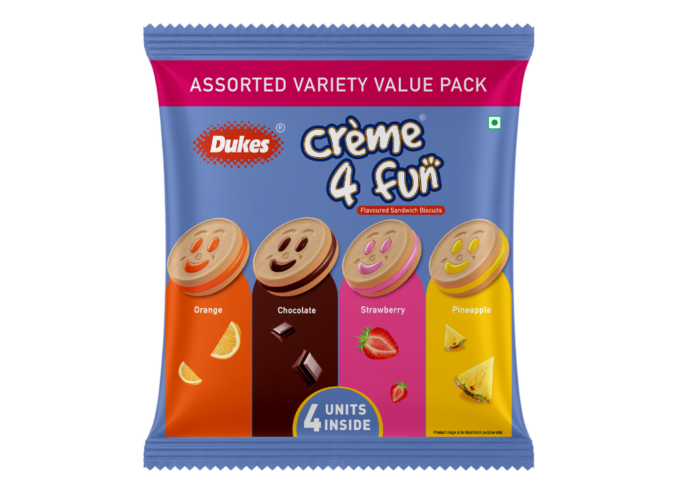

From biscuits and wafers to chocolates, confectionery and cakes, Dukes is strengthening its core business while pursuing cross-category innovation, wider distribution and international growth.
For more than three decades, Ravi Foods Pvt. Ltd. (RFPL) has built its presence in India’s baked goods and confectionery market through Dukes, alongside its other brands, Treff and Dynas. What began as a biscuits business in Andhra Pradesh and Telangana in 1995 has evolved into a multi-category operation with 17 manufacturing facilities, a pan-India footprint and exports to more than 120 countries. Today, Dukes is focused on reinforcing its established biscuits and wafers business while developing newer opportunities in chocolates, confectionery and cakes.
From a Regional Biscuit Business to a National Brand
Dukes’ journey began with a focused regional strategy before expanding rapidly into a national business. The brand was launched in 1996, a year after Ravi Foods entered the biscuit market, and achieved pan-India presence by 1997. Its subsequent entry into wafers, chocolates and confectionery helped broaden its consumer proposition beyond its original category. The evolution reflects a strategy of building on established consumer familiarity while creating new occasions for consumption. The launch of Waffy in 1999 was an important step in extending the business into wafers, followed by investments in chocolates and confectionery. More recently, the cake line and centre-filled chewing gum have widened the portfolio further.
Strengthening the Core
Biscuits, wafers and Waffy Rolls continue to form the foundation of Dukes’ business, supported by established consumer recognition and distribution. Chocolates and confectionery are important growth drivers, with cakes representing another opportunity to extend the brand’s presence across everyday snacking and indulgence. According to Srinivas Agarwal, Assistant Vice President & Operations Head, Dukes, the focus is on strengthening the established categories while scaling emerging opportunities.

The portfolio spans sandwich, plain, coated and centre-filled biscuits, cookies, savoury products and crackers. Its wafer range includes traditional wafers and wafer rolls, while chocolates cover multiple formats and product propositions. Confectionery includes eclairs, chewing gum and other sugar-based products, alongside the Good Bake cake range.
Pricing, Manufacturing and Distribution
Operating in the mass-market segment requires balancing affordability with cost management, particularly as raw material prices fluctuate. Dukes approaches this through price-pack architecture, pack-size adjustments and operational efficiencies, aiming to protect consumer value while maintaining competitiveness. “Price pack architecture, pack sizes and operational efficiencies help us stay competitive while managing cost pressures,” says Agarwal.
Manufacturing scale and process efficiencies are central to this strategy. RFPL operates 17 manufacturing facilities, supporting production across its categories and helping the company manage productivity, product availability and market reach. Its distribution network is another important component, connecting the brand with established and emerging markets.
The company has a strong presence in southern and northern India, while its export business contributes significantly to overall operations. With a presence in more than 120 countries, Dukes has developed an international business that extends its reach beyond the domestic market.
Channel Strategy and Changing Consumer Expectations
Modern Trade and CSD-CPC remain Dukes’ strongest sales channels, supported by regular footfall and established buyer bases. However, the company is also strengthening General Trade and e-commerce to capture additional demand and improve market penetration. The channel strategy is accompanied by a focus on innovation that retains the familiarity consumers associate with established mass-market brands. Rather than changing the core proposition, Dukes explores new flavours, formats and pack sizes to introduce variety while keeping products accessible and relevant.
Agarwal describes this balance as bringing “newness without losing familiarity.” It is particularly relevant in categories where consumers are attentive to price, established tastes and the perceived value of everyday purchases.
Selective Expansion and the Next Growth Phase
Dukes’ expansion strategy combines deeper penetration in existing categories with selective entry into adjacent segments. The immediate priorities are to strengthen the core portfolio, accelerate cross-category innovation and expand its reach in urban and town markets. Alongside wider distribution, the company is looking to build stronger consumer connections and grow across categories, channels and geographies.
For a business with a three-decade history, the next phase is therefore less about moving away from its established strengths and more about extending them. Biscuits and wafers remain the foundation, while chocolates, confectionery and cakes offer opportunities to diversify consumption occasions. With manufacturing capacity, domestic distribution and exports already established as important parts of its business, Dukes’ challenge will be to translate these capabilities into sustained growth while retaining the affordability and familiarity that have shaped its journey.