

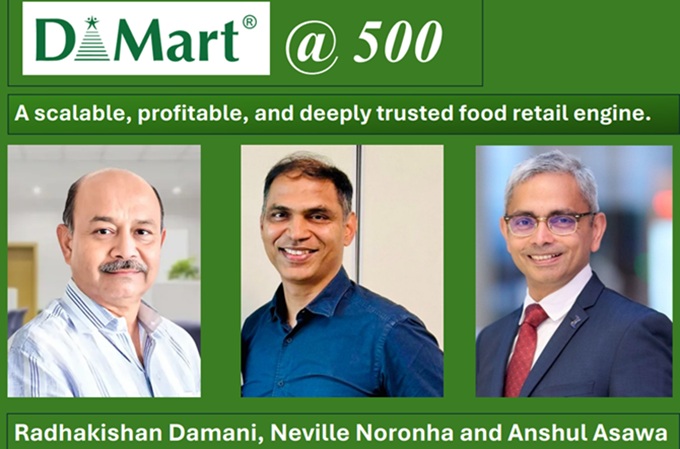

The opening of DMart’s 500th store in Avadi, Chennai is more than a scale milestone—it is a powerful validation of a retail model that has quietly mastered the economics of food and grocery in India.
A Retailer Built on the Kitchen Economy
Long before it became a national retail powerhouse, DMart understood a simple truth about Indian consumption: the kitchen drives the household economy.
While modern retail in India initially leaned towards aspiration—fashion, electronics, lifestyle—DMart anchored itself in the everyday: staples, packaged food, and household essentials. This decision would go on to define its trajectory.
Today, food and grocery remain the central nervous system of DMart’s business, driving footfall, frequency, and financial stability. The monthly grocery run is not just a transaction—it is a habit. And DMart has embedded itself deeply into that habit across millions of Indian homes.
INFOGRAPHIC: The DMart Grocery Engine
- High-frequency consumption (monthly/weekly baskets)
- Focus on staples & packaged foods
- Limited assortment (~6,000–8,000 SKUs)
- Everyday low pricing (EDLP)
- High inventory turns and low wastage
The Science of Throughput
What distinguishes DMart in food retail is not merely its scale, but the precision with which it drives throughput economics.
In a typical DMart store, products do not sit—they move. Staples such as rice, atta, pulses, edible oils, and packaged foods are stocked deep and sold fast. This velocity creates a powerful cycle: faster sales reduce holding costs, improve cash flows, and allow the company to negotiate better terms with suppliers.
Unlike retailers that chase margins through premiumisation or assortment expansion, DMart relies on volume-led profitability. Its stores are designed to maximise movement, not display.
This is where the seemingly modest store design—functional layouts, pallet-based stocking, minimal visual merchandising—reveals its strategic intent. Everything is engineered for efficiency.
Private Labels: Value Without Visibility
Running parallel to this high-volume grocery engine is DMart’s quietly expanding private label ecosystem.
Unlike global retailers that position private labels as brands, DMart takes a subtler approach. Its in-house products—spanning staples, packaged foods, and home essentials—are often positioned as value alternatives rather than brand statements.
For the consumer, the proposition is straightforward: comparable quality at a better price.
For DMart, however, the implications are far more significant. Private labels enable tighter control over sourcing, better margins, and pricing flexibility—all without the overheads of brand building.
Over time, this has allowed DMart to build what can be described as an “invisible margin layer” within its grocery business—one that strengthens profitability while reinforcing its value positioning
The DMart Unit Economics Loop
Lower procurement cost → Lower prices → Higher volumes → Faster inventory turns → Stronger cash flows → Better supplier terms → Back to lower cost
Neville Noronha: Building the Machine
If DMart’s strategy appears simple, its execution has been anything but—and much of that execution discipline can be traced to Neville Noronha.
Joining the company in its early years and serving as CEO for over two decades, Noronha played a defining role in transforming DMart from a regional retailer into a national institution.
His approach was grounded in operational excellence rather than strategic experimentation. Expansion was cluster-led, ensuring supply chain efficiency. Costs were scrutinised relentlessly. Store-level profitability was non-negotiable.
Under his leadership, DMart scaled from a handful of stores to hundreds, while maintaining financial consistency that remains rare in Indian retail.
Equally important, Noronha institutionalised a culture where processes mattered more than personalities—ensuring that the model could sustain beyond individual leadership.
A New Phase: Anshul Asawa Steps In
The recent transition to Anshul Asawa, a seasoned leader from Hindustan Unilever, marks an inflection point—but not a departure.
Asawa brings with him deep expertise in FMCG distribution, consumer behaviour, and category management—all of which are highly relevant to DMart’s grocery-centric model.
Having spent nearly three decades in a company synonymous with scale and supply chain excellence, he understands both the science of demand and the art of distribution.
His mandate is unlikely to be reinvention. Instead, it will revolve around sharpening what already works—particularly in areas such as private labels, supply chain optimisation, and evolving consumer needs.
The Structural Advantage: Why DMart Wins in Food Retail
Food retail in India is notoriously complex. Margins are thin, competition is intense, and operational inefficiencies can quickly erode profitability.
Yet DMart has built a system that absorbs these challenges.
DMart’s Food & Grocery Operating Model
| Lever | DMart Approach | Outcome |
| Category Focus | Staples-led, essentials-heavy | High frequency, stable demand |
| Assortment | Limited, high-depth SKUs | Better supplier leverage, faster turns |
| Pricing | Everyday low pricing | Strong consumer trust, repeat visits |
| Private Labels | Value-driven, low visibility | Higher margins, pricing flexibility |
| Store Design | Functional, no-frills | Lower operating costs |
| Real Estate | Predominantly owned | Long-term cost stability |
| Inventory | High rotation | Strong cash flows |
Relevance in the Age of Instant Retail
As quick commerce reshapes urban consumption with speed and convenience, DMart’s model operates on a different axis.
It does not compete for immediacy—it competes for economics.
The monthly stock-up trip, where households optimise value across large baskets, remains a powerful consumption behaviour. DMart has entrenched itself in this mission, making it less vulnerable to the volatility of impulse-driven channels.
In this sense, DMart is not being disrupted—it is anchored in a different consumer need-state.
500 Stores, One Core Idea
The opening of the 500th store is not a pivot point—it is a continuation.
Across geographies, formats, and leadership transitions, DMart has remained remarkably consistent in its belief system:
- Food and grocery as the anchor
- Value as the proposition
- Efficiency as the enabler
The Quiet Dominance of a Grocery Powerhouse
In a retail landscape often defined by disruption narratives, DMart offers a counterpoint.
It has not reimagined food retail—it has refined it to its most efficient form.
By focusing on essentials, mastering unit economics, and embedding itself into the rhythm of household consumption, DMart has built something few have achieved:
A scalable, profitable, and deeply trusted food retail engine.
At 500 stores, that engine is not slowing down. It is simply getting better at what it was always designed to do.