


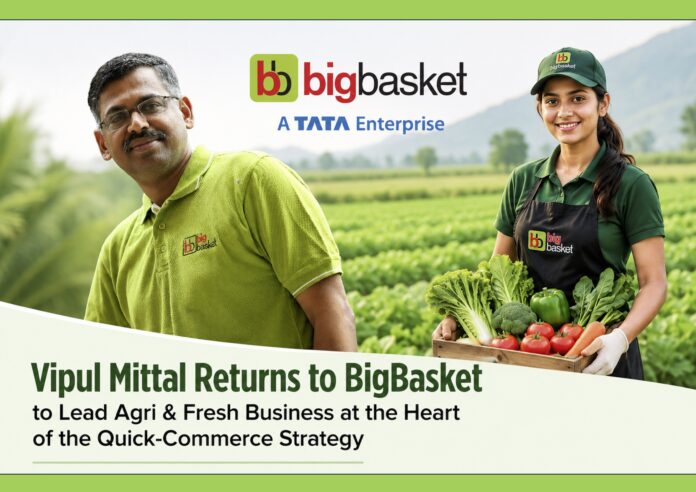
Vipul Mittal is returning to bigbasket at a time when the company’s biggest competitive advantage may lie not in how quickly it can deliver a basket, but in how efficiently it can move that basket from the farm to the dark store.
Bigbasket has appointed Mittal as Chief Agri Business Officer (CABO) to lead its agri and fresh-produce portfolio. With more than 35 years of experience across food, FMCG and retail, including over 18 years in India’s organised horticulture and fresh-produce sector, Mittal brings an unusually deep understanding of a business that has become increasingly strategic for bigbasket.
His experience spans Amul, Adani Agrifresh, Mother Dairy F&V, Bharti Walmart, bigbasket and NCOL. But it is his earlier work at bigbasket that makes his return particularly relevant. During his previous tenure, the company was building the foundations of what would become one of its most important structural advantages: a direct, technology-enabled farm-to-fork supply chain.
The Infrastructure That Began With Farmer Connect
When bigbasket introduced its Farmer Connect programme in 2016, the objective was straightforward but ambitious: reduce the layers between the farmer and the consumer, improve farmer realisations and build greater control over the quality and availability of fresh produce.
By 2019, bigbasket was working with around 20,000 farmers through a network of collection centres, including in major horticulture hubs such as Nashik, Agra and Vijayawada. The programme was designed to take middlemen out of multiple stages of the chain while placing agronomists closer to farmers to help with quality, crop selection and production requirements.
By 2021, bigbasket said its Farmer Connect network had expanded to more than 30,000 farmers, with direct sourcing and traceability forming an important part of its fresh-produce proposition.
The significance of that investment becomes even clearer today. A direct farm network is one thing when an online grocery order is delivered in a scheduled slot. It becomes a very different competitive asset when the same fresh produce has to reach an urban dark store, be picked, packed and delivered to a consumer within minutes.
That is the business challenge awaiting Mittal.
From Farmer Connect to Quick-Commerce
Bigbasket has undergone a fundamental change since Mittal’s earlier stint. The company has shifted decisively towards quick-commerce, with BB Now and its dark-store network becoming central to the business. In FY26, bigbasket’s revenue reached Rs 8,223 crore, although its losses also widened significantly as the economics of quick-commerce remained under pressure.
The strategic question is therefore no longer simply how to source good fruits and vegetables. It is how to forecast demand, procure at the right point, move produce through the chain with minimum handling and wastage, and position it close enough to the consumer to fulfil a 10-to-15-minute promise.
Fresh produce is particularly unforgiving. Excess inventory becomes wastage; insufficient inventory becomes a stock-out. The wrong harvest timing affects both quality and availability. And every additional handling point adds cost and time.
This makes the farm-to-fork architecture increasingly important to quick-commerce economics.
Bigbasket’s own experience has given it a significant foundation here. Its supply chain has evolved into an integrated system spanning sourcing, warehousing, transportation and order management. The company’s BB Matrix platform, developed from these operating experiences, integrates warehouse, transport and order management capabilities. Bigbasket has subsequently commercialised BB Matrix as an enterprise SaaS platform, with the company claiming potential transportation-cost reductions of up to 50% and lead-time reductions of up to 60%.
That is more than a technology story. It represents an operating model built around the idea that the closer the business can connect demand with supply, the more control it gains over cost, quality and availability.
The Fresh Advantage in a Dark-Store World
This is where Mittal’s mandate acquires a much larger business significance.
The quick-commerce industry has increasingly converged around dark stores. Bigbasket itself had around 700 dark stores in 2025 and was targeting a substantially larger network as it expanded its rapid-delivery proposition.
For a company operating hundreds of neighbourhood fulfilment points, fresh produce cannot be managed as a conventional wholesale category. The supply chain has to anticipate what each micro-market will require, and increasingly, when it will require it.
The advantage of Farmer Connect, therefore, is not merely that bigbasket can say it sources directly from farmers. The bigger advantage is the control that direct sourcing can potentially provide across the chain—from crop planning and quality standards to aggregation, processing, replenishment and final availability.
That is particularly valuable for bigbasket’s fresh and private-label businesses. The company has long used direct sourcing and supply-chain control to support brands such as Fresho, giving it greater control over quality, assortment and availability than a model dependent entirely on wholesale markets.
The B2B Backbone Matters Too
There is another, less visible part of the business that makes Mittal’s role important: the procurement and supply infrastructure sitting behind bigbasket’s consumer-facing operations.
Bigbasket’s B2B entity, Supermarket Grocery Supplies, reported FY26 revenue of Rs 2,298 crore, up 3.2% from Rs 2,227 crore in FY25, while its loss remained unchanged at Rs 102 crore.
In a market where the consumer-facing quick-commerce business is under pressure to improve unit economics, a resilient procurement and supply-chain backbone becomes increasingly important. The ability to aggregate supply, negotiate directly, manage quality and move inventory efficiently can determine how much margin survives between the farm gate and the consumer.
Mittal’s experience across both fresh produce and organised retail puts him at the intersection of these two worlds.
A Different Kind of Fresh-Produce Challenge
The fresh-produce business Mittal returns to is therefore considerably larger and more technologically integrated than the one he left.
Earlier, the challenge was to build organised sourcing in a market dominated by fragmented supply chains. Today, the challenge is to make that infrastructure work at the speed and precision demanded by quick-commerce.
As bigbasket itself describes its approach, technology and supply-chain integration are central to its ability to operate across multiple models—from scheduled grocery delivery to quick-commerce and B2B. Its BB Matrix platform now supports more than 15 million orders a month across its broader ecosystem and highlights the company’s evolution from an online grocery retailer into a technology-led supply-chain operator. (bbmatrix.ai)
This is also why Mittal’s return should not be viewed simply as the appointment of another senior executive to run fresh produce. He is coming back to a business where the farm-to-fork supply chain has become an important part of the competitive equation.
From Sourcing Produce to Engineering Availability
In his welcome message, Mittal points to the foundation he helped build earlier and the next phase he wants to shape.
“Coming back to bigbasket feels special because I have had the privilege of being part of its journey and contributing to what it has become over the years,” he says, describing bigbasket as a pioneer in grocery e-commerce, particularly in transforming agri supply chains through technology and a farmer-first approach.
His stated focus going forward is on “customers, farmers, partners and people.”
For bigbasket, the immediate opportunity is to make those priorities work together commercially: better farmer relationships, more predictable sourcing, higher-quality fresh produce, tighter inventory management and faster movement through an increasingly dense urban fulfilment network.
The company has already built much of the physical and technological architecture required to do this. The next challenge is to extract greater economic value from it.
That is what makes Vipul Mittal’s return particularly timely. He knows the farm end of the business, understands organised fresh produce, and has already been part of bigbasket’s journey in building its direct-sourcing capabilities.
Now he returns to a very different retail environment—one in which the farm-to-fork advantage has to translate not only into better produce, but into better availability, lower wastage, faster replenishment and stronger unit economics.
And in the increasingly unforgiving economics of quick-commerce, that could be one of bigbasket’s most important battles.