



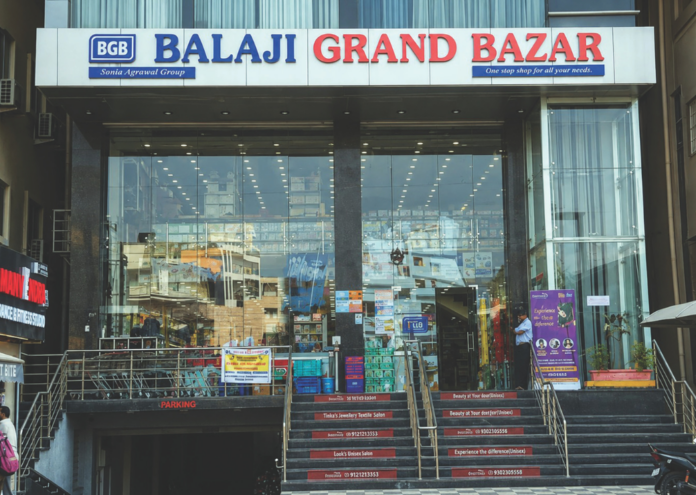
Balaji Grand Bazar is taking organised grocery retail closer to where customers live, work and shop every day.
In a retail environment where scale often dominates the conversation, neighbourhood relevance remains a key differentiator. Even as quick commerce, e-commerce and national supermarket chains reshape grocery retail, regional players with a deep understanding of local consumers continue to hold a distinct advantage.
In Hyderabad, Balaji where the retail landscape is evolving rapidly, Balaji Grand Bazar has built a distinct identity by focusing on premium neighbourhoods, personalised service and strong community connect—proving that convenience, trust and customer relationships continue to matter as much as scale.
What began as a 360 sq. ft. family-run store in 1958 has grown into a 22-store supermarket chain, steadily building its presence by focusing on premium residential neighbourhoods, gated communities and a customer-centric retail experience. While the fundamentals of the business remain rooted in service and community engagement, the retailer is now entering a new phase of expansion, targeting premium high streets and Hyderabad’s fast-growing IT corridor.
In an interaction with Business of Food, Sunil Agarwal, Managing Director, Balaji Grand Bazar, discusses the company’s evolution, its expansion strategy and the changing dynamics of modern food retail.
From a Single Store to a Trusted Retail Brand
Balaji Grand Bazar was also among the early retailers in Hyderabad to introduce private labels, helping build customer loyalty while creating a differentiated product offering. This emphasis on quality, value and assortment has remained central to the retailer’s growth journey.
Following the business restructuring in 2018, the company has continued its expansion under the Balaji Grand Bazar (Sunil Agarwal Group) banner. Led by Managing Director Sunil Agarwal, alongside Executive Directors Prateek Agarwal and Darpan Agarwal, the family-run business continues to strengthen its retail footprint while adapting to the evolving dynamics of organised grocery retail.
The Next Phase of Growth
For Balaji Grand Bazar, choosing the right location has become one of the most critical growth decisions. Rather than pursuing rapid expansion, the retailer has built its network around affluent residential clusters where purchasing power and customer loyalty remain strong.
“At the moment, we have a total of 22 stores. Out of these, two are located in premium high-street locations, while 20 are situated in gated communities catering to SEC A, A+ and elite-class customers,” says Agarwal.
These gated community stores currently serve more than 30,000 families across Hyderabad’s premium neighbourhoods, giving the retailer a strong foothold among high-value consumers.
Looking ahead, the company plans to broaden its reach without moving away from its premium positioning. “We are planning to expand into employee hubs located in the IT Corridor and Special Economic Zones, where more than 15,000 employees work. This will help strengthen familiarity with the brand and further expand our reach among top-end customers,” he remarks further.
All staples, pulses, flours, etc., are Balaji Grand Bazar’s in-house brands. In its stores, the company’s own brands contribute more than 30% of its revenue/sales. Major Foods contributes approximately 60% of the retailer’s total sales, driven primarily by its proprietary product line and fast-moving consumer goods (FMCG).
Within this mix, Ready-to-Eat (RTE) foods, beverages, and carbonated soft drinks (CSDs) exhibit the highest inventory turnover and market demand. Millet-based, organic, and wellness products are set to perform even better because of increasing customer awareness and a well-defined target segment.
Fighting Quick-Commerce
The rapid rise of quick-commerce platforms has emerged as one of the biggest challenges for traditional grocery retailers, significantly impacting store footfalls and slowing revenue growth. According to Agarwal, changing consumer behaviour has made convenience-led digital shopping the new norm, compelling brick-and-mortar retailers to rethink their strategies.
“Shopping behaviour has completely shifted from ‘Let me walk to the store’ to ‘Which app should I open?’ Due to the aggressive penetration of quick-commerce platforms, physical retail stores are experiencing nominal, near-flat revenue growth,” he says.
In response, Balaji Grand Bazar has adopted a hyperlocal omnichannel strategy aimed at retaining customers and strengthening neighbourhood engagement. The retailer has introduced dedicated mobile applications for gated communities, offers free home delivery irrespective of order value and has rolled out targeted discount schemes to remain competitive against instant-delivery platforms.
The company is also investing in neighbourhood campaigns and community events to rebuild customer loyalty while continuing its physical expansion across Hyderabad. Its store network is increasingly focused on premium gated communities, enabling the retailer to serve residents within high-density residential clusters.
Margins Under Pressure
Balaji Grand Bazar is currently absorbing higher promotional expenses to retain customers and sustain market share. At the same time, investments in community engagement programmes, experiential campaigns and specialised quantity purchase schemes (QPS) are adding further pressure on operating margins.
“Current operating margins are exceptionally thin, as we are temporarily absorbing higher promotional costs to sustain market share and retain customer loyalty,” he says. Despite the near-term impact on profitability, the retailer believes these investments are essential to strengthening its long-term competitive position.
Curated Category Mix
Beyond grocery, Balaji Grand Bazar has gradually expanded its assortment to include categories such as home furnishings, apparel and neighbourhood food kiosks, although the format varies depending on store size and location.
As a result, stores typically offer a focused range of home furnishings and apparel, alongside micro food kiosks serving local favourites such as chaat, tiffins and beverages, wherever permitted under society guidelines. While customers have responded positively to these additions, Agarwal notes that sales remain constrained by the limited selling space and restricted product assortment.
Hyderabad Remains Focus
Balaji Grand Bazar is prioritising deeper market penetration within Hyderabad and Secunderabad before pursuing expansion into new geographies. While the retailer had earlier outlined plans to expand beyond the city, its immediate focus remains on strengthening its presence in premium residential catchments.
The company plans to add two to three new stores during the current financial year, with most of the expansion centred on premium gated communities. Agarwal says that the immediate operational strategy is strictly focused on consolidating our presence within the twin cities of Hyderabad and Secunderabad.
Customer-First Growth
Convenience, agility and personalised service are set to define Balaji Grand Bazar’s next phase of growth. The company is continuously fine-tuning its product assortment to reflect evolving consumer preferences while introducing localised promotional campaigns designed to resonate with neighbourhood communities. The emphasis is on remaining responsive to demand without losing the personalised touch that has defined the brand over the years.
Digital convenience is equally central to the company’s roadmap. App-based home delivery, doorstep card-swiping facilities and multiple digital payment options are being deployed to simplify the shopping journey and bridge the gap between traditional retail and the speed of modern commerce.
“We consistently optimise our product assortments, introduce dynamic consumer promotion schemes and provide rapid, app-based home delivery with frictionless pay-at-the-doorstep payment solutions to ensure maximum convenience for the consumer,” Agarwal conveys.
Rather than competing with quick-commerce players on speed alone, Balaji Grand Bazar is betting on a combination of technology, local engagement and customer service to strengthen long-term loyalty and sustain future growth.