


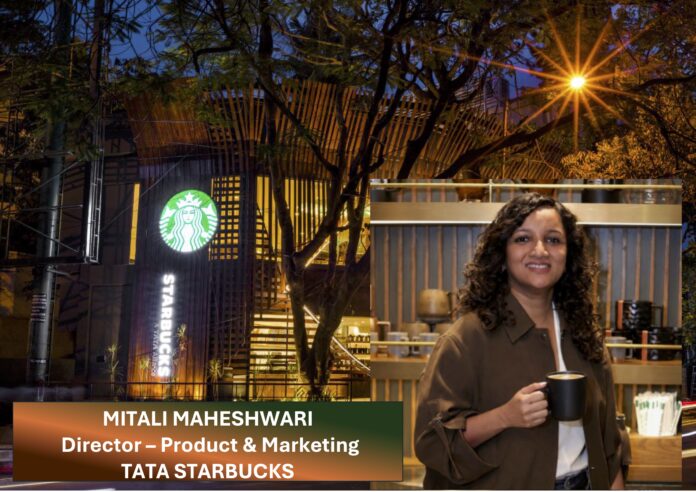

Mitali Maheshwari has been promoted to Director – Product & Marketing at Tata Starbucks, stepping into a larger mandate at a particularly important stage of the coffee chain’s India journey. Having joined Tata Starbucks in 2024 as Head – Product & Marketing, Maheshwari now takes charge of the product, portfolio and marketing organisation as the brand moves beyond the race for store count and focuses increasingly on sustainable growth, stronger customer engagement, regional relevance and profitability.
Her elevation comes as Tata Starbucks has crossed the 500-store mark in India, with its network reaching 505 stores across 81 cities as of early November 2026. The company added 23 net new stores during FY26 and another 13 during the first half of FY27. At the same time, the business has been showing improving growth momentum: revenue from operations rose 7% to Rs 1,367 crore in FY26, while the company’s net loss narrowed 27% to Rs 99 crore, from Rs 136 crore in FY25. Operational EBITDA stood at Rs 234 crore.
The momentum has continued into FY27. Revenue grew 11% in Q1 FY27 and accelerated to 15% in Q2 FY27, while the September quarter marked the brand’s fifth consecutive quarter of positive same-store sales growth. The numbers suggest that the next phase of Starbucks India’s story is not simply about adding more cafés, but about making the existing network increasingly productive while opening the right stores in the right markets.
From a Love for Coffee to a Larger Leadership Mandate
For Maheshwari, the promotion is also a natural progression of a career that has combined consumer marketing, brand building, youth culture and retail. Her association with Starbucks began with a personal affinity for coffee and the brand’s customer experience. In her own words, her love for coffee, marketing, experiences and food brought her to Tata Starbucks, where she had her first specialty coffee and experienced what she describes as the power of small customer moments.
That experience now sits at the centre of her professional mandate. “I’ve always believed that great marketing goes beyond building brands. It’s about understanding people, anticipating their needs and creating things that earn a place in their lives,” Maheshwari said while announcing her elevation.
Her career before Starbucks gives that philosophy an interesting dimension. Maheshwari spent more than 10 years with Red Bull, eventually becoming Head of Brand Marketing for India, after earlier roles as National Brand Manager, Assistant Brand Manager and Consumer Collecting Manager. She began her career at DDB Mudra Group, giving her exposure to both agency-side brand building and consumer marketing before moving into FMCG and then foodservice.
At Tata Starbucks, she joined in April 2024 as Head – Product & Marketing, before moving into the Director role in October 2026. Her expanded mandate now brings together product development, portfolio strategy and marketing—three functions that are becoming increasingly interconnected as India’s organised café market becomes more competitive.
Starbucks India’s Next Phase is About Quality of Growth
Tata Starbucks’ growth story has entered a different phase. The brand has spent years establishing the Starbucks experience across India’s major cities and building a national café network. It now has 505 stores across 81 cities, but its expansion blueprint has also evolved.
The company’s earlier ambition of reaching 1,000 stores by 2028 is being recalibrated around a more economically disciplined model. Instead of pursuing store count at any cost, the strategy increasingly focuses on geographic clustering, with the objective of having more than five stores in a city wherever the opportunity supports it. Such clustering can improve supply-chain efficiency, kitchen utilisation, delivery economics and operational productivity.
This is an important shift for the foodservice business. A café chain’s economics change materially when stores move from being isolated points of presence to a connected city network. Procurement, replenishment, delivery, manpower deployment, local marketing and customer frequency can all benefit from density.
The strategy is therefore becoming less about how many cities can Starbucks enter? and more about how deeply can Starbucks build a market once it enters?
The Product is Becoming the Bridge Between Global and Local
That is where Maheshwari’s product mandate becomes particularly important. Starbucks has to protect the global equity that makes the brand recognisable while making the menu feel increasingly relevant to the many different Indias it serves.
The approach has included products and flavours that connect with Indian preferences, including Malabari Coconut Chai, Cardamom Chai and regional food pairings such as Paneer Tikka Sandwiches. The introduction of the Picco 6 oz size is another example of localisation—not by changing the Starbucks proposition fundamentally, but by adapting portion size and entry pricing to Indian consumption habits.
The strategy also extends to coffee itself. While Starbucks continues to draw on its global coffee heritage, the use of beans from India’s Coorg coffee-growing region allows the brand to bring local provenance into its product narrative.
For Maheshwari, the challenge is therefore not simply to launch new products. It is to build a portfolio architecture in which global familiarity and local relevance coexist without compromising the aspirational positioning of Starbucks.
Making Premium Coffee More Accessible Without Making it Ordinary
The Picco launch illustrates this tension particularly well. India’s café market has become crowded with chains offering increasingly aggressive pricing, promotions and value-led propositions. Starbucks’ response has not been to abandon its premium positioning, but to create more accessible entry points within the existing experience.
The smaller format gives consumers an opportunity to enter the Starbucks ecosystem at a lower price point while retaining the brand’s store environment, service proposition and visual identity. It is a form of accessible premiumisation rather than discount-led acquisition.
That distinction could become increasingly important as the organised café market expands beyond the traditional urban consumer. Starbucks needs to attract new consumers without training its customer base to wait for discounts. Product architecture, portion sizes, local flavours and format innovation can therefore become more powerful growth tools than purely promotional pricing.
The Experience Remains the Real Differentiator
For Starbucks, however, the product has always been only one part of the proposition. The larger competitive advantage lies in the experience around the cup.
Maheshwari’s own description of her first Starbucks experience—particularly the interaction with a barista who told her, “If you don’t like it, I’ll make it right”—captures the philosophy. The interaction is small, but it reinforces the idea that Starbucks is selling hospitality and belonging alongside coffee.
That philosophy has also shaped the brand’s marketing. The #ItStartsWithYourName campaign, for example, used Starbucks’ familiar cup-naming ritual to explore identity, inclusion and human connection. Instead of communicating only product attributes or price promotions, the campaign sought to make the café a space associated with personal stories and emotional connection.
For a foodservice brand operating in an increasingly competitive category, that emotional equity can become a valuable moat. Coffee can be replicated. Store formats can be replicated. Menu categories can be replicated. But the accumulated relationship between a customer and a brand is harder to copy.
From Red Bull’s Youth Culture to Starbucks’ Coffee Culture
Maheshwari’s Red Bull experience is particularly relevant here. During more than a decade with the energy drink brand, she worked across consumer collecting, brand management and ultimately brand marketing, gaining experience in building communities and cultural relevance around a product that goes far beyond its functional proposition.
At Starbucks, the cultural canvas is different but the underlying marketing challenge is similar: how does a global product become part of everyday consumer life?
Her mandate at Starbucks now involves building products and stories for what she describes as the “many Indias within India”. That is increasingly important as Starbucks expands beyond the largest metropolitan markets and encounters consumers with different taste preferences, spending patterns, occasions and cultural contexts.
Local Stores for Local Consumers
The localisation strategy is also visible beyond the menu. Starbucks has been using local artists for store murals and city-specific merchandise, including customised mugs linked to cities such as Mumbai, Bengaluru and Delhi.
Such interventions may appear small compared with store openings and financial performance, but they contribute to a larger strategic objective: making a global chain feel like a local neighbourhood institution.
That becomes increasingly relevant as the network expands. A Starbucks in a premium Mumbai business district does not necessarily need to communicate in exactly the same way as a Starbucks in a fast-growing Tier-II city. Local art, merchandise, food preferences and community connections can help the brand retain its global identity while creating a stronger sense of local ownership.
Premium Formats Add Another Layer
At the other end of the product and experience spectrum, Tata Starbucks is also continuing to invest in premium formats. The first half of FY27 saw the addition of two Starbucks Reserve stores, strengthening the company’s prestige positioning and giving the brand a platform for more elevated coffee experiences.
This creates an interesting portfolio architecture: accessible products such as Picco can bring new consumers into the ecosystem, mainstream Starbucks cafés can build frequency and everyday consumption, while Reserve formats can strengthen coffee credentials and premium brand equity.
The challenge for the product and marketing organisation is to make these layers work together rather than allowing them to fragment the brand.
The Business Behind the Brand
The timing of Maheshwari’s promotion is ultimately as much about business performance as it is about marketing. Tata Starbucks has demonstrated improving financial momentum while continuing to expand its network.
| Metric | Performance |
| FY26 revenue from operations | Rs 1,367 crore |
| FY25 revenue | Rs 1,277 crore |
| FY26 revenue growth | 7% YoY |
| FY26 net loss | Rs 99 crore |
| Reduction in net loss | 27% |
| FY26 operational EBITDA | Rs 234 crore |
| Q1 FY27 revenue growth | 11% YoY |
| Q2 FY27 revenue growth | 15% YoY |
| Q2 FY27 SSSG | 5th consecutive positive quarter |
| India store network | 505 stores |
| Cities | 81 |
| FY26 net new stores | 23 |
| H1 FY27 net new stores | 13 |
The numbers point towards a business that is trying to achieve something more difficult than rapid expansion: growth with improving economics. The reduction in losses, operational EBITDA and sustained same-store sales growth suggest that the company is increasingly focused on productivity within the network even as it continues to add stores.
That makes the product and marketing function critical. New products need to generate incremental visits, existing products need to encourage frequency, regionalisation needs to widen the customer base, and marketing needs to strengthen both brand affinity and commercial outcomes.
Building the Next Chapter of India’s Coffee Culture
Maheshwari’s promotion comes at a time when India’s coffee market is entering a more interesting and competitive phase. International chains, Indian specialty coffee brands, premium cafés, quick-service operators and independent coffeehouses are all competing for increasingly diverse consumption occasions.
For Starbucks, the answer is unlikely to be a single new beverage or another store-count milestone. It will be the combination of product innovation, regional relevance, customer experience, network density and disciplined expansion.
Maheshwari’s expanded role brings these pieces together. Her brief is to blend Starbucks’ global heritage with Indian preferences, make the portfolio more accessible without diluting its premium credentials, and create experiences that turn coffee consumption into a habit rather than an occasional indulgence.
As she put it while announcing her promotion, the opportunity ahead is to “build great products for the many Indias within India, tell authentic stories that connect with consumers, create meaningful experiences and, ultimately, drive impact on both brand and business.”
For Tata Starbucks, that could be the most important shift of all: the next phase of India’s coffee story will not be won simply by opening more cafés, but by giving consumers more reasons to return to them.