


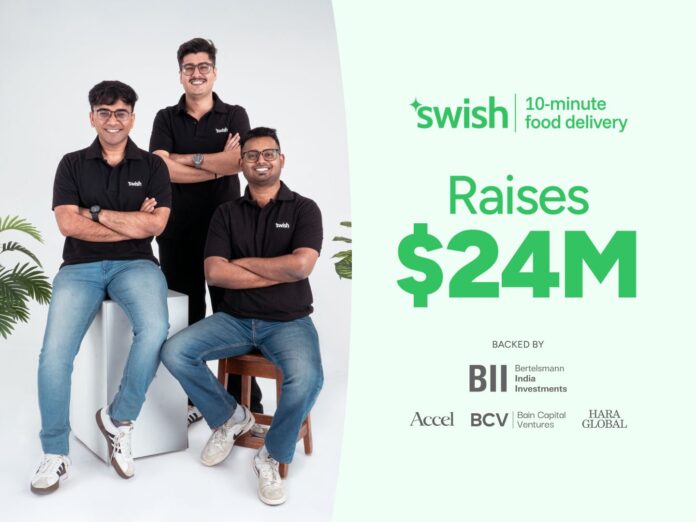
Swish is barely two years old, yet it has raised about $78 million and is now valued at around $175 million. The bigger story is not the money—it is why investors continue to back a business model whose economics even much larger players have struggled to crack.
Swish, the 10-minute fresh-food delivery startup founded by Aniket Shah, Ujjwal Sukheja and Saran S, has raised another $24 million in an extended Series B round led by Bertelsmann India Investments (BII), with existing investors Accel, Bain Capital Ventures and Hara Global also participating. The fresh capital comes barely five months after the company raised $38 million, taking total funding to about $78 million since its July 2024 launch. The latest round values Swish at roughly $175 million, up from about $139 million in March 2026.
That pace is striking when set against the company’s early financials. Swish reported Rs 4 crore in net revenue and a Rs 19 crore statutory net loss for its first eight months of operations ended March 2025. Yet institutional investors have continued to increase their exposure. That makes the central question far more interesting than the latest fundraise: what are they seeing in 10-minute food that others may have missed?
The Battle is No Longer Just About Food Delivery
India is becoming a laboratory for several different ways of delivering prepared food at extraordinary speed. Swish is pursuing a full-stack model, operating neighbourhood kitchens and controlling the menu, preparation and delivery. Blinkit Bistro and Zepto Cafe are extending the quick-commerce playbook into prepared food. Swiggy Bolt takes the asset-light route, using existing restaurants and a tightly restricted delivery radius. BigBasket brings the proposition into the wider Tata quick-commerce ecosystem.
| Model | Major players | Core advantage |
| Full-stack food | Swish | Own kitchens, menu & operations |
| Quick-commerce food | Blinkit Bistro, Zepto Cafe | Existing dark-store density |
| Restaurant network | Swiggy Bolt | Huge restaurant & delivery base |
| Ecosystem play | BigBasket | Grocery + food infrastructure |
The scale already achieved by Bolt is particularly revealing. Swiggy said in May 2025 that Bolt had reached 500+ cities and 45,000+ restaurant brands, and was powering more than one in every ten Swiggy food-delivery orders. Its model works within a roughly 2-km radius and focuses on dishes requiring minimal preparation.
This proves one important thing: Indian consumers are willing to embrace much faster food delivery at scale. But it does not prove that every model can make money.
Swish is Trying to Change the Consumption Occasion
The real opportunity may not be stealing existing orders from Zomato or Swiggy. It could be creating more occasions in which consumers choose delivered food.
Traditional food delivery is largely meal-led and planned. The 10-minute proposition is designed around immediacy—breakfast before a meeting, coffee between calls, a quick lunch, an evening snack, dessert or a spontaneous dinner.
Quick commerce has already changed the consumer’s definition of convenience. If groceries and everyday essentials can arrive in minutes, the next question becomes obvious: why should freshly prepared food take 30–40 minutes?
That is the behavioural bet behind the category.
If consumers begin ordering food with the frequency with which they order convenience products, the addressable opportunity expands substantially.
Density—Not 10 Minutes—Is The Real Game
The headline promise is 10-minute delivery. But speed itself is not a moat.
Anyone can promise 10 minutes. Building enough demand within a small radius to make those 10 minutes economically viable is much harder.
Swish’s reported crossing of one million monthly orders across roughly 50 pincodes is therefore more interesting as a measure of density than as a headline volume number. At that level, the company is generating roughly 20,000 orders per pincode per month, or around 650–670 orders a day per pincode on a simple average basis.
That does not establish profitability, because one pincode may contain more than one kitchen and demand is not evenly distributed. But it highlights the critical operating equation: kitchen density + order density + menu productivity + rider productivity.
The winner in this category may ultimately be the company that can make those four variables work together—not the company that simply delivers fastest.
The Full-Stack Gamble
Swish is taking the more capital-intensive route.
Its neighbourhood kitchens give it control over ingredients, menu design, preparation processes, inventory, packaging and dispatch. That allows the company to design the food itself around the speed promise rather than asking thousands of independent restaurants to redesign their operations.
The trade-off is equally clear. Swish carries kitchen infrastructure, food inventory, labour and real-estate costs that an asset-light marketplace does not.
The model therefore makes a very specific bet: greater control today can produce better unit economics tomorrow.
If order density rises sufficiently, the same kitchen infrastructure can support significantly more transactions, creating operating leverage. If density remains inadequate, however, the fixed costs become a burden.
Bigger Players Provide the Warning
This is where the story becomes particularly compelling.
Swiggy launched Snacc, a standalone 15-minute food-delivery service, in January 2025 using a micro-kitchen model. Less than a year later, it shut the service down. Swiggy said product-market fit was emerging, but “the broader economics made it challenging to scale.”
That is perhaps the most important piece of evidence in the entire 10-minute-food story.
Consumer demand is not necessarily the problem.
Economics are.
Swiggy itself subsequently explained that its micro-kitchen model required a high density of demand in micro-markets to operate sustainably.
That observation goes directly to Swish’s thesis.
A two-year-old startup is now attempting to prove that a specialist, highly focused network can achieve the density that a much larger ecosystem found difficult to achieve.
Why are Investors Still Writing the Cheques?
The answer is not simply that investors believe Swish is already profitable. They are effectively funding the next stage of the experiment.
| Investor logic | What they are betting on |
| Frequency | More food occasions move online |
| Density | More orders per neighbourhood kitchen |
| Control | Better menu, food-cost & preparation economics |
| Automation | Lower labour intensity over time |
| Network | Dense kitchens create faster, cheaper fulfilment |
| Market expansion | New cities multiply the opportunity |
There is also a strategic reason for the continued interest. India’s quick-commerce infrastructure is rapidly expanding beyond groceries into adjacent consumption categories. Food is one of the most natural extensions because it combines high frequency, short delivery radius and strong consumer urgency.
For venture investors, the upside is therefore not limited to today’s order economics. They are underwriting the possibility that a dense food-production network could eventually become a valuable consumer-infrastructure layer.
The $78-Million Test
Swish’s next phase will be much harder than its first.
The company has demonstrated that there is demand for very fast food. It now has to prove that the demand can be converted into repeat behaviour, high kitchen utilisation and sustainable contribution margins.
Expansion will test the model further. Bengaluru and Delhi-NCR contain dense, affluent micro-markets where rapid delivery can make intuitive sense. Replicating the economics across hundreds of neighbourhoods and eventually multiple cities is an entirely different proposition.
That is why the competitive landscape matters. Blinkit Bistro and Zepto Cafe bring enormous quick-commerce density; Swiggy Bolt brings an unparalleled restaurant network; Swish brings control over the entire food-production chain. Each is testing a different answer to the same consumer question.
The eventual winner may not be the one with the biggest kitchen network, the largest restaurant base or the fastest delivery promise. It will be the one that can consistently balance consumer convenience with contribution economics.
The Real Bet
Swish has already demonstrated that Indians will order freshly prepared food in 10 minutes.
The harder question is whether they will do it often enough—and at a price high enough—for the model to make money.
That is what the latest $24 million is really funding.
Swish’s first two years have been about proving the demand. The next three could determine whether 10-minute food becomes merely another quick-commerce experiment—or a new, profitable layer of India’s food-services economy.