


How restaurants, cafés, hotels and institutional buyers are reshaping product development and distribution.
India’s frozen food market has nearly doubled in five years, growing at a CAGR of 15% from Rs 9,200 crore in FY 2020 to Rs 18,400 crore in FY 2025, and is projected to grow at a CAGR of 17% to reach Rs 40,500 crore by FY 2030. Behind these numbers sits a less obvious story built by hotels and restaurants rather than convenience stores and supermarkets.
For many decades, frozen food in India subsisted at the margins of the shopping list. Supermarket freezers stocked a narrow set of products: green peas, French fries, frozen parathas, a handful of vegetarian and non-vegetarian snacks. These served consumers looking for occasional convenience rather than everyday meal solutions. Fresh food was the default. Frozen products were often perceived as substitutes reserved for situations where fresh alternatives were unavailable or would take more time to prepare than in hand.
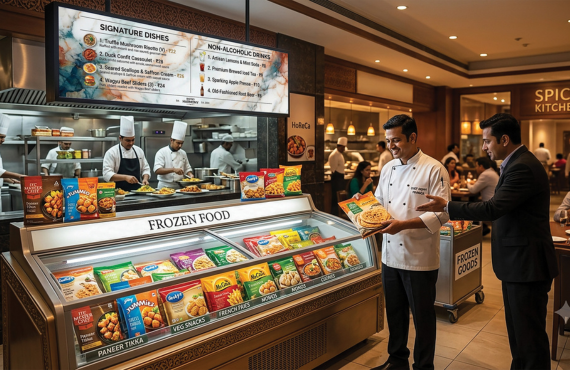
This changed. Frozen food is no longer shorthand for convenience alone. It now carries associations with indulgence, consistency, quality, hygiene and food safety. Interestingly, this transformation did not originate in supermarket aisles. It began inside kitchens of food services establishments such as hotels, restaurants, cafés, quick service restaurants (QSRs), cloud kitchens, etc. The rapid expansion of India’s organised foodservice sector has quietly reshaped the frozen food category.
As restaurant businesses scaled operations across multiple cities and formats, their menus opened a market for similar products on the retail shelves. This all started with the humble French fries and has moved to exotic Southeast Asian delicacies now being sold through the deep freezer aisles of the retail stores. The other thing that the HoReCa has done and would not have been achieved by traditional retailers is to change the perception of the Indian consumer in accepting frozen food in their daily life.
Every Indian household is now looking at achieving the perfectly crisp French fries at home, which is being sold at McDonald’s; perfect burger assembly like Burger King; the crunchiest snack served at KFC; and the most juicy momos being prepared at organised food services outlets. Consumers experienced products they liked the most first through restaurant brands or hotels they trusted, long before they consciously started purchasing them from supermarket freezers.
Another important driver that pushed the Frozen Food categories in the pantries of Indians was the COVID-19 pandemic. Restaurant closures during lockdown periods, compounded by intermittent restrictions on home delivery, removed consumers’ primary access point to food through organised foodservice. In the absence of these channels, consumers turned to retail frozen aisles as the closest available substitute, seeking to replicate a restaurant-style eating experience within the home.
The progression of the category highlights a clear shift in innovation priorities. Early growth was driven by Western QSR staples such as French fries, nuggets and burger buns, led by players like McCain Foods India. As organised foodservice expanded and consumer tastes evolved, manufacturers increasingly localised their portfolios by introducing Indian snacks such as Aloo Tikki, Veggie Fingers and stuffed parathas, followed by regional formats including Sabudana Patty, Vada Pav Patty and Mumbai Aloo Vada.
The evolution of the category also reflects a broader shift in consumer expectations. Frozen foods are no longer purchased solely to save time; they are increasingly chosen to recreate indulgent, restaurant-style eating experiences at home. As organised foodservice exposed consumers to a wider range of cuisines and premium snack formats, expectations moved beyond basic convenience towards greater variety, authenticity and quality.
This shift is evident in the products now entering the category. Consumers who were once satisfied with frozen peas and French fries are increasingly seeking café-style appetisers, premium asian cuisines, regional street-food favourites and complete meal solutions. Rather than replacing fresh food, convenience frozen products are increasingly serving occasions where consumers want restaurant-quality experiences without the time or cost associated with dining out.
The category has since expanded beyond snacks into premium global cuisines and complete meal solutions. Brands such as Prasuma and ITC Master Chef have introduced products including Momos, Bao Buns, Korean Fried Chicken, Falafel Kebabs and Piri Piri Prawns, while players such as Haldiram’s, Meatzza, MTR and Gits have expanded frozen offerings across regional snacks, curries and complete meals.
What matters here is the order of events. These consumers weren’t encountering frozen food for the first time when their schedules got tighter. They had already eaten it. When time constraints began shaping grocery decisions, frozen food wasn’t an unfamiliar risk. It was a familiar product that could now be made at home in a fraction of the time. HoReCa built the confidence. Changing household routines, accelerated by the pandemic’s disruption to daily schedules and further reshaped by post-pandemic work patterns, supplied the demand to match it.
This shift was further reinforced by changing household dynamics. Women’s workforce participation increased from 23.3% in 2018 to 41.7% in FY2024, before moderating to 40.0% in FY2025, contributing to the rise of dual-income households and increasingly time-constrained lifestyles. As less time became available for everyday cooking, consumers sought convenient meal solutions without compromising on quality. Frozen foods, already familiar through organised foodservice, increasingly transitioned from being an occasional substitute for fresh food to a practical way of recreating trusted restaurant experiences at home.
The Freezer is Becoming the New Pantry
The capital now flowing into this category is not speculative, and the pattern of investment tells its own story about where confidence in this market is coming from. Within a single recent window, an FMCG incumbent acquired a premium frozen brand for approximately Rs 300 crore. A domestic potato processor committed Rs 1,000 crore to triple its capacity and pivot from export dependence to domestic growth. An agri-processing group entered the ready-to-cook and ready-to-eat meat segment through a joint venture aimed squarely at commercial kitchens. India’s largest grocery platform launched its own private-label frozen brand. Its largest dairy cooperative introduced a frozen foods range for the first time.
A global furniture and lifestyle retailer entered the category with ready-to-cook Indian and international meals.
ITC, HyFun Foods, Allana-Chatha, BigBasket, Amul and IKEA have little in common as businesses, except that all of them looked at India’s convenience frozen food market and decided, around the same time, that it was worth entering or expanding into. That convergence is the real signal. These are not niche bets. They are bets on a structural change in how urban India eats, one that restaurants have been quietly building for well over a decade, one consistent meal at a time.
The consumer who once treated frozen food as a compromise has largely been replaced by one who expects it to be good, because restaurants taught her it could be. Working professionals reaching for a frozen paratha or a ready-to-cook kebab on a weeknight is not settling for less. They are repeating a choice they have already made hundreds of times before. Restaurants did not simply benefit from India’s growing frozen food industry.
They created it, through the consistency of their kitchens, the scale of their supply chains, and the trust they extended, invisibly, to every frozen ingredient they cooked and served. The pandemic accelerated the shift from restaurant plate to home freezer, but it did not start it, and it will not be the reason it continues. The commercial kitchen has been the category’s most effective sales force, and as more of urban India’s routines bend around less time and higher expectations, the freezer is fast becoming the new pantry.