

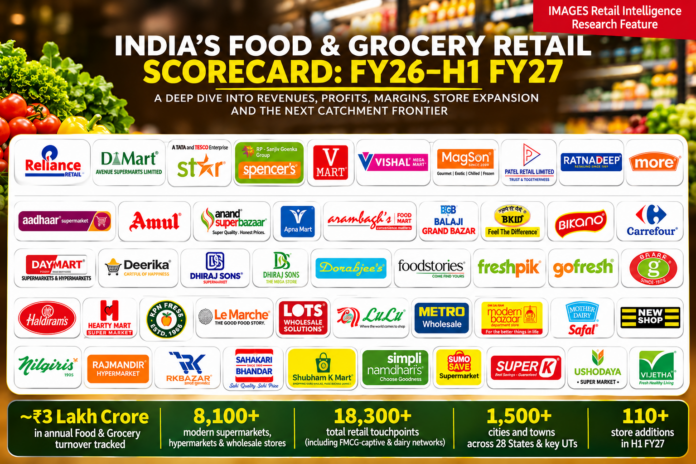

From DMart’s scale and Ratnadeep’s regional profitability to Patel Retail’s rapid growth and Spencer’s continuing losses, the FY26–H1 FY27 financial scorecard reveals an increasingly competitive food and grocery sector where revenues, margins, store productivity and distribution efficiency matter more than expansion announcements.
India’s organised food and grocery retail sector is entering a more demanding phase of growth. National chains are adding stores, regional supermarkets are consolidating their home markets, private labels are gaining importance, and neighbourhood formats are competing for increasingly fragmented shopping baskets. Yet beneath the expansion announcements lies a more revealing financial story: growing revenues do not necessarily mean improving margins, and larger networks do not automatically generate stronger returns.
The FY26–H1 FY27 performance of India’s leading grocery and grocery-linked retailers illustrates this divergence. Avenue Supermarts continues to demonstrate the scale of a predominantly food-and-FMCG retail model. Reliance Retail operates a much wider multi-format ecosystem. Vishal Mega Mart and V-Mart use FMCG to support repeat visits within value-led merchandise propositions, while regional businesses such as Ratnadeep, Patel Retail and MagSon offer different examples of concentrated growth. Spencer’s Retail, meanwhile, highlights the difficulty of restoring profitability in a competitive supermarket business.
The strategic question is no longer simply how many stores a retailer can open. It is how much incremental revenue, operating profit and cash flow those stores can generate—and whether the supply chain supporting them becomes more efficient as the network expands.
Scale Is Growing, but Financial Performance Is Diverging
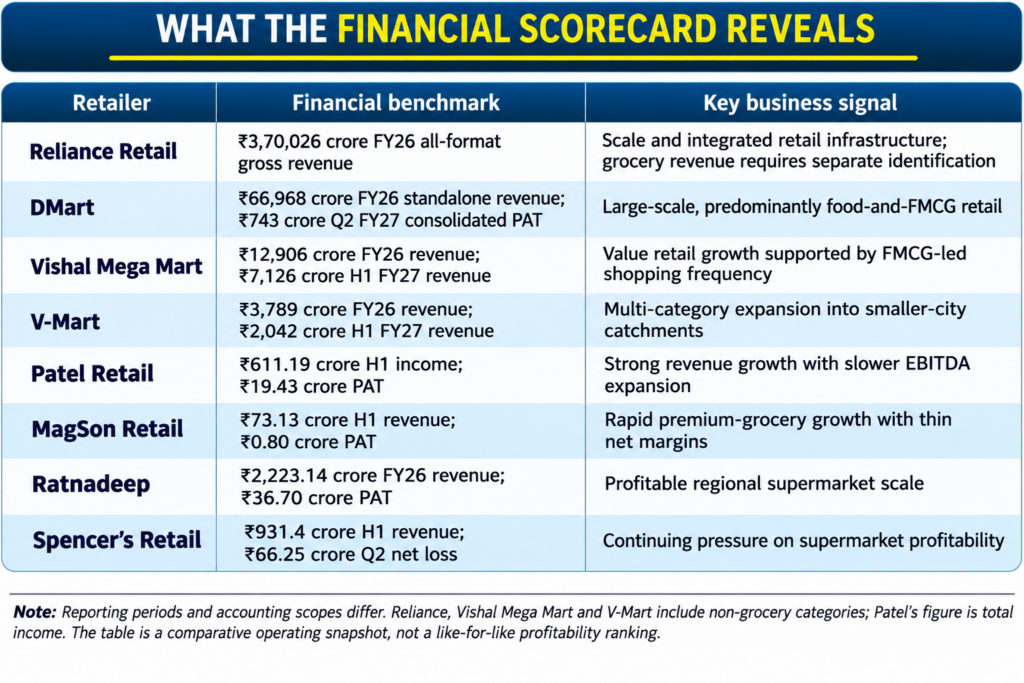
Reliance Retail remains the largest retail platform in the comparison, with FY26 all-format gross revenue of Rs 3,70,026 crore and H1 FY27 gross revenue of Rs 1,82,124 crore. Its food and grocery ecosystem spans SMART Bazaar, Smart Point, fresh-food formats, wholesale operations and JioMart-linked fulfilment. However, its consolidated retail revenue includes several non-grocery businesses, making it inappropriate to compare the headline figure directly with supermarket-only revenues.
Avenue Supermarts offers a more focused benchmark. DMart generated FY26 standalone revenue of Rs 66,968 crore, with food and FMCG accounting for approximately 76.3% of its H1 FY27 sales mix. H1 FY27 standalone revenue reached Rs 37,550 crore, while Q2 consolidated profit after tax stood at Rs 743 crore. Its 518-store network demonstrates the potential of a disciplined supermarket operating model built around everyday value, inventory turnover and high-volume retailing.
The broader value-retail segment shows another growth pattern. Vishal Mega Mart recorded FY26 revenue of Rs 12,906 crore and H1 FY27 revenue of Rs 7,126 crore, supported by an 844-store network. V-Mart reported FY26 revenue of Rs 3,789 crore and H1 FY27 revenue of Rs 2,042 crore, with 613 stores. Both chains use FMCG to strengthen shopping frequency, but their business models extend substantially into apparel and general merchandise. Their financial results therefore illuminate the economics of value retail rather than pure grocery profitability.
The distinction matters. A supermarket carrying a predominantly essential-food basket operates with different margins, inventory requirements and purchasing patterns from a value retailer whose FMCG department supports a broader merchandise proposition.
The Regional Profitability Equation
Some of the most revealing numbers come from retailers operating far smaller networks.
Patel Retail’s H1 FY27 total income increased 49.6% to Rs 611.19 crore. EBITDA reached Rs 40.24 crore and profit after tax Rs 19.43 crore. Yet EBITDA growth of 13.6% was substantially below revenue growth, indicating pressure on margin conversion. Based on these figures, the H1 EBITDA margin was approximately 6.6%, while the PAT margin was about 3.2%.
This is an important distinction for investors and expansion teams. Rapid sales growth can reflect new stores, stronger throughput or changes in business mix, but sustainable profitability depends on what remains after procurement, labour, occupancy, distribution and financing costs.
Patel’s operating footprint of 54 supermarkets is concentrated in Maharashtra’s Thane, Raigad and Palghar districts. Its expansion plans include further development of this contiguous market, supported by additional distribution capacity. The model demonstrates how a regional chain can pursue growth without immediately dispersing its infrastructure across unrelated geographies.
MagSon Retail presents a different example. The premium and gourmet supermarket operator recorded FY26 revenue of Rs 110.24 crore, up 63%, while H1 FY27 revenue surged 92.8% to Rs 73.13 crore. EBITDA, however, was Rs 2.10 crore and PAT Rs 0.80 crore. That translates into an H1 EBITDA margin of approximately 2.9% and a PAT margin of just 1.1%.
MagSon’s 46-store network across Gujarat, Goa and Rajasthan highlights the opportunity in premium food retail, but also the operating demands of imported products, speciality assortments, chilled merchandise and inventory management. Its financial performance illustrates why high revenue growth must be assessed alongside gross-margin retention, operating expenses and cash generation.
Ratnadeep offers a useful counterpoint. The Hyderabad-centred supermarket operator recorded FY26 revenue of Rs 2,223.14 crore, EBITDA of Rs 111.33 crore and PAT of Rs 36.70 crore. Its EBITDA margin was approximately 5.0%, supported by a network of 190 stores concentrated primarily in Telangana, with additional operations in Karnataka and Andhra Pradesh.
The proposed Rs 400 crore IPO, including an intended allocation towards new stores, places Ratnadeep among the regional grocery businesses attracting capital-market attention. Its profitability demonstrates that regional concentration can coexist with meaningful revenue scale, although the sustainability of margins as the network expands will remain an important test.
Why Supermarket Profitability Remains Difficult
Spencer’s Retail illustrates the challenges facing operators with established networks but continuing financial pressure. The company, together with Nature’s Basket, generated approximately Rs 931.4 crore in H1 FY27 revenue, while its Q2 net loss stood at Rs 66.25 crore. Its 121-store combined footprint includes 91 Spencer’s stores and 30 Nature’s Basket outlets.
The contrasting propositions within this portfolio—mainstream supermarkets and premium food retail—require different merchandising, inventory and customer-acquisition strategies. Scale alone cannot eliminate the financial burden of underperforming locations, occupancy costs or inefficient replenishment.
Across the industry, grocery profitability depends on a delicate balance between traffic-driving essentials and higher-margin categories. Staples generate repeat purchases but typically offer limited gross margins. Packaged foods, personal care, household products and speciality merchandise can improve the basket’s profitability, provided inventory turns and markdowns remain under control.
Fresh produce presents another challenge. It can strengthen customer loyalty and store differentiation, but shrinkage, temperature-controlled logistics, sourcing variability and daily replenishment requirements can quickly erode margins.
Private labels offer one route to differentiation and potentially better gross margins. Trent’s STAR business, with reported own-brand penetration exceeding 74%, represents a particularly distinctive merchandising strategy. However, private-label success depends on quality consistency, sourcing efficiency, customer acceptance and inventory productivity—not merely the proportion of shelves allocated to proprietary brands.
The Expansion Race is Becoming a Productivity Race
Store additions remain an important indicator of investment confidence, but the H1 FY27 numbers require closer examination.
Vishal Mega Mart added 49 net stores during the first half, V-Mart added 36 and DMart added 18 net stores from 24 gross openings. Patel Retail added four stores and Trent STAR three. Together, these five operators accounted for 110 additions, although their formats and reporting scopes differ.
The significance lies in what follows the opening. A new supermarket must develop repeat household traffic, establish a viable basket size, control shrinkage and achieve sufficient sales density to absorb rent and staffing costs. It must also fit within a distribution network capable of replenishing inventory economically.
A retailer opening several stores within an existing supply-chain cluster may achieve better purchasing and logistics efficiency than one entering distant markets without adequate distribution support. Conversely, excessive concentration can limit growth if the local market approaches saturation.
This is why regional operators deserve greater attention. KPN Farm Fresh, with more than 300 stores and FY25 operating revenue of Rs 863.58 crore, demonstrates the scale possible through a fresh-food-led regional model. Vijetha Supermarkets, SuperK, Apna Mart, Aadhaar and other regional businesses are pursuing different combinations of neighbourhood supermarkets, franchise operations, local sourcing and compact formats.
Their operating models are not interchangeable. Company-owned supermarkets require greater capital and inventory commitments, while franchise networks distribute some investment responsibilities across partners. The appropriate model depends on assortment control, replenishment economics, customer spending patterns and the retailer’s ability to maintain consistent service standards.
The Next Growth Opportunity Lies in Catchment Economics
India’s grocery expansion opportunity extends well beyond the largest metropolitan markets, but smaller-city growth cannot be approached through a uniform store template.
The research identifies five regional corridors: the Upper North and Himalayan circuit, the East and Northeast frontier, the Deep South and island belt, the Western Golden Quadrant, and Central India’s micro-hubs. These are analytical groupings intended to assess market readiness rather than forecasts of store openings.
Established commercial centres such as Coimbatore, Madurai, Vijayawada, Siliguri, Nashik and Raipur already support organised retail activity. Their next phase of development will depend on format differentiation, competitive pricing and supply-chain productivity rather than simply introducing modern retail for the first time.
District towns and emerging markets present a different proposition. Smaller supermarket formats, regional assortments and efficient replenishment may be commercially appropriate where household demand supports them. Remote and hill markets require additional consideration of transport reliability, seasonality, refrigeration and inventory buffers.
For shopping centre developers, the implications are equally significant. Grocery anchors can generate frequent visits, but their viability depends on nearby residential density, access, loading facilities, parking, power infrastructure and sustainable occupancy costs. A supermarket’s ability to attract traffic does not automatically justify an expensive location.
Omnichannel Retail Adds Another Financial Test
The distinction between physical and digital grocery is also becoming less straightforward. Established retailers increasingly use their stores, distribution centres and inventory networks to support online ordering and local delivery.
Vishal Mega Mart reported 781 digitally enabled stores within its 844-store network, while Reliance operates a much larger integrated retail ecosystem. However, digital enablement does not establish that every location operates as a profitable grocery fulfilment centre.
DMart Ready provides an instructive example of disciplined market selection. Its service footprint contracted from 19 cities in H1 FY26 to 11 by H1 FY27, demonstrating that concentrating operations in stronger markets can be more commercially rational than pursuing geographical coverage at any cost.
The economics ultimately depend on order frequency, basket value, picking costs, delivery distance and customer retention. A supermarket can benefit from using existing infrastructure for digital fulfilment, but the incremental channel must still justify its operating costs.
Digital-first quick-commerce platforms, dedicated dark-store networks and pure-play online supermarkets operate under different financial models. Their revenue recognition, gross order values and fulfilment economics warrant a separate examination rather than being combined indiscriminately with physical retail turnover.
The Real Winners Will be Decided by Returns, Not Reach
The FY26–H1 FY27 results reveal a sector with considerable expansion potential but no universal formula for profitable growth. National operators benefit from purchasing scale and infrastructure investment. Regional retailers can exploit local sourcing, customer familiarity and contiguous distribution networks. Premium specialists differentiate through assortment, while value retailers combine essential purchases with broader merchandise categories.
Each model faces a different financial test.
For boards, investors and retail management teams, the next set of performance indicators should extend beyond revenue growth and store additions to comparable-store sales, gross-margin retention, inventory turns, occupancy costs, distribution efficiency, operating cash flow and returns on invested capital.
India’s grocery opportunity remains substantial. But as competition intensifies and retailers enter more diverse catchments, the advantage will increasingly belong to operators that understand not only where customers shop, but how profitably those shopping occasions can be served.
The next phase of Indian grocery retail will be won not by the retailer with the longest store-opening announcement, but by the one that converts local demand into repeat purchases, stronger cash generation and sustainable returns.