


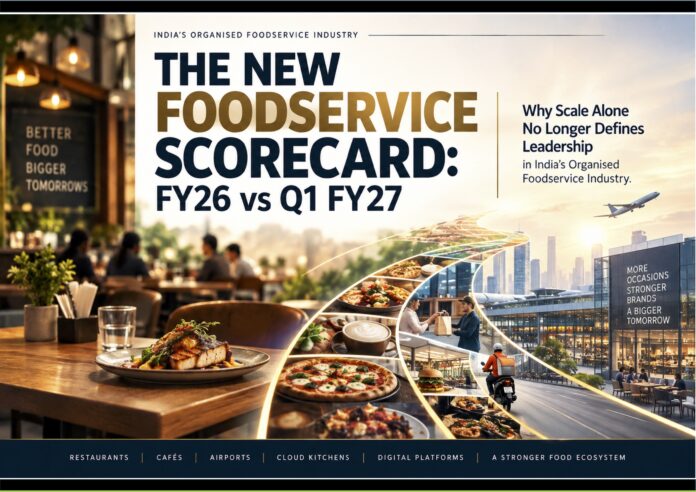
FY26 and Q1 FY27 results show a structural shift in organised foodservice, with same-store sales, unit economics, portfolio diversification, technology and capital productivity emerging as the new measures of leadership.
India’s organised foodservice industry is entering a more mature and demanding phase of growth. The headline numbers remain impressive: Jubilant FoodWorks closed FY26 with Rs 9,512.5 crore in revenue; Devyani International reported Rs 5,611.5 crore; Travel Food Services recorded Rs 3,214.4 crore in system-wide sales; and Tata Starbucks crossed the 500-store milestone. But beneath these numbers lies a more important shift. Restaurant companies are increasingly being judged not simply by how many outlets they operate, but by how productively those outlets perform, how effectively brands are diversified, and how well technology, real estate and consumer data are converted into profitable growth.
The latest FY26 and Q1 FY27 performance suggests that the traditional foodservice formula of more outlets = more growth is giving way to a broader scorecard. Same-store sales growth (SSSG), unit economics, premiumisation, portfolio diversification, digital engagement and capital productivity are becoming equally important indicators of competitive strength. The transformation is visible across QSRs, cafés, airport foodservice, cloud kitchens and experiential dining.
The Leaders Are Building Platforms, Not Just Restaurant Chains
Jubilant FoodWorks remains the largest organised foodservice player in the scorecard, with FY26 revenue of Rs 9,512.51 crore, up 16.4%, and Q1 FY27 revenue of Rs 2,569.3 crore, up 14.1%. Its global network reached 3,712 outlets after 76 net additions in Q1, including 58 Domino’s stores in India. Yet the strategic story extends beyond Domino’s. Popeyes, Hong’s Kitchen and COFFY are expanding the company’s participation across fried chicken, Chinese cuisine and value coffee.
Devyani International represents another model of platform building. FY26 revenue stood at Rs 5,611.5 crore, while Q1 FY27 revenue rose about 16.5% to roughly Rs 1,581 crore. Its portfolio combines KFC, Pizza Hut and Costa Coffee with Indian concepts including Vaango, Biryani By Kilo, Goila Butter Chicken and The Bhojan. The proposed combination with Sapphire Foods would add another 1,052 restaurants, taking the platform beyond 3,000 outlets. Sapphire itself reported Q1 FY27 revenue of Rs 890.96 crore, up 14.7%, and returned to profitability with PAT of Rs 14.02 crore.
The significance is clear: diversification is no longer simply about owning more brands. It is about creating an operating platform that can share procurement, technology, supply chain, real estate and consumer data across multiple businesses.
Travel Food and Rebel Foods Redefine What “Scale” Means
Travel Food Services demonstrates why restaurant count is becoming an inadequate measure of foodservice scale. Its FY26 system-wide sales grew 25.4% to Rs 3,214.4 crore despite relatively modest passenger growth. With more than 500 Travel QSRs and around 38 lounges, its model is built around increasing spend per passenger through a combination of restaurants, cafés, premium lounges and multiple food brands.
Rebel Foods turns the conventional restaurant model on its head. Its platform combines more than 450 cloud kitchens, thousands of virtual storefronts and an expanding physical presence through EatSure Smart Foodcourts, Wendy’s and Smoor. A single kitchen can support multiple brands and consumption occasions, making traditional outlet-count comparisons increasingly meaningless.
This raises a fundamental question for the industry: what constitutes scale in modern foodservice? For Domino’s or McDonald’s, the restaurant remains the basic operating unit. For Rebel Foods, the productive asset may be a kitchen supporting several digital brands. For Travel Food Services, the same passenger can generate value across restaurants, cafés and lounges. The new definition of scale therefore has to consider productive capacity, not just physical footprint.
Same-Store Sales Emerges as the Critical Metric
If one number best captures this changing scorecard, it is SSSG. Outlet additions can generate topline growth even when existing stores are underperforming. Same-store sales asks a harder question: are the restaurants already operating actually selling more?
Q1 FY27 provides some compelling evidence. Burger King India delivered 12.6% SSSG, while KFC India under Devyani recorded 3.3%. United Foodbrands reported an exceptionally strong 28.7% SSSG, although its figure needs to be viewed alongside its evolving portfolio and comparative base. Westlife Foodworld also moved from only 0.5% SSSG in Q1 FY26 to a materially stronger positive trajectory.
This changes the interpretation of growth. Network expansion tells retailers how quickly their footprint is increasing; SSSG indicates whether the existing asset base is becoming more productive. Both matter, but increasingly investors and operators will need to understand the relationship between them.
Coffee Becomes the New Daypart Battleground
Coffee is emerging as another strategic growth engine. Tata Starbucks crossed 500 cafés, reaching 502 outlets across more than 80 cities, while achieving EBITDA positivity in FY26. The expansion is increasingly moving beyond expensive metropolitan locations into Tier-II and Tier-III cities, airports, highways, drive-throughs and alternative formats.
At the same time, Costa Coffee is expanding through Devyani, Jubilant is building COFFY, and McCafé gives Westlife another revenue and consumption occasion within its McDonald’s estate. The competitive question is consequently shifting from who has the largest café network to who can most profitably capture morning, afternoon, meeting, work and on-the-go consumption.
Digital Platforms Become Foodservice Infrastructure
The transformation is not restricted to restaurant operators. Eternal/Zomato reported FY26 consolidated revenue of Rs 20,243 crore, up 67%, while its Q1 FY27 food-delivery NOV reached Rs 10,769 crore. Swiggy reported FY26 revenue of Rs 23,053 crore, up 44.7%, with its latest reported food-delivery GOV at Rs 9,005 crore, up 22.6%.
These platforms increasingly influence discovery, demand, promotions, advertising and consumer engagement. Restaurants therefore face a strategic balancing act: use aggregators for reach while building their own apps, loyalty systems and first-party consumer relationships.
Technology is simultaneously moving deeper into the operating model. AI-assisted demand forecasting, inventory optimisation, labour scheduling, kitchen automation and data-led menu management can create significant margin benefits when deployed across hundreds or thousands of restaurants. At scale, even a one-percentage-point improvement in wastage or labour productivity can materially change cash generation.
From Expansion at Any Cost to Smarter Capital Allocation
The next phase of organised foodservice will therefore be less about asking how many restaurants can be opened and more about asking where the next restaurant should open, what format it should take and whether the capital can generate an acceptable return.
Devyani’s acquisitions and proposed Sapphire combination, Jubilant’s use of Domino’s scale to build new categories, Westlife’s productivity drive across a mature McDonald’s estate, Tata Starbucks’ move into alternative locations and Rebel’s selective addition of physical formats all illustrate different versions of the same strategic shift.
India still has enormous headroom for restaurant expansion. But the next decade is unlikely to belong simply to companies that build the most restaurants. It will belong to those that build more productive restaurants, stronger brands, smarter portfolios, deeper consumer relationships and technology-enabled operating platforms—while converting scale into sustainable returns.
The full story examines FY26 performance and Q1 FY27 momentum across India’s leading foodservice companies—and asks the bigger question: what really defines leadership when scale alone is no longer enough?
Read the full story in the August 2026 edition of Business Of Food.
SUBSCRIBE
Business Of Food — August 2026 Edition