


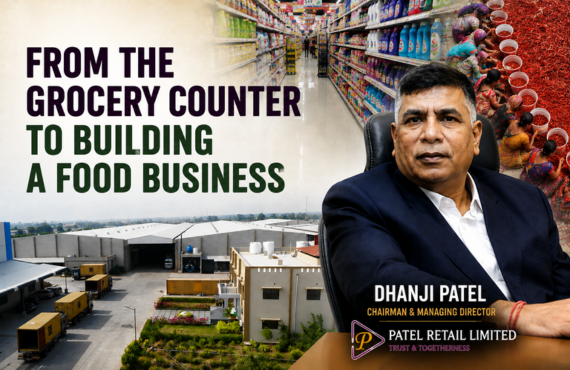
Dhanji Bhai Patel is taking Patel Retail beyond the supermarket—into sourcing, processing, brands, exports and food manufacturing.
Rs 1,048 crore FY26 revenue. Rs 39 crore PAT. Rs 310.24 crore Q1 FY27 total income, up 69.35%. Rs 19.68 crore Q1 EBITDA. Rs 9.52 crore Q1 PAT, up 37.43%. 53 Patel’s R Mart stores. And in FY25, Rs 361.17 crore of processing revenue—almost as much as the Rs 368.87 crore generated by retail.
The numbers establish the scale. But they do not explain what is perhaps the more interesting story unfolding inside Patel Retail. The company may have become known as a value retailer through Patel’s R Mart, but Dhanji Bhai Patel is steadily building something much broader—a food business that reaches backwards to farmers and commodities, moves through processing and manufacturing, creates its own brands and ultimately reaches consumers through retail, exports and other channels.
It Started at a Grocery Counter
Dhanji Bhai’s story goes back to 1984, when he moved from Dudhai in Kutch to Ambarnath and joined his elder brother Bechar Patel, who was already in the grocery business. After six years of learning the trade, Dhanji Bhai opened his first grocery store under Patel Enterprises in 1990. The first Patel R Mart supermarket followed in 2003, marking the beginning of the organised retail journey that would eventually evolve into today’s Patel Retail.
Those early years behind the grocery counter perhaps explain much about Dhanji Bhai’s business instincts. He learnt food not from a management textbook but from watching consumers shop, understanding what families could afford, seeing which products moved and, importantly, observing how much of the value in a food product was created before it ever reached the retail shelf.
That understanding would eventually take him in the opposite direction from the conventional retailer.
Instead of stopping at the shelf, Dhanji Bhai started looking behind it.
The Retailer Who Looked Backwards
As Patel’s R Mart grew, the question was no longer simply how to sell more groceries. It was how to gain greater control over what was being sold. Sourcing, quality, processing, packaging, availability and cost all sat outside the retailer’s direct control.
Dhanji Bhai’s answer was backward integration. Patel Retail moved into processing agricultural commodities and progressively built capabilities around spices, peanuts, sesame, flour and other food products. The company established its first food-processing factory in Dudhai in 2016, followed by further processing infrastructure and an agro-processing cluster. Its own history describes the strategy as directly sourcing commodities from farmers, bringing them to its factories for processing and packaging.
What began as a way of strengthening the retail supply chain gradually became a business in its own right.
When Processing Became Almost As Big As Retail
This is where the numbers become revealing. In FY25, Patel Retail generated Rs 368.87 crore from retail sales and Rs 361.17 crore from processing sales. Processing therefore represented about 44% of revenue from operations—almost exactly the scale of the retail business.
| PATEL RETAIL — THE FOOD & RETAIL ENGINE | FY26 / Q1 FY27 |
|---|---|
| FY26 Revenue from Operations | Rs 1,048 crore |
| FY26 PAT | Rs 39 crore |
| Q1 FY27 Total Income | Rs 310.24 crore |
| Q1 FY27 Total Income Growth | 69.35% |
| Q1 FY27 EBITDA | Rs 19.68 crore |
| Q1 FY27 PAT | Rs 9.52 crore |
| Q1 FY27 PAT Growth | 37.43% |
| FY25 Retail Revenue | Rs 368.87 crore |
| FY25 Processing Revenue | Rs 361.17 crore |
| FY25 Processing Share of Revenue from Operations | ~44% |
| Patel’s R Mart Network | 53 stores |
| Export Markets | 35+ countries |
The latest Q1 FY27 numbers reinforce the momentum. Total income reached Rs 310.24 crore, EBITDA stood at Rs 19.68 crore and PAT grew 37.43% to Rs 9.52 crore. But the more important structural point is that Patel Retail now has two substantial engines: the stores that connect it to the consumer and the processing business that increasingly controls what goes into those stores.
The supermarket is the visible business. The food engine is becoming the deeper business.
From Dudhai to The Food Factory
There is an appealing circularity in Dhanji Bhai’s journey. He comes from a farming family in Dudhai, Kutch, and today Patel Retail has built significant food-processing capabilities in the same region. The company’s facilities handle whole and powdered spices, wheat flour, peanuts, sesame and other agricultural commodities, with processes spanning cleaning, sorting, grading, drying, grinding, pulverisation and packaging.
This is more than manufacturing for manufacturing’s sake. It gives Dhanji Bhai greater control over the journey of a food product—from the commodity that enters the factory to the packaged product that leaves it.
His farmer background also shapes the sourcing philosophy. Patel Retail says it directly sources commodities from farmers and highlights direct procurement, reasonable rates, transparency, immediate payments and farming guidance as part of its farmer ecosystem.
That creates a chain that is unusually integrated for a retailer: farmer, sourcing, processing, packaging, brand, retail and export.
Indian Chaska: When a Private Label Wants to Become a Brand
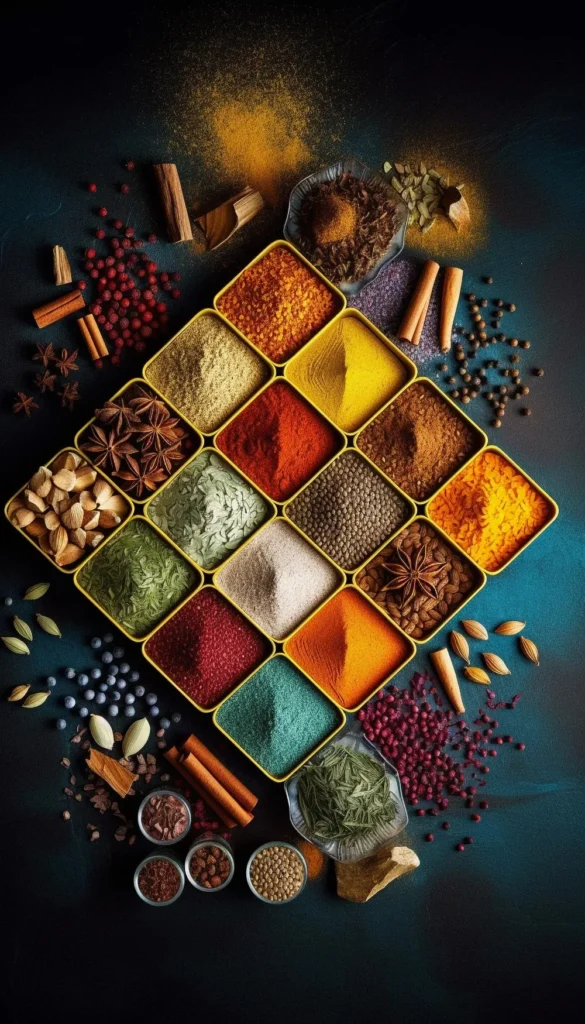
The next logical step was branding. Indian Chaska is perhaps the clearest indication that Dhanji Bhai is thinking beyond the traditional private-label playbook.
The brand spans whole spices, pure spice powders and blended spices, with a portfolio that includes regional products such as Rajapuri Haldi, Palitana Mirch, Malvani Mix Masala and several varieties of coriander, chilli and turmeric powders.
But Indian Chaska is being built with ambitions beyond Patel’s R Mart. In October 2025, Patel Retail appointed Sanjeev Kumar Nigam as CEO of Indian Chaska specifically to strengthen the brand and expand its presence pan-India. Dhanji Bhai described the mandate around market penetration, customer engagement and the brand’s pan-India growth.
That distinction matters.
A private label primarily strengthens a retailer.
A consumer brand has to earn a place in the consumer’s mind—and eventually on shelves that do not belong to its parent retailer.
Indian Chaska is where Dhanji Bhai’s retailer mindset is beginning to meet FMCG ambition.
Patel Fresh: The Everyday Food Basket
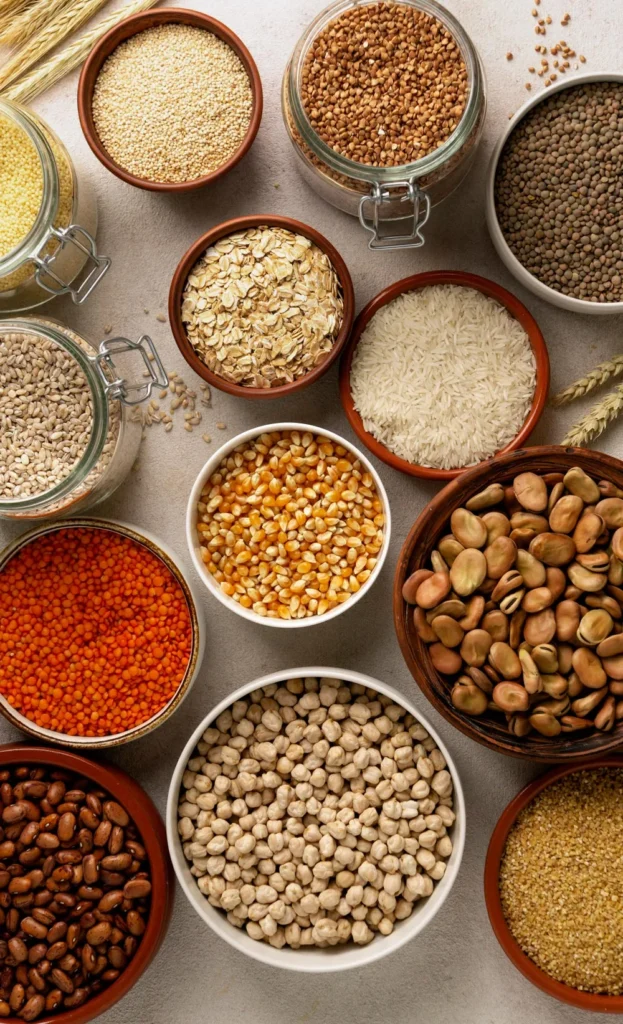
If Indian Chaska gives Patel Retail its flavour and spice identity, Patel Fresh takes it deeper into everyday consumption. The brand covers pulses, nuts, dry fruits, rice, sugar, jaggery, flours and millets, giving Patel Retail a much wider food basket beyond spices.
That combination is strategically attractive. Spices and blends can provide differentiation and brand identity, while staples such as pulses, rice and flour generate regular household consumption. And because both can be supported by the same sourcing and processing infrastructure, the economics become increasingly interconnected.
The model is beginning to look less like a retailer adding private labels and more like a food company using retail as one of its distribution engines.
The Supermarket as a Food Laboratory
There is another advantage Dhanji Bhai has over a conventional FMCG entrepreneur: he owns the consumer interface.
Patel’s R Mart gives the company a live environment in which products, pack sizes, price points and categories can be tested. The store is therefore not simply where the final transaction takes place; it can also provide valuable feedback on what consumers want and how they respond.
That becomes particularly useful when the company is trying to expand its own brands. Instead of building a food product in isolation and then searching for distribution, Patel Retail can learn from its own shoppers before taking products into wider markets.
It is a retailer’s route into FMCG: understand the shelf before trying to conquer the market.
The First Export Was a Small Step Towards a Bigger Food Business
Dhanji Bhai’s export journey is equally revealing. Patel Retail’s international business began with food exports and has since expanded across a much wider geography. The company says it has exported to more than 35 countries, covering staples, groceries, pulses, spices and pulps under Patel Fresh and Indian Chaska as well as products made for customers’ own brands.
That last part is particularly significant. Patel Retail is not simply exporting its own products. Its processing infrastructure can also support customers looking for private-label food manufacturing.
The factory therefore has two possible lives: it can create Patel’s own brands, and it can quietly manufacture for somebody else’s.
The Factory is Becoming a Platform
This may ultimately be the most interesting part of the food strategy. Patel Retail is using its processing infrastructure not only for its own brands but also to improve utilisation and develop private-label opportunities for domestic and export customers.
The company has specifically described using Indian Chaska for whole and powdered spices and Patel Fresh for products such as atta, while private-label production and export customers help keep the processing infrastructure productive beyond seasonal peaks. It is also offering one-stop private-label capabilities across categories including spices, atta, sesame and peanuts.
That changes the role of the factory.
It is no longer simply a support function for the supermarket.
It can become a manufacturing platform serving brands, retailers, exporters, HoReCa and institutional customers.
The Food Business Behind The Retail Business
This is why Patel Retail deserves to be looked at differently today. The company’s identity was built around value retail, but its food capabilities have become too substantial to be considered merely backward integration.
There is now a connected ecosystem: agricultural sourcing feeds the processing plants; processing feeds Patel Fresh and Indian Chaska; the retail network gives those brands an immediate consumer channel; external distribution can take them beyond Patel’s own stores; and exports open another market altogether. Patel Retail itself describes its model as combining modern retail with backward integration in agri-processing to improve quality, cost efficiency and supply reliability.
For Dhanji Bhai, the logic is remarkably simple.
If you understand the consumer, understand the commodity and control more of the journey between the two, you have a better chance of building a durable food business.
The Next Battle is Brand, Not Capacity
The infrastructure is increasingly in place. The next challenge is consumer pull.
Can Indian Chaska become a nationally recognised food brand? Can Patel Fresh build awareness beyond the Patel Retail ecosystem? Can external distribution become a significant growth engine? Can private-label manufacturing scale? And can exports continue to grow while maintaining quality and margins?
These are very different questions from those Dhanji Bhai faced when he was running his first grocery store in Ambarnath. But the underlying instinct is the same: understand what the consumer wants and build the capability to deliver it.
From Retailer to Food Entrepreneur
What makes Dhanji Bhai’s story particularly interesting is that there was no sudden announcement that Patel Retail was becoming a food company. The transformation happened one logical step at a time.
The retailer wanted greater control over sourcing, so it moved closer to farmers. Better sourcing led to processing. Processing created manufacturing capability. Manufacturing enabled private labels. Private labels created the opportunity to build brands. Brands needed wider distribution. And once the company had sourcing, processing and manufacturing capabilities, exports and private-label production became natural extensions.
One capability created the reason to build the next.
That is why Patel Retail today is more than the 53 stores that consumers see. Behind those stores is an increasingly integrated food chain—one that begins with agricultural commodities and ends not only at the Patel’s R Mart checkout counter, but increasingly with a branded product, an export customer or another retailer’s shelf.
For Dhanji Bhai, the grocery store was where the journey began.
The bigger ambition now is to build the food business behind the grocery store.